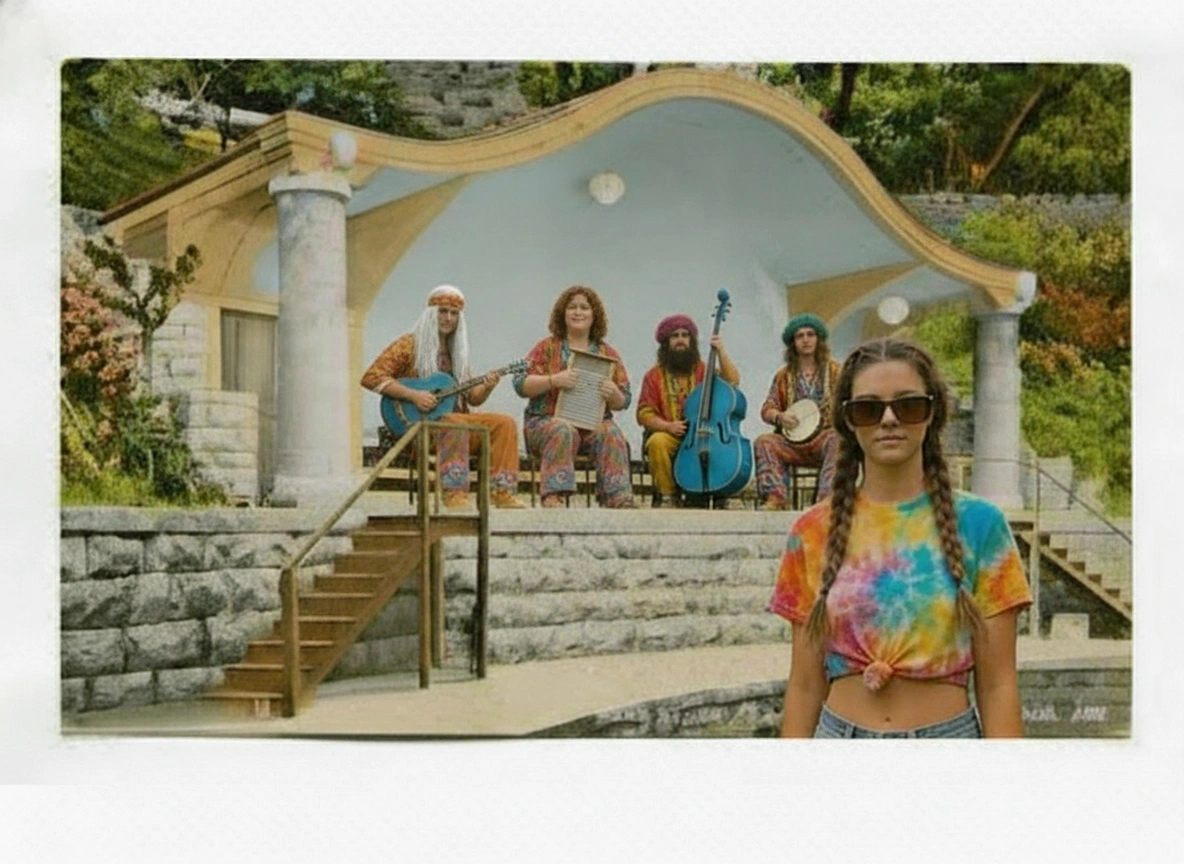
I was walking down Highway 23 again and thinking about my conversation with Teddy from Illinois. Right after his family and I finished singing "Jesus Loves Me," he pulled into the parking lot of Garr's Grocery in Holiday Hills and made me get out. I don't think it was the theological discussion that pissed him off so much as the suggestion that I might grab the steering wheel and crash the car. I can understand his pissiness. It's a flaw I have whenever I get into a debate. I puff up like a toad and get uppity and say something stupid that shuts down the whole conversation. Never, ever would I grab the wheel of a car and send it veering into a semi and kill everyone. But I'll say damn near anything, and that gets me into trouble. Anyhow, I wasn't really surprised that Teddy made me get out. He handed me my duffel bag and my guitar and slammed the trunk and got back in the car. He and Louise didn't look at me or say anything, but I saw the children wave good-bye through the back window.
I hadn't gone far when a Volkswagen van pulled over. Now I know what you're thinking. Here we go, the cliché of all clichés: a VW van full of pot smoking hippies who practice free love and protest the war. As it turns out, however, you would be right. Smoke was wafting from the windows and a half-naked fat girl was sitting in the rear-facing seat and thumping a drum. The door slid open, and a beard with hair and sunglasses leaned out.
"Hey, man, you need a ride?"
"I do. Where you headed?"
"Eureka. You?"
"Onyx."
"Is that in Arkansas?"
"Supposed to be."
"Cool. Get in."
So, I handed him my duffel bag and guitar and climbed in. The Naugahyde was split, and a little cloud of yellow dust puffed up between my legs when I sat down.
Well, here we go again, I thought.
The girl in the wayback kept thumping the drum—pum, pum, pum—and I heard a rhythmic whine like a baby trying to chant an Indian war dance. I turned around and saw a fellow with blond hair about my age; he was leaning against the window with his eyes closed, and he kept saying, "WAH-WAH-wah-wah; WAH-WAH-wah-wah," over and over. A girl was asleep with her head in his lap, and she had drooled on his jeans. The driver of the van was an old man with a red bandana tied around his hoary head and aviator sunglasses, and on the bench next to him sat a pretty girl with long chestnut braids, green eyeshadow, ochre lips, Audrey Hepburn neck (swanlike but tan), bra-less in a tie-dye tee, trim-waisted in cutoff blue jeans, and legs stretching forth in crural, even cruel, perfection. Actually, all I could really see was the back of her head (ergo, the braids) and a glimpse of her eyes in the mirror (ergo, the green eyeshadow). The rest of her I assessed and admired when we got out of the van. On the girl's right was Beardly who stowed my gear. The girl's arm rested on Bandana's thigh, but her right leg lay over Beardly's left knee. That confused me.
"We're going to the folk festival. You want to join us?" Bandana asked.
"Sure. Are you entertainers?"
"Well, we're performers; whether or not we entertain anybody is for them to say." Then he fired up a joint and made the "hsst" inhale sound before he passed it to the Braided Girl [hsst] who handed it to Beardly [hsst] who handed it to me [hsst], so I passed it to back to Wah-Wah [hsst] who held the joint over the seat for the Pum-pum girl, who didn't take it, so he gave up and passed it back to me, and I tapped Bandana on the shoulder and passed it back to him, and he said, "That was fast." So, the joint went round and round as we wound down valleys and back up hills, and the world became sunnier and funnier until we drove past a depot where a steam train sat puffing, and Beardly said, "Look, everybody's smoking, even the Little Engine That Could," and he said, "I think I can, I think I can," and we laughed like that was the funniest thing we'd ever heard. And so we all started saying, "I think I can, I think I can," and soon we were driving up Main Street, and pretty people in madras shirts and khaki pants and long flowing skirts of blue and green and lacy blouses and blue jeans and periwinkle halter tops and rainbow tee shirts that said, "Let the Son Shine," "Folk the Whole World," and "Truckin'" were walking by us on both sides of the street. A banner stretching over the street proclaimed, "Welcome to the Ozarks Folk Festival," and everyone seemed to love everyone else in this happy flow of pretty people in colors.
We parked behind the Auditorium and sat fuzzy headed for a minute before we got out and crossed the street to the Basin Springs Park. Up on the stage was a pretty girl with a guitar, and she was singing about the passing of sorrow and her hope for tomorrow and peace and compassion when hate's out of fashion, and more than anything in the world, I wished that I could hold her in my arms and love her till she and I flowed together like the pretty people in their tee shirts of many colors. For seventeen is the age for making love, is it not? At seventeen, every desire is palpable with hot breath and moist hands and pounding hearts, even when you're alone and dreaming in your bed. But then you see a pretty girl, and your head spins, and you become nothing but desire. Such is true at seventeen in all times and places.
But to be seventeen in 1967 was the best time ever in the history of the world to be seventeen because all the doors were opening, and all the girls were pretty, and all the people wore colors, and everyone was dreaming of a world that was no longer stupid and mean, a world where you didn't have to pretend to believe things you didn't really believe because life itself had become so beautiful that you didn't have to believe anything at all; it was enough just to be in the world. The girl finished her set, put her guitar in its case, and said, "Thank you." Then a man stepped up to the microphone and said, "Isn't she lovely in every way?" and we nodded and applauded. He didn't look cool—he looked like any other peckerwood, what with his clipped hair and his trimmed mustache and his open at the neck, old man shirt—but Bandana leaned over and said, "That's Vance Randolph, the most famous folklorist in the Ozarks. Most of our repertoire comes from his ballad collection." I didn't know who Vance Randolph was—I had never been to the Folk Festival before, and I didn't know the difference between a folklorist and a forklift—but I felt like I was standing at the threshold of another opening door. Then Mr. Randolph said, "Please welcome my good friend, Max Hunter, who will tell you about the rest of the afternoon. Max?" Polite applause and Mr. Hunter said that John Thomas and the Reivers would perform at three.
Bandana, who, as it turned out, was John Thomas, said, "That's what we needed to know. C'mon, let's get something to eat," so we crossed Spring Street again and walked over a metal footbridge that led to an Italian cafe and ordered spaghetti and garlic bread and a carafe of the house wine. An old man was playing "Chim Chim Cher-ee" on the banjo, and people were drinking wine and smoking cigarettes, and before long, a pretty girl brought us our food. I sat across from the Braided Girl, but I was too hungry and too awed and too stoned to say anything, so I just wound spaghetti on my fork and ate till I was stuffed. And I can tell you that was the best meal I ever had on the most beautiful day I ever lived in the most beautiful town that has ever been on God's good earth.
Speaking of Eureka Springs and the folk spirit that still lives in these hills—here's a tongue-in-cheek folk-punk track by Creek Stink that captures the essence of the area:
► Watch on YouTube