Centuries ago in Greece, at the summit of a wild and precipitous mountain pass, rose the walls of an inn. Its very appearance was forbidding, yet many a weary traveler preferred to knock upon its doors, rather than risk the darkness without. Procrustes, the innkeeper, was even more inhospitable than his dwelling indicated, for all his guests, large or small, once within the gray stone walls, must be made to fit a bed. If the unfortunate was too short, he was suspended by the innkeeper between the limbs of giant mountain pines to be stretched—incidentally to be torn limb from limb. If the guest was too long, the projecting length was chopped off. This was many years ago.
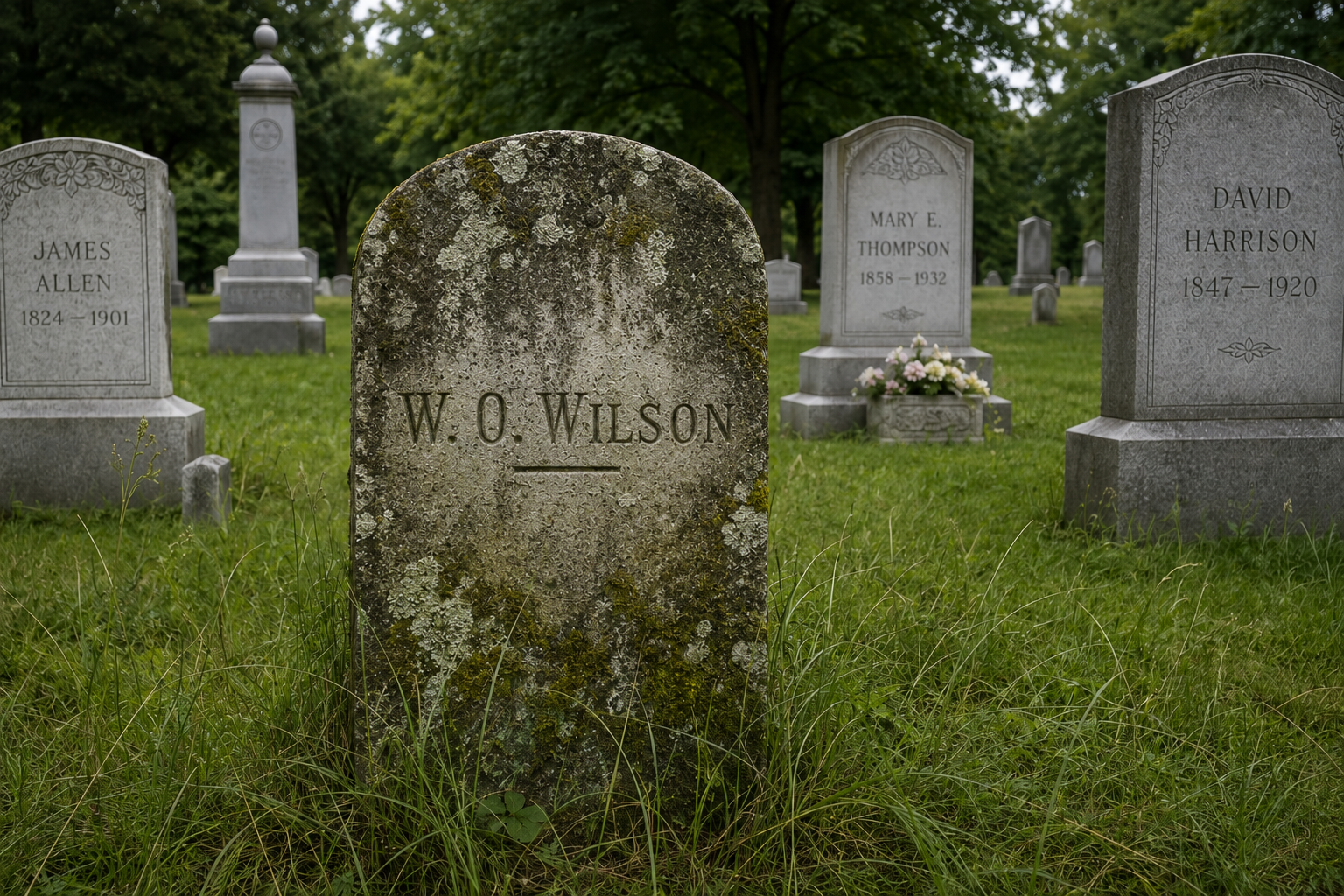
But in the old Methodist burying ground at Lewisburg, near Morrilton, stands a moss-covered stone—a stone in memory of a later Procrustes. The stone is dark and discolored. Around it grows weeds and brambles, but still visible is the name, "W. O. Wilson." There is no date of birth, no date of death, no word of remembrance. Those who can remember when Lewisburg was young, will tell you the fantastic, unbelievable tale of Wilson.
He was born and reared in Alabama. As a young man he was employed in a large mercantile store, which among other merchandise, sold valuable watches. These watches began to disappear and suspicion narrowed to Wilson. The owner, a Mr. Stoddard, was loath to suspect Wilson, but one day, leaving Wilson busy at the store, he obtained entrance to his rooms. Search revealed the missing watches hidden in a mattress. Pocketing these, he returned to the store and accused Wilson. For the sake of his family, however, he agreed that if Wilson would leave Alabama, he would not prosecute him.
Young Wilson went west to seek his fortune. His travels through Missouri, Nebraska, and the Indian Territory were marked by brawling, horse stealing, and even murder. Finally he came to Arkansas, settling at Happy Bend, a neighborhood eight miles above Morrilton.
Here, not far from the banks of the Arkansas River, he built a double log house, planted flowers, and, with the help of a negro woman slave, opened an inn.
The house was neat, clean and attractive. The negro cook, whom he had brought from Missouri, was excellent, and the inn soon had a favorable reputation throughout the region. Then queer tales began to circulate. It was said that the lone travelers who had fat wallets or bestrode fine horses had ridden up to this door and were never seen again.
Wilson pretended to be indignant at these reports. He offered his house to the public to be searched. A few hardy souls went so far as to look through it. Nothing could appear more innocent.
Several years passed. Mr. Wilson prospered. Some of his neighbors hinted that his prosperity might be derived from horses that belonged to somebody else—and that deals were handled skillfully and successfully by the horse thief gang of the Fourche Valley, members of which were seen in close consultation with Wilson.
Neighbors also laid at the door of the handsome and affable innkeeper certain incidents of barn-burning and of runaway slaves. As time rolled on, an ever increasing number of travelers joined the list of Wilson's guests who had disappeared. Suspicion and distrust was the common attitude of the Happy Bend neighborhood, but there was no proof.
One day in early fall, neighbors saw a traveler ride up to Wilson's door and dismount. One neighbor noticed him, on account of the unusually beautiful horse that he rode—a fine, large sorrel. Others took note because he was well known in that part of the country, a Mr. Paschal, of Galley Rock, a merchant to whom Wilson owed a large sum of money for merchandise. Paschal was seen to ride up and dismount and was never seen again.
Inquiries were made at Galley Rock, only ten miles from Happy Bend. The merchant was traced as far as Happy Bend. The inn-keeper said he had slept there, and had ridden off at daybreak. Paschal's relatives demanded a search of the inn, but the search was futile.
Wilson was kept under constant surveillance. One day some boys followed a narrow path to the river, and in a thicket of willows found the body of a horse tied to a tree. The horse had died of starvation. The boys' fathers identified the horse as that of Paschal, and the whole community was notified.
Wilson and the negro cook were seized and taken to old Lewisburg, the county seat, for trial. Wilson was confined in a room above the Gordon Mercantile Store. Questioning of both Wilson and the negress failed, however, to produce confessions. The negro woman seemed to fear her master more than all Lewisburg combined, and remained silent. A week went by, and though the log house inn was searched and researched, no sign of the missing Paschal could be discovered.
Wilson was still held, and murmurs of mob violence began to be heard. One night when Wilson's guard intimated to him that it might be possible for him to escape, Wilson agreed readily. On the following night, when the guard went to sleep, Wilson was to descend by a ladder from the window and escape across the river in a boat, which the guard was to place there during the day. Night came and the guard slept. Wilson descended from the store, crept to the river bank, and pushed off in the skiff.
As the current carried the skiff out into the moonlight waters, a group of men stepped out of the shadows. Moonlight glinted on rifle barrels, which were levelled at the target in the river. The figure settled into the bottom of the boat. Another skiff pushed out, rowed to the drifting boat, and made it secure. The aim of the marksmen had been poor. Wilson was not badly hurt, so he was taken back and imprisoned in the store-room. On the following night, while the guard slept or pretended to sleep, a public spirited citizen climbed the ladder and sent the inn-keeper off on his eternal journey.
Slight interest was shown in the identity of the midnight visitor.
Only one negro woman seemed grieved, but her emotion was tinged with relief, for when she was fully convinced that Wilson was dead, she willingly related the rest of the story.
If the searchers had examined carefully the floor of the guest room of the inn, they would have found a trap door, through which the wealthy traveler was dropped into the cellar, where Wilson awaited with a club. The body was then cut into small pieces by Wilson and his negro servant, and was placed in a gunny sack. This sack was weighted with stones and thrown into the middle of the Arkansas river. The horses of the slain were run off by the Fourche Valley horse thieves, who allowed Wilson a liberal share of the profits.
When Paschal disappeared, the disappearance was noised so quickly that the horse could not be disposed of. Wilson, fearing its identification, had hidden it in the willows and allowed it to starve to death, planning to bury the body later.
Lewisburg was aghast at the arson, horse-stealing, and murder, as described by the negro woman. But Wilson had to be buried. In an examination of the house after his death, a large sum of money was found. No relative appeared to claim the body or the money, so with this blood money, Lewisburg buried him in the old Methodist burying ground, beside honest men, and above him they raised a stone. No one knew the date of his birth, few cared to know the date of his death, and there was about him nothing good to be remembered. So, clearly graven on the moss-covered stone is only the name, "W. O. Wilson."
— Eleanor Wood Moose, in Arkansas Gazette