"The Folk Origin of the Arkansas Myth"
Part Three
A Paper Read By Ted R. Worley Saturday Morning, June 19th At the [1954] Annual Meeting of the Arkansas Folklore Society
Among the travel books on Arkansas were those of Henry R. Schoolcraft, Frederick Gerstaecher, and George W. Featherstonhaugh. All of them emphasized the wretchedness of Arkansas living. Alfred W. Arrington, a citizen of Washington County in the 1830s and 1840s, wrote two novels on the theme of Arkansas violence — Duels and Duelling in the Southwest and Lives and Adventures of the Desperadoes of the Southwest. These paper-backed thrillers were several times reprinted. Even the geography texts of the times described Arkansas as fearfully and wonderfully made. F. Lucas' map of the state in 1823 showed the bulk of eastern Arkansas as the Great Swamp. S. Griswold Goodrich's A System of School Geography (1836) placed a desert of salt in Southeast Arkansas. Goodrich had, of course, confused the Arkansas prairie with the salt flats of Utah and Nevada. J. Olney's geography (1855) put eastern Arkansas down as unhealthy and uninhabitable.
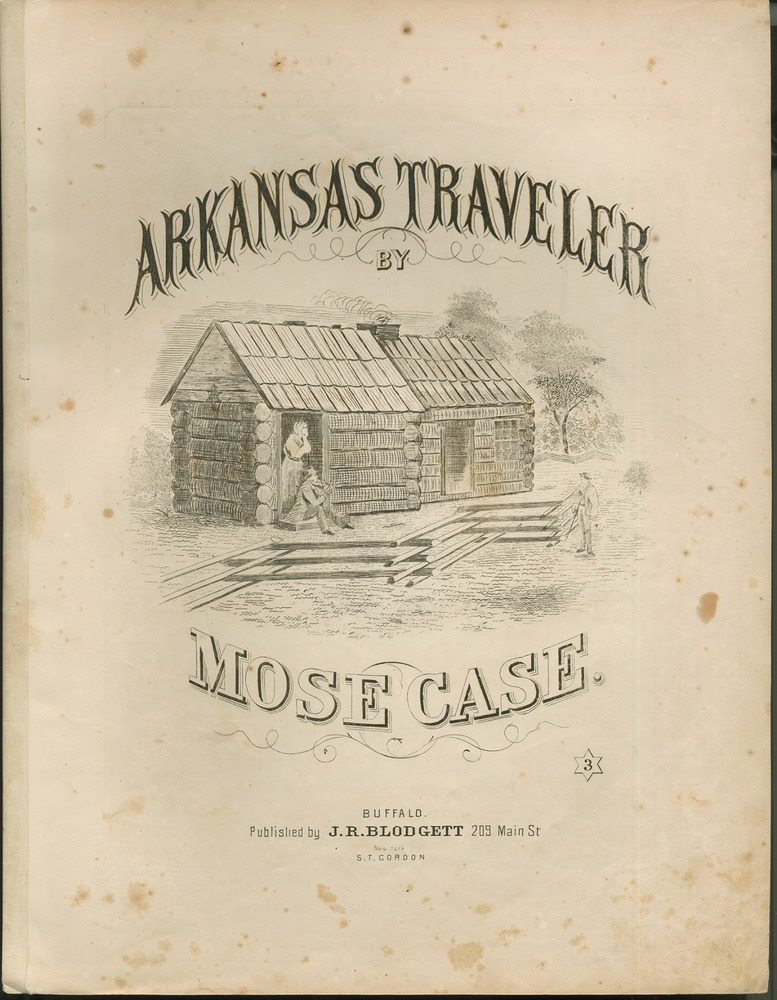
The Arkansas Traveler was, of course, a part of this old Southwest tradition. Folklore joined artistically an old dialogue, a fiddle tune, and a picture into one of the major creations of American mythology.
All this, remember, happened before the Civil War. Arkansas was Rackensack and the Bear State. Later writings added only appendages to the organic structure — notably razorbacks, barefootedness, and slow trains. By 1860 the Arkansawyer had become, in the words of Robert Morris, "an American symbol," like the Kentucky Colonel, the Texas Ranger, and the California Gold Miner. This Arkansawyer of symbol had become "like the Big Bar himself, a 'creation critter,' that delighted in big talk, elusive exaggeration, and inventive power…" When Mark Twain applied his genius to the description of the old river towns, including Helena, Napoleon, and Arkansas City, and Opie Read placed the Arkansas backwoodsmen in his novels, they were mining a well-known vein.
The existence of a formidable body of writing about primitive Arkansawyers does not prove that this writing was responsible for the myth. Humorous writings about other states did not result in a similar body of beliefs. George Washington Harris' Sut Lovingood tales, set in Tennessee, did not create a Tennessee symbol. Nor did Longstreet's Georgia Scenes tag Georgia as a land of boisterous yokels. Thorpe's Louisiana hunting tales did not make Louisiana the Bear State. The literary theory fails also in that it has nothing to say concerning the way jokesmiths happened to gang up on Arkansas, rather than some other southwestern state. It does not explain why a literary tradition southwestern in origin should survive as an Arkansas tradition. Why not a Three Years in Louisiana, A Slow Train Through Oklahoma, or a nationally known periodical called the Tennessee Traveler?
My own idea about the origin of the Arkansas myth is simple. It is not original, except perhaps in one respect. The myth originated in Arkansas folkways that resulted from a prolongation of the frontier in Arkansas. The very persistence of the myth is evidence of its roots in old folkways. When the gospel of the New South was being preached in the generation after the Civil War, the myth refused to step aside. The ideals of the new gospel were hard work, acquisitiveness, thrift, and conformity. The Arkansas folk were not proper subjects for the lockstep of industry. The idea that one man is as good as another, if not better, is not conducive to the best organization in business and commerce. There were Arkansawyers who believed that working part of the time was better than working all the time. They never really took seriously the maxims of Poor Richard or Mr. McGuffey in spite of generations of exposure. The frontier had taught them the necessity of hard toil; but the Southern ideal had taught them to avoid it like a gentleman, when at all possible. Among some of them contempt for book learning continues, and they have a profound distrust of educated peckerwoods (the old term for eggheads).
To combat the Arkansas myth it has been necessary to concoct a phony counter myth that says that Arkansas is really not Arkansas at all, but something very nearly like Ohio or Illinois. The counter myth boosts all things Arkansas which are considered good and denies the existence of the bad. It transformed the Bear State into the Wonder State and finally into the Land of Opportunity. The proponents of the counter myth made the mistake of not recognizing the tenacity of folkways. Instead of accepting the structure of the old tradition and building on it, they attempted to raze the building and start over. They believed they were dealing with a bundle of news-butch literature when in fact they were dealing with a way of life. There are signs that the advocates of the counter myth are beginning to see the light. Over the protests of the filiopietistic organizations the "Arkansas Traveler" has become the official state song, which in its present form is a curious compromise between Rackensack and the forces of Progress. The tune belongs to Rackensack and the words to the Land of Opportunity. A movement is even now underway — and you are invited to contribute — to place a marker at the grave of Sandford C. Faulkner, said to be the original Arkansas Traveler. Most heartening of all, an Arkansas town in recent years elected a folklorist president of the Chamber of Commerce. A good myth will not down.