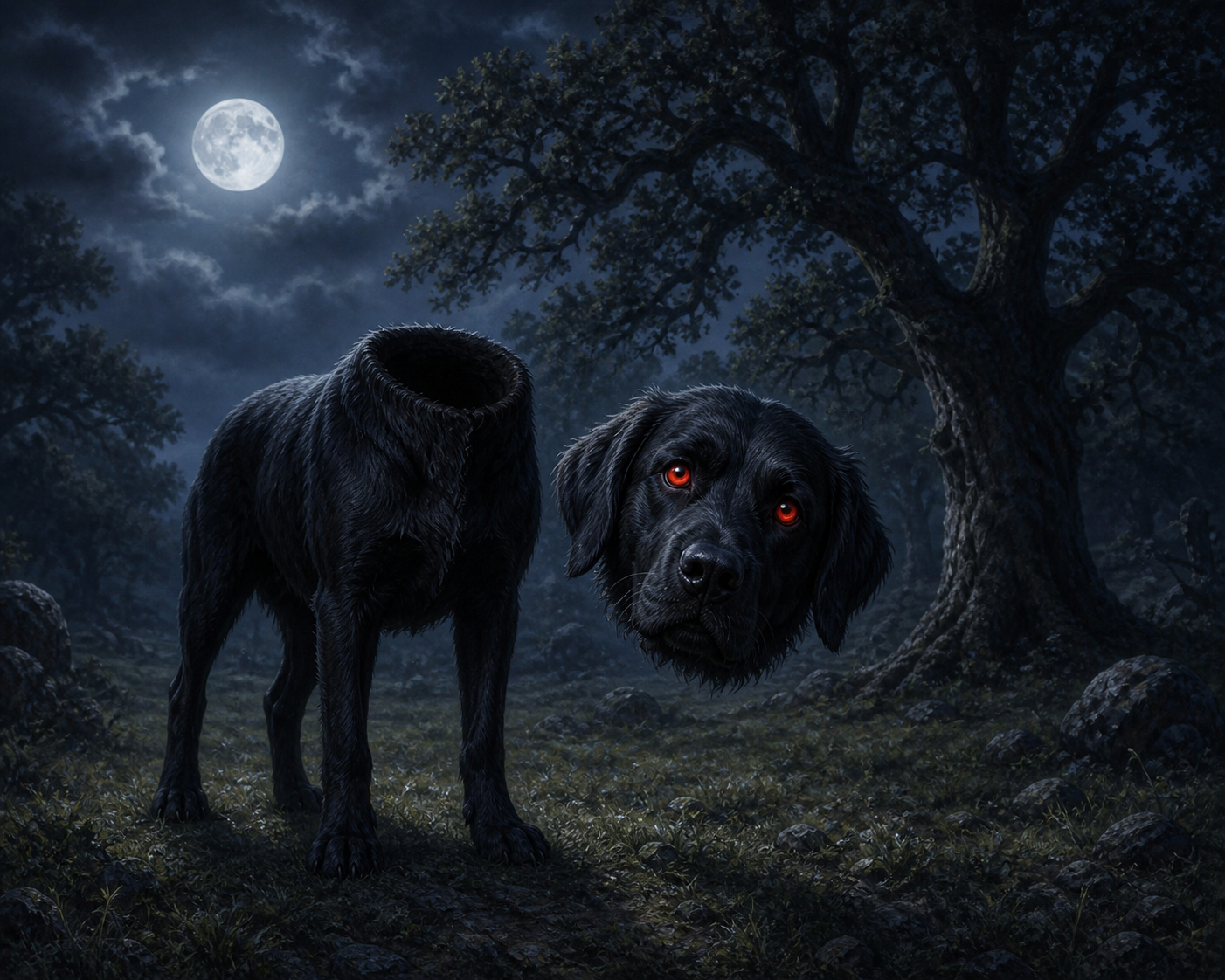
As one might guess, Vance Randolph first mentions the dreaded “booger dog” in his book Ozark Magic and Folklore. He recounts a story he heard from a fellow who once met “a spotted hound that was bigger than a cow and made tracks in the snow nearly two feet across.” The storyteller was only a lad at the time of the sighting, but even so, he was astute enough to know there are no dogs that big, and so he must have seen a “booger dog,” that is, a “great ghost hound.” Randolph thought this fellow may have told the story for his “especial benefit” — which I interpret to mean “pulling his leg” — but, no, Randolph found this fellow had been telling the story for twenty years and most everyone had heard it.
Dr. J. Gordon of Bunker, Missouri, told Randolph that he had several times seen a great dog when he was making his rounds. On one bright moonlit night, he saw the dog walking on water “without making a ripple.” Dr. Gordon reported that one time the dog had even jumped on the rump of his horse, and though he slashed at the dog with his pistol, “it went right through the figure as if nothing was there” (224).
In some variations of the story the ghost dog was headless. A group of fellows in Pemiscot County claimed they saw a headless eight foot long hound when they were coon hunting. One of them threw his axe at the dog, but it passed right through the animal and stuck in a tree. However, since this wild story occurred in the Bootheel of Missouri and not the Ozarks, we are not obliged to believe it.
Perhaps the most famous account of the Booger Dog was given in Randolph’s book The Talking Turtle and Other Ozark Folk Tales. A revised version of the story follows here:
Once there was a superstitious farmer who believed in charms and demons and all kinds of magic. Whenever he saw anything uncanny, he believed the Devil was behind it or witches or some similar nonsense. He would write Bible verses on pieces of paper, chew them up, and burn the spitball. He buried talismans at the crossroads and swept the house with mistletoe to ward off spirits. He nailed horseshoes to the lintel and a triangle of nails in the door jamb.
Well, a big black dog started nosing around the farmer’s cabin every day. He was on familiar terms with all the dogs in his neck of the woods, and nary a neighbor had a dog that resembled this one. He thought, “That ain’t right,” so he put some strychnine in a piece of meat and left it where the dog would find it. Sure enough, the dog ate the meat, and when the farmer looked out the window, he saw the dog was having fits. At first the farmer felt sorry for the animal and thought he had mistaken a natural dog for a ghost dog, but when the dog was frisking around the next night, the man knew he was up against a demonic presence of uncommon strength.
His neighbors, of course, knew otherwise: the dog was natural, but the man had put too much poison in the meat; the dog vomited it up, and there wasn’t enough left to kill him. One of the neighbor ladies even told the farmer such, but he just sneered at her and said, “In the last days will come mockers and scoffers.” She went home, shaking her head and muttering, “That poor dumb animal.” Whether she was talking about the dog or the farmer is still a matter of contention.
The next time the booger dog came to his cabin, the farmer fetched his shotgun and gave the beast both barrels. The dog “laid there a-kicking,” so the farmer up with his axe and chopped off its head.
Story over, right?
Wrong!
Later that same night, the black dog was back and running around with its head in its mouth! Randolph writes, “When the neighbors heard that one they all just laughed like fools…” They said, “You old idiot — how the hell can a dog with its head cut off have a mouth to hold its head? Did the damn thing have two heads to begin with?” They ribbed him with similar jibes until “the fellow got so mad he wouldn’t talk about it no more.” That reminds me of the one about the AI model that was so self-aware that it was aware it had no self.
Well, sir, the dog showed up later in the week, running around with its head still paradoxically in its mouth, and the farmer thought, “That’s it! I’m a-takin’ him to the cleaners for real this time.” That night he melted a silver spoon into a slug that fit his shotgun, drew a bead on the animal, pulled the trigger, and “ka-boom!” The dog fell over again, this time with no kicking or other spasmodic twitchings. The man built a big pyre of wood, dragged the carcass on top of it, and burned the whole thing down to ashes. After that he didn’t see the dog anymore.
Randolph goes on to say that a week after the immolation, a couple of naughty boys came over to ask the farmer about the booger dog, and he told them what happened. The boys furrowed their brows and uttered various expressions like “Wow!” and “You don’t say!” and “You really did it this time!” But, of course, they were holding themselves back from laughing in his fool face. Strange thing is, when the boys went to poke through the ashes, they didn’t find any bones or teeth or anything. Randolph writes:
So when the boys couldn’t find nothing only wood ashes, they began to feel kind of spooky. They all knowed in reason that a natural dog couldn’t carry its head in its mouth, like the fellow said. But if the varmint was a genuine booger dog, it is something else again.
Randolph, or rather Randolph’s informant, Mr. D.A. Hicks, concludes this macabre tale with a pertinent observation:
There is lots going on in this world that people don’t know about, like them miracles in the Bible, so the boys figured the booger dog story might be true, after all. It ain’t no use to argue about things like that, anyhow.