It was a month later, in early July, when Joanna awoke in the middle of the night to the sound of singing. She thought at first that kids were partying up on the ridge, but then she noticed the songs were hymns. The window of her bedroom faced the valley, and the moon was riding high, so she guessed it was midnight or later.
The singing began again, "Just a closer walk with thee; grant it, Jesus, is my plea," and Joanna wondered, What in the hell is going on? She pulled on some jeans and a light jacket and her rubber boots and went out the back door. Then she began trudging up the steep hill to the singing on the ridge. The moon was at a good angle to give her light, and she followed the shadows stretching out before her.
How great Thou art!
Who in the world would be out here singing in the middle of the night?
For a passing moment, Joanna wished that she had brought a gun, but then she thought, For Christ's sake, they're singing hymns. These folks might be strange, but I can't imagine they're dangerous.
She tried walking more softly, and then thought that, too, was absurd. Why should she care if a bunch of people singing hymns heard her coming? It was more likely they would welcome her.
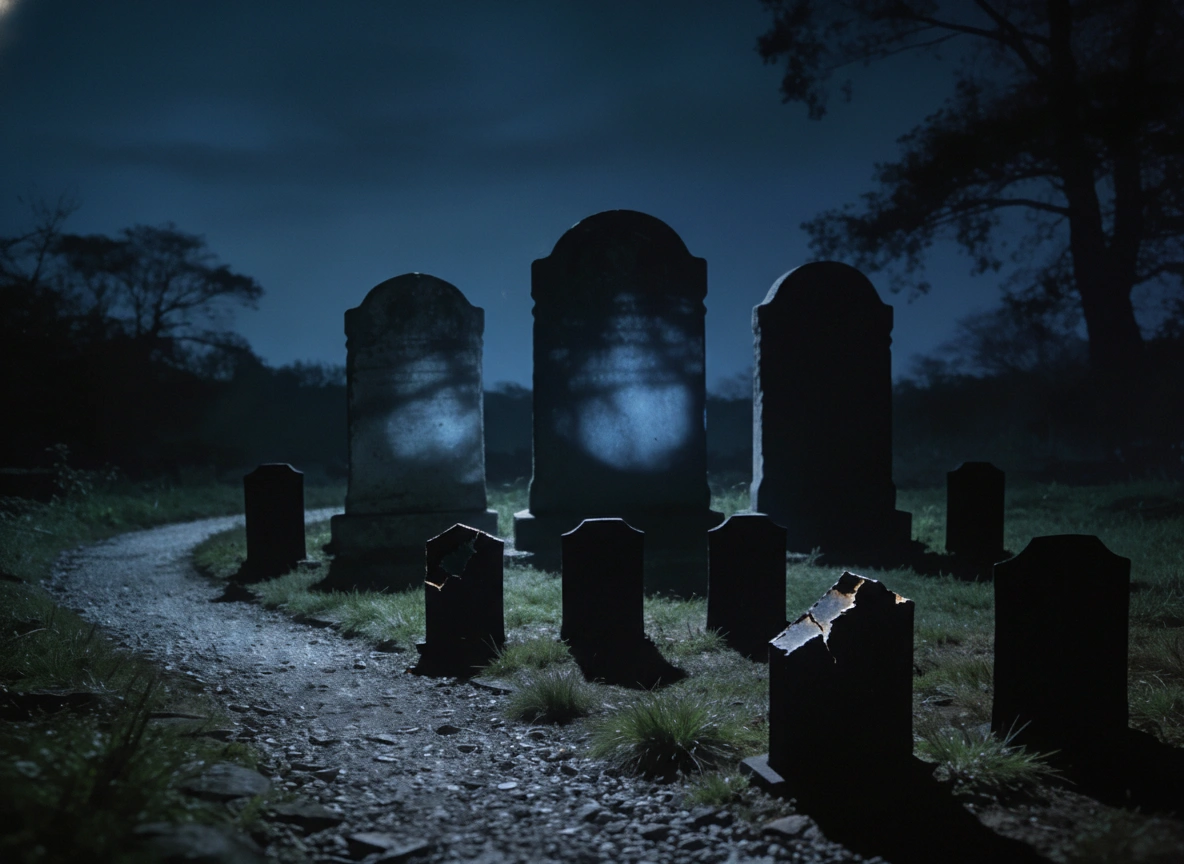
She topped the rise and saw the headstones in the moonlight. Those of her parents and William reflected the moon dimly, but the other stones were black.
Then the singing began again.
With shout of acclamation
And take me home
What joy shall fill my heart!
Joanna heard the blood pounding in her ears. The people were singing words of hope and joy in tones of lamentation. Something uncanny was happening, a service she didn't want to see, a ceremony of sadness that made her want to run, stumbling and sliding through the leaves, down the hill to wrap herself in quilts and tremble in her bed.
But she had to see.
The trees were columns of pale silver against jet-black shadows, and she found herself walking toward the old brush arbor. As she drew nearer, she saw that fresh limbs, fully leafed and carefully interlaced, had been lashed to the trees, and the singing grew louder. She kept moving closer, and she could just make out people standing because the arbor cast them in shadow.
She stopped when she heard a voice cry out, "Have you repented your sins?"
And the people replied as one, "We have."
"And begged forgiveness?"
"We have."
"For the suffering of Elaine?"
"For all our manifold sins."
She knew for certain what she feared at first: William was speaking.
She heard a man's voice reply, "Why did you not visit me when I was ill, boy?"
And William told her father, "Because I was selfish and foolish and had suffered too little."
Another voice, a woman's voice, said, "My mind became a blank, and I only wished to see my daughter. But she never came. Ah, Joanna!"
And her father said, "When I breathed my last on earth, Joanna wasn't there."
And William said, "Joanna left me to die alone. But the Master said—"
And the voices replied together, "—let the dead take care of the dead."
Her ancestors had spoken against her, the living, who stood outside the congregation, and she wanted to scream but knew she should not, that screaming would be folly, and the ancestors might turn and pursue her into the cemetery, where…where she didn't know what they might do. So she began to step backward, to retreat from this ghastly place, and as she turned, she stepped on something she thought was a stick, but it squirmed and writhed and coiled as if to strike, and the terrors of the night and the voices raised in unison against her unraveled her mind, and she shrieked, blood-chilling in the night.
And then she began to run, first toward the cemetery, for there she could see her way most clearly among the stones, but then she would run toward the cleft and scramble down the hill to safety. Before she threw herself down the steep declination, however, she saw the great bluff across the valley, glowing faintly beneath the westering moon and looming over Butler's Glen. And at that moment, the bluff symbolized death, inevitable and foreboding and beckoning. Her only hope was a desperate descent into the dark reaches of the valley, for behind her were rustlings and whisperings and fingers picking lightly at her clothes. She heard her name repeated, "Joanna! Joanna! Joanna!"
Impulsive and charged with fear, she faced the milling host and cried, "What do you want from me?"
Her mother said, "We want to forgive you. But you must want to be forgiven."
"Yes, that is what I want. Please, I beg you, forgive me. Please..." Her voice and eyes were urgent, with fear, certainly, but also with regret and the pain of memory.
William asked, "Do you repent of your manifold sins?"
"I do! I failed you, and I'm sorry. And I failed you, Dad. I am too weak to face death, anyone's death but especially my own.
"And so were we. We forgive you."
Joanna never doubted the reconciliation. She didn't find an errant leaf in her jacket pocket that proved she had been in the woods that night. She never looked for one. She had been forgiven. And she knew that someday she would lie beside her husband and her mother and father and all the others, silent and restless until they sang hymns in the old brush arbor, gone but not forgotten.