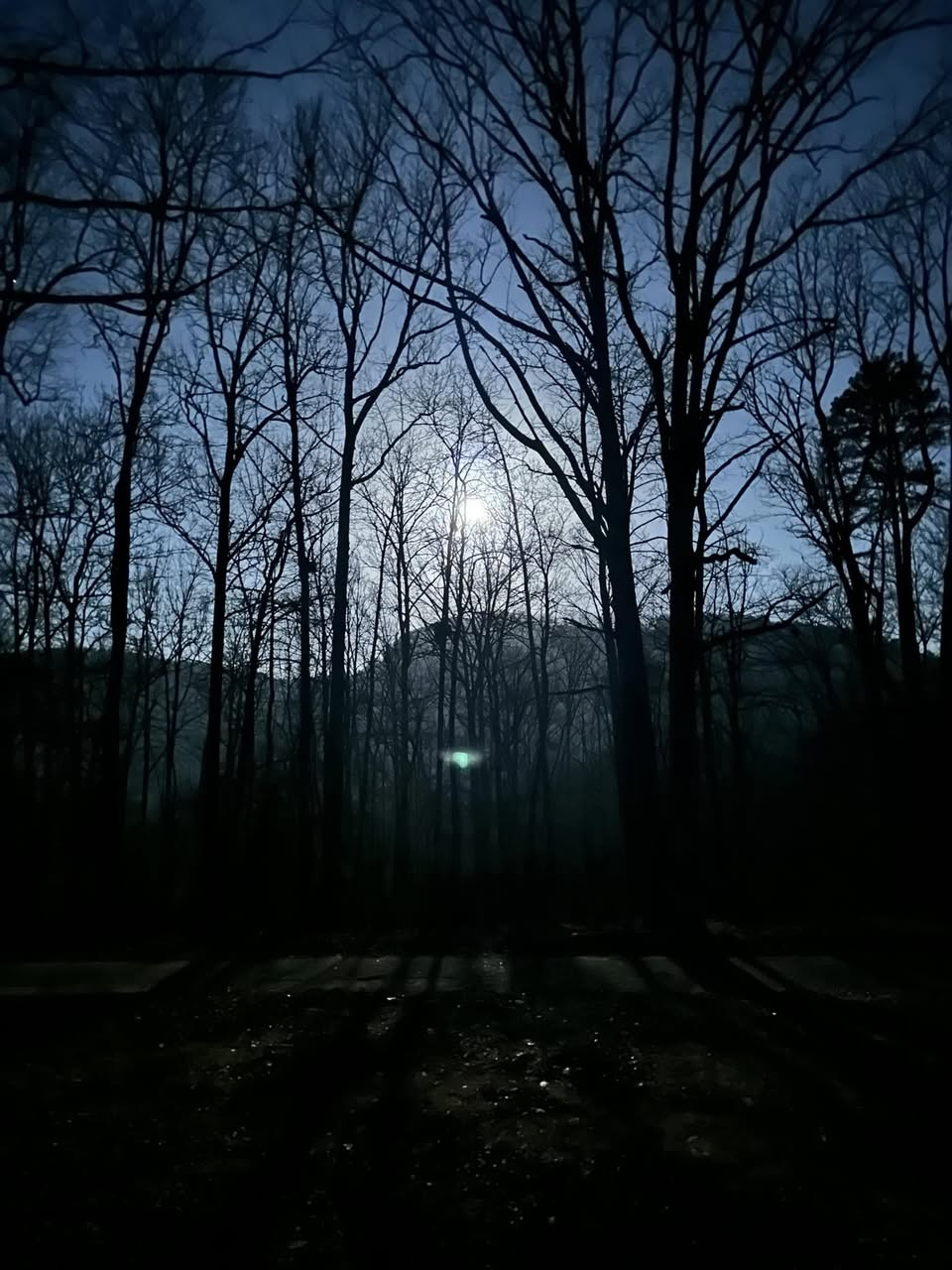
Actual view of from the brush arbor in late afternoon.
Joanna Butler-Thomas lived in the deep woods of her ancestral homestead. She was the fifth generation to be reared in Butler's Glen, a furrowed swath of bottom land beside the banks of the Little Red River. About a quarter of a mile east of the Little Red ran a long, low shelf where the old homes stood—two log cabins built in the 1800s and converted into impromptu sheds for storing haybales and farm tools, a rambling farmhouse with a porch still trying to decide whether or not it would slide down the hill, and a trailer home dragged in for Uncle Ralph, who years ago had taken to drink and would never amount to anything. Behind the homes and the low rise, a nearly perpendicular hill of oak and hickory trees and occasional rock outcroppings stretched upward another four hundred feet. On the crown of that ridge was a family cemetery of maybe a dozen headstones. The oldest graves weren't memorialized with anything more elaborate than a chunk of rock, which made Joanna sad when she was a little girl. She wondered who might be down there, gone and forgotten. Not far from the cemetery lay the rotted timbers, stumps, and benches of a long ago brush arbor. In those days, the faithful who gathered beneath the arbor would look across the valley of Butler's Glen to admire the high bluff beyond the Little Red, and more than one preacher began his sermon, "I will lift up mine eyes unto the hills whence cometh my help."
After her parents died, Joanna looked to the hills and found nothing but rocks. Her father died first, as fathers are wont to do. Cancer, of course. Her mother had converted the guest room—it was Joanna's room before she left for Fayetteville—into a sickroom, and her father never saw the valley he loved again. His view through the window was of the leaf strewn verticality behind the farmhouse. Joanna's mother exhausted herself caring for her husband, and Joanna visited when she could. During the summer, she brought peaches she bought at a fruit stand in St. Joe. She told her father, "I wish I could stay longer, Dad, but I'm so busy with work. I was assigned to develop a new plan for city expansion south of town. I can't believe they gave it to me! And William is consumed with classes and writing his dissertation. He sends his love. I'll be back as soon as I can."
The truth is that Joanna feared death and didn't want to watch her father die. Of course, like everyone else in her generation, she had parted ways from her parents: politically, religiously, socially. Her university classes had seen to that. But she still loved her mom and dad. Perhaps they held retrograde opinions, but they had loved her with an optimism and loyalty she couldn't deny. So, it wasn't their differences that kept her away in those final moments; it was the awful reality of dying.
Her mother's decline into dementia seemed as inevitable as her father's death by cancer. Obviously, she couldn't stay in the old farmhouse—that became apparent when she almost burned the house down trying to cook an empty pot—and Joanna couldn't find anyone in Fox or Timbo to care for her mother, and if even she did, how could she afford in-home care? So, Joanna did what she had to and put her mother in a nursing home in Marshall. When the old woman's senses failed completely and she sat in a wheelchair, eyes-closed and gumming air, Joanna stopped driving over to see her. What was the point?
William was another headache. He had never really gotten along with her parents. Her dad wanted to talk farming and the Razorbacks, and William wanted to talk about the Elaine Riot of 1919. In fact, William was a hundred pages into a dissertation on the subject when the University of Arkansas published a book that argued his thesis. William was furious. "Why didn't anyone in the history department tell me this was coming? How could they let something like this happen?"
He tried to start over but couldn't, and Joanna's nagging didn't help. She said things like, "If you hate teaching freshman history, you're going to have to finish your doctorate." But that made him angrier, and he would grab his coat and head to the bars on Dickson Street.
Finally, her mother died and the house and valley and cemetery atop the hill came to Joanna along with a little money. She and William discussed selling the old place but decided to spend a week in Butler's Glen to make sure that's what they wanted. The timing was not auspicious—it was the first week of December—and William spent the first day cutting firewood he stacked by the front door while Joanna cleaned out the kitchen. That night the temperature plunged and froze the mist rising off the river, and hoarfrost covered every twig, limb, and sapling along the riverbanks and even the cedars rising up the bluff face and the oaks behind the farmhouse. When the sun lifted above the cemetery and the morning light fell on the frost covered trees, the whole of Butler's Glen shimmered in white and rose and gold. William stood on the porch and said, "That's it. We're not going anywhere." William gave up his graduate studies and earned his teaching certificate while Joanna found a job at the Folk Center in Mountain View. They moved into the old farmhouse in May when the dogwoods were blooming and daisies filled the valley.
William died so quickly, Joanna barely managed to avoid the moment of his death. Her father's cancer was downright leisurely compared to the pancreatic cancer that wasted her husband. Of course, they sought treatment in Fayetteville, but pancreatic cancer is the diagnosis everyone fears. It's as certain a death sentence as the electric chair. Joanna had left his bedside to get some fresh air, and while she was walking by the river, he died, and the old house had one more ghost to haunt the rafters.