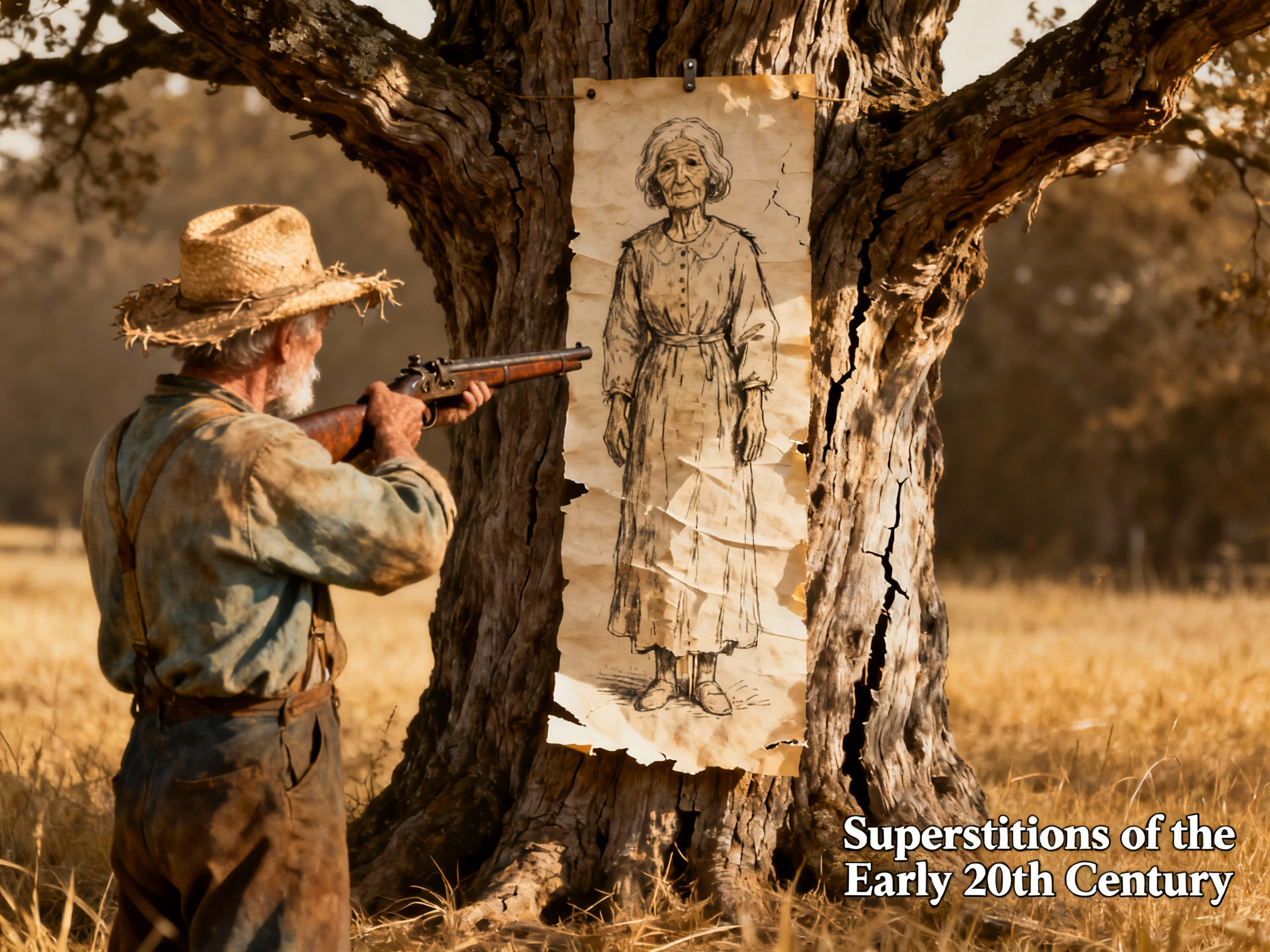
In the 1938 January-March issue of The Journal of American Folklore, S.P. Bayard recounts several interesting stories and superstitions about witches, four of which will be considered here. The year of publication is important because it demonstrates the persistence of these superstitions into the twentieth century.[1] Bayard's informants for the stories were Mrs. Mary Pierson Rogers and Mrs. Hannah Bayles Sayre, and the area from which he collected the stories is rural West Virginia and southwestern Pennsylvania (46).
The first and second stories concern a practice called flyting in which verbal mastery is effective in securing protection from sorcery. According to a footnote on the same page, "Flyting . . . is drawing one's foe into a controversy and scolding him roundly" (46). According to various sources on the Internet, "flyting" as a verbal clash between rivals persists in contemporary culture through "rap battles" like that between Drake and Kendrick Lamar and is exemplified in Lamar's hugely popular song, "Not Like Us."[2] When Lamar was invited to perform the song (in part) at the Super Bowl, "flyting" was raised to the level of a football championship, which, aside from war, is the ultimate American expression of physical rivalry.[3]
The third story introduces the employment of effigies in combatting witchcraft, and the fourth recounts the traditional association of witches with cats and concludes not in a verbal confrontation but a violent act directed against an innocent creature.
Now, to the stories themselves: Bayard's informant Mrs. Sayre recounted the story of the Bayles family, who were "experiencing" certain hardships "due to the witchcraft of a neighbor." According to Mrs. Sayre, "She [the neighbor] troubled them [the Bayles] at first by causing their rest to be disturbed by a number of cats, who would suddenly appear in the room, frolic over the beds, and then disappear just as mysteriously as they had come—since the house was shut up for the night and there was no opening through which animals of their size could enter or leave." Subsequent troubles included a "sudden shaking of the whole house," which continued night after night, "sometimes throwing them out of their beds." To his wife's questions concerning these unnerving occurrences, Mr. Bayles replied that "the devil was about; but he knew who was doing it; he'd fix them." Mr. Bayles found his opportunity when their neighbor/witch paid the Bayles a visit. "He immediately accused her [and] told her that he knew of her evil doings: that she had come at first 'with cats,' then 'with trying to shake the house down'. . . . 'Finally, heaping invectives on her, he ordered her to go and never return. She fled hastily, and they neither saw her nor were troubled by her magic again" (48-49). In brief, "she" not like "us."
A subsequent story also describes the power of "flyting": "Mrs. Rogers, who believes as firmly as Mrs. Sayre in the efficacy of flyting, told me this anecdote: As she was going by the house of an old woman who was reputed to be a witch (and whose dwelling she never passed without muttering a few precautionary curses), the woman suddenly ran out of doors and came straight toward her, crying 'Chicken-guts, chicken-feathers, chicken-guts, chicken-feathers!' This scared Mrs. Rogers so badly that she fled at full speed, screaming out oaths and invectives as she ran. She attributed her safety then and afterward to the curses she had levelled at the old woman; for she was sure that the above words carried a malign spell" (50). Of course, it is certainly unpleasant when an old woman runs toward you hollering about chicken guts and chicken feathers, but it may be that compassion would have been a more humane and effective response than curses.[4]
A third story from the Journal discusses effigies as a means to defeat witches: "Mr. Bayles was asked to cure a child whom a witch had caused to fall into convulsions. The criminal was a woman in the neighborhood, as Bayles well knew. The wizard, having identified the guilty person, gave his family the usual warnings against letting her have anything from the house, and then proceeded to mold his silver bullet. But through an oversight, the witch managed to get a needle from some member of the household; and just as Bayles had loaded his gun with the charmed bullet, and was preparing to shoot a 'profile' of the offender which he had drawn with charcoal on paper and hung up against the wall of the house, she appeared in the doorway. She was immune from his magic, and she grinned at him and mocked him while he stood with levelled gun, powerless to pull the trigger" (50-51). All it took to thwart the "witch master" and render him powerless was an object as slender and insignificant as a needle.
A fourth story from Bayard's article draws on the traditional association of witches and cats: When Mrs. Sayre was a small girl, her family lived near a witch who persisted in coming to visit and to plague them in the shape of a huge black cat. This creature could squeeze into the house through a very small opening—much too small to admit any normal cat. But the old grandmother of the family was well aware of the beast's true nature, and once, when someone called her attention to another visit from 'old Nance Lyon's cat,' she exclaimed, 'Yes, God damn her, I know 'tis: I'll break her back for her.' She seized the poker and dealt the cat a hard blow across the back just as it was leaving the house. Shortly afterward, the news came that the witch had been 'horse-throwed' and had broken her back; but old granny Bayles knew better how the accident had happened. They took pity on the woman and in a few hours went to visit her, whereupon she recovered—"but if they hadn't 'a' gone, she'd 'a' died!'" What became of the cat we will never know.
Now we can put in relationship several recurring themes and images: flyting; an old woman suspected of being a witch; cats; the use of effigies and silver bullets; and incantations that empower a "good" person to defeat a malevolent rival. Also evident is the concept of "projection", that is, imbuing an image or thing with power in order to vanquish that power.
These themes received various treatments in the Vance Randolph's seminal study of Ozarks superstitions, Ozark Magic and Folklore. With regard to "flyting," I found no specific references to this means of combatting witches. Randolph does record an incantation that enables the speaker to vanquish a rival, but it would take quite a bit of interpretive manhandling to equate it with "flyting." Randolph writes, "Here is a rhyme from a manuscript book which Miss Miriam Lynch, Notch, Missouri, obtained from one of her neighbors. It is supposed to be repeated by one who is about to enter a struggle or contest and fears that his adversary may be assisted by the Powers of Evil: 'God the Father is with me, /God the Son may be with thee, /The Holy Ghost is with us all, /But I will rise and you will fall" (286). While the charm doesn't constitute a verbal duel, it does suggest the power of words to affect positively a (physical?) confrontation with a rival.[5] In this sense, an incantation could be construed as a more powerful and succinct means of vanquishing witches than "flyting." Who needs trash talking when you can deliver a knockout blow with a charm?
From the evidence Randolph presents, it seems that Ozarkers preferred the more physical means of defeating witches, and that's where effigies and silver bullets and cats come into play. Concerning effigies, Randolph writes, If the witch master knows the identity of the woman who is causing the trouble, he draws her picture on a board and fires a silver bullet into it. This is supposed to kill the witch, or at least to cause her great bodily and mental anguish. I interviewed one renowned witch killer who cuts a silhouette out of paper and writes the witch's name on it. The he very slowly tears the paper doll to pieces—pulls off a hand one day, a foot the next, and so on. Finally he snips off the head, whereupon the witch is expected to die, or suffer a paralytic stroke, or become violently insane. (287)
With regard to cats, Randolph offers this example: There is an old story of a drunken bravo in northwestern Arkansas who was bantered to sleep all night in a shack where witches were known to be "usin' round." He said that if they gave him a jug of whiskey he'd sleep anywhere. He lit a candle, and drank heavily, and felt very well until midnight, when suddenly there appeared an enormous cat. The creature yowled and spit at him, and the man fired his great horse-pistol—a muzzle-loading weapon loaded with buckshot. Somewhere a woman screamed, and the hillman always swore that just as the candle went out he saw a woman's bare foot, covered with blood, wriggling around on the table. Next day it was learned that a woman who lived nearby had shot her foot off accidentally and died from loss of blood. Some say that she died a-yowlin' and a-spittin' like a cat! (269)
Why this persistence of themes and repetition of symbols, these allusions to cats, effigies, and silver bullets? We could appeal to tradition, but that would beg the question. Whether the roots of all this nonsense go back to Babylonia or Europe or Appalachia, the reasons why superstitions persist has less to do with origins that it does with a substrate of meaning that retains psychological resonance through time. I argue that this underlying "meaning" resides in the darkest corner of the human psyche, namely, the urge to scapegoat someone or something to address problems and redress wrongs.
We begin by observing the obvious: an old woman, usually widowed, who has been designated a witch is the most vulnerable member of her community: She has a scarcity of resources, no one to protect her, and a limited ability to protect herself.[6] Through the projection of someone "within" the community, she is imaginatively transformed from the weakest to the most powerful and malevolent force in the community. At the same time, the projection pushes her to the margins of society, so that a witch is both central and marginal to the consciousness of the community. Her equivocal status and lack of resources transform the "witch" into the perfect scapegoat for the community's troubles. Often her only infraction is the "crooked gaze," the infamous "evil eye" of folklore.[7] Nevertheless, "looking askance" is enough to convict her of witchery, and as everyone knows, it's easy to kill witches because they can't fight back.[8]
Cats, which are only partially domesticated and retain unpredictable feral tendencies (which is one reason we love them), share the liminal status of witches; they are both within society (the house) and without because they are not fully tamed. With their teeth and claws and vertical pupils, cats possess the attributes of our most feared predators: carnivorous mammals and poisonous snakes. Their size, however, enables cats to become house pets while at the same time, it makes them vulnerable to irrational scapegoating—just like witches.[9]
Effigies share a similar duality: An image is not the person it represents, but it points to the person, presumably through some identifiable caricature or at least through the intention of the "artist." Striking or killing cats and shooting effigies involve the same imaginative projection that created the witch in the first place: Identify something powerless and imbue it with malevolent power; destroy it and you also destroy the power it possesses. Such is the ruthless illogic of domination and scapegoating.
The fact that a witch needs only a needle to thwart the "witch master" does not attest to her power but to the triviality of the whole complex of superstitions. An envious eye, a needle, an errant cat: All belong to a world of powerless people struggling to read meaningless signs and order their world to prevent random tragedies with the weakest of tools.
And this brings us to the "witch master's" use of silver bullets. In alchemical lore, silver is associated with the moon. The moon, too, is a liminal light—brighter than a star but weaker than the sun, it both reveals and conceals. The moon can't be shot like an effigy[10] or killed like a cat, but as Hecate—the maiden, matron, and crone[11]—the moon symbolically presides over witches, cats, and effigies. She also presides over the tides and menses, and so over women. From a traditional perspective—which is clearly what we are dealing with when we're dealing with these superstitions—words belong to the domain of women, physical strength to the domain of men. Men fight; women use persuasion—or speak incantations. If we define domination in terms of physical strength, women are obliged to "fight" with weaker arms unless some kind of power is imaginatively projected into words. In the 20th century, men are prevented by law from physically assaulting suspected witches. "I thought she was a witch" no longer held up in court. So, men, too, were limited to wielding the weak arms of magic and charms.
To conclude: witches, incantations, and spells belong to the world of a people without power, the folk who are moved about by the Big Powers: Government, Church, and the mysteriously inaccessible Power of God, as variously interpreted and imposed by Government and Church according to their particular needs of the moment. However, whenever the "small power" of superstition and words is appropriated and exploited by the "Big Powers," the results are horrific. When folktales "rise" from the sphere of stories and language—words—into the sphere of physical domination—deeds—all manner of barbarous and cruel evils are perpetrated on the innocent: From the persecution of Christians in Rome, to the persecution of witches in the Middle Ages, to the persecution of blacks in America, to the persecution of Jews by the Nazis, to the persecution of Christians in Uganda, and on and on.
When folktales function in their proper sphere, however, they hold a mirror up to the Big Powers to reveal the superstitious underpinnings of the systems of domination. [See my "Bible as Folklore" essay in "Bulfinch's Theology."] Most important, folktales uncover the dark motive of scapegoating that lies behind the little world of meaningless interpretations and the big world of governance and warcraft. It's worth remembering that the word "monster" is derived from the Latin word monere, "to show" or "to warn." A woman becomes a witch becomes a monster becomes a warning about our most vicious impulses. When superstitions are wedded to power, somebody's going to burn.
For an excellent overview of the history of persecution of witches, check out the link below to the October 26, 1890, edition of the St. Louis Globe-Democrat, "Witches and Witchcraft: The Horrible Delusion that Prevailed for Four Hundred Years":
https://www.newspapers.com/image-view/571299315/?match=1&terms=%22witch%22
Recall also that this article was written almost sixty years before Ozark Magic and Folklore.