Three Lessons in Rhabdomancy
By Lee F. Vance
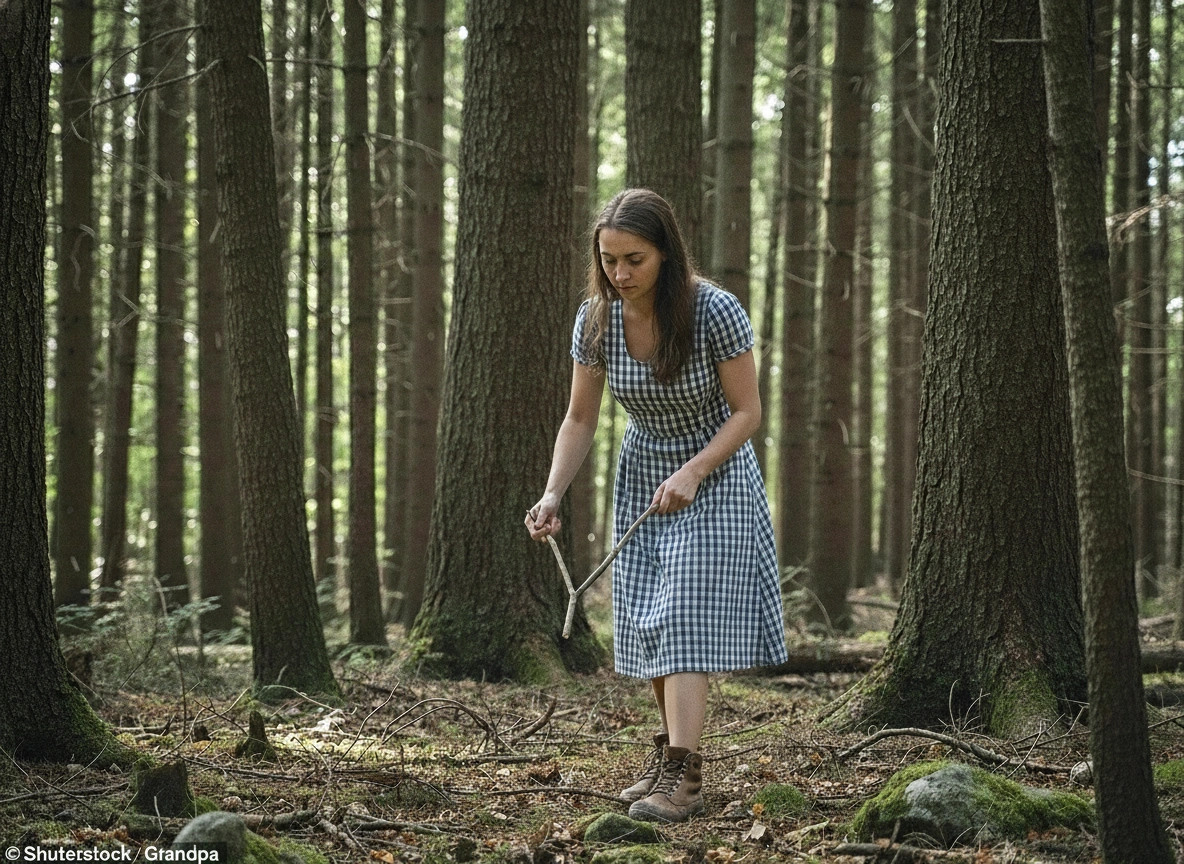
To those who have not seen the divining rod in working order, we would say that a forked branch of witch-hazel or of peach is selected always in the shape of the letter Y. The branches are grasped at the ends by the hands, with the palms turned upwards, the ends of the branches being between the thumb and the forefinger, the stem where the branches unite being held horizontally. Then the diviner, with the elbow bent and the forearm at right angle, walks over the ground, and the forked stems move, rising up or down, according as there is or is not a subterranean spring or mineral vein beneath the surface.
It has been my good fortune to take three lessons in rhabdomancy.
1. The first lesson was some seven years ago. It was given in eastern Ohio, at the time of the excitement over gas wells. Curious to relate, there appeared any number of philanthropic individuals who offered to locate a good paying gas or oil well for a small consideration. With them it was a case of heads I win, tails you lose. If they struck oil or gas, they got a handsome fee; if they failed, they lost nothing but their time.
One man in particular had been successful in one instance, and that was enough to establish his reputation as a great diviner. He interested some half a dozen people in our city. As a guarantee of good faith, he wanted to show his prospective investors how the magic rod worked in his hand.
I remember well the bright summer morning when we rode out into the country. Our conveyance stopped in front of a ten-acre lot, under which, according to the rodsman, gas flowed in an immense volume. We all stood silently around while the expert was getting his apparatus ready for the experiment. He used what I took to be two metal wires coming together into a fork or shank, on which was placed a covered cap. The contents of this cap was of course a deep secret. Holding his two elbows at right angles, he began to walk over the ground with military step. He assumed an expression best denoted by the word "intense." He started off in a trance-like state, and his amused audience followed on and on behind.
Suddenly the rodsman seemed to be in a fit. He finally recovered his composure and his breath to say: "Here is the spot. If you dig down here, you will find enough gas to blow up a whole county." The performance of the rodsman was so remarkable that no one ventured to dispute his word. One of the party stepped forward and said, "Let me try it. I should like to see whether the rod will wiggle in my hand." But the rod remained straight and motionless.
Then others ventured to try the instrument, but in every case the rod refused to move in the hands of an unbeliever. I afterwards learned that one man, having more faith than judgment, did sink a shaft down some hundred feet on the spot located; that, instead of gas, there issued forth from the earth a copious volume of water.
2. My second lesson was extremely interesting and instructive. Some five years ago I ran across a curious specimen of the Dick Dousterswivel order in Yates County, New York. He had a local habitation, and a name for finding water, but at this time he was engaged in locating gas and oil wells. I made his acquaintance, and soon persuaded him to show me some of the secrets of his craft. He was not particularly secretive or modest in talking about himself and his doings. He certainly had a fond belief in his extraordinary power to locate water, oil, and gas veins by the aid of the rod. His répertoire included a large assortment of forked sticks. Some were simply green tree twigs; others were of wire or metal; others, again, were incased in leather.
I met the rodsman by appointment one Sunday afternoon, and together we experimented with the different wands. I tried each and all of them, but in no single instance was I successful in having any twisting, or turning or signs indicating water, gas, or oil under the surface. However, in his hands, any one of the rods would twist and turn in a most remarkable manner. Two or three times I quietly marked the exact spot which he had indicated. After leading him off to other places, and then back again to spots already marked, I discovered that he located entirely new places.
I rather think that I won the confidence of the rodsman by professing deep interest in his magical performance. I took so many lessons in modern rhabdomancy that he came to regard me as a convert to his art. After a while, he expressed the belief that I would soon be able to work the twig as well as any one. Certainly I have since become quite an adept in the tricks of his trade.
Let me state that this rodsman was really sincere in the belief in his own power. He was not a little proud of the workings of the rod in his hand. He had exhibited his different forked sticks in some half a dozen counties in New York State. His name had been celebrated in the local papers, from which he kept many clippings. Two or three extracts will suffice to show popular confidence in his claims to be regarded as a wonderful diviner. This is from the "Chittenango Times": "And so it is; down goes the well, and it goes down where Jonathan and his divining rod have located it." Another extract, from the "Ithaca Daily Journal," reads as follows: "Some time ago, Dr. Champlin devised an instrument which will disclose the existence of natural gas, no matter how deep down. It is a secret, not a patented appliance. I have seen its operations, seen the truth of its actions verified, and have an abiding faith in it" (September 3, 1889). In the "Dundee Record" there is some doggerel, in which occurs this line: "We put our trust in Champlin and his great divining rod." One man had faith enough to pay all the expenses of the rodsman to Texas. The "San Angelo Standard" said: "We think Mr. C. is a man of astounding abilities, and would be as famous as Edison if better known." And so notices of this extraordinary diviner might be multiplied.
3. My third lesson in rhabdomancy was about a year ago. Last December there appeared in the "New York Times" an account of the wonderful discoveries of a diviner in Morrisania. I made up my mind to go the next day and see for myself. The scene of operation was a brewery yard, and there the expert showed several of us what he could do. In this case the magic instrument was quite different from many I had seen, or even heard of. A small lump of metal, looking like a plumb-bob, hung from a fine wire, which was connected (so he said) with a small electrical apparatus held in the hand.
The diviner claimed that he had located from the floor on which we then stood the direction of a hose filled with water on the floor below. He also claimed that the vibration of the wire indicated approximately the volume of water beneath the surface of the ground. The diviner distinctly repudiated any magic that might be attributed to his art. On the contrary, the apparatus which enabled him to detect subterranean springs was a scheme of his own invention, and was based on scientific principles.
Several of us tried our hand at locating any hidden spring that might be running under our feet. Only in one instance did the wire show the least vibration or quiver. When the diviner walked over the same spot, a very considerable agitation of the wire was noticed. Several times he stopped and said, "Here is a place where the water is not only large in volume, but swift-running." The expert was very loath to impart much information about his scientific device, and in many ways our tests with him were unsatisfactory.
Here endeth the third lesson.
The practical use of rods or wands dates back to ancient times. It was known to the Greeks, from whom we get our word "rhabdomancy." M. Lenormant, in his "Chaldean Magic," mentions the use of divining rods by the Magi. He says that divination by wands was known and practised in Babylon, and "that this was even the most ancient mode of divination used in the time of the Acadians." Then came a revival of the superstition in the Middle Ages, when the rod was used chiefly as a means of discovering hidden treasures or precious metals, of detecting guilt, etc.
The supposed mystic movement of the divining rod is one of the commonest superstitions in American life. Tracing the antecedent history of the rod in this country, it would appear that the early New England settlers were in the habit of using the hazel twig to find veins of water. Many of the tea-kettles of our grandmothers were filled by rhabdomancy. The pioneers carried the superstition wherever they went. The authors of the "Life of Lincoln," in the "Century Magazine," say: "They (the pioneers of Illinois) were familiar with the ever-recurring mystification of the witch hazel or divining rod."
Too often rhabdomancy has been used by quacks and impostors. The divining rod has been the stock-in-trade of every Cagliostro. In 1798, or three years after the death of the original Cagliostro, a farce was enacted in the town of Warren, R.I., almost parallel to the scene described by Carlyle. A certain schoolmaster spread the notion that there lay hid a treasure which might be fortunately lifted. The "Darby Ring" was a circle of some forty feet in diameter, about which the fortune-hunters, in single file, would follow their leader at a dog-trot, reciting some silly jargon and holding aloft a forked stick of witch hazel, which would enable the holders to discover the presence of the buried treasure. Think of those grave, practical ancestors of ours prancing about the "ring," each with his magic stick! How they must have danced after they learned the truth!
Speak of a hidden treasure, and the cupidity of man is easily aroused. In his "Life of Jo Smith," the founder of the Mormon sect, Mr. Kennedy, says that the principal business of the Smiths, father and son, consisted in finding water, digging wells, and in raising money from dupes to find buried treasures by the divining rod.
When gold was discovered in California, all sorts and conditions of rodsmen flocked to the field to offer their services. A writer in the "Democratic Review" for March, 1850, says: "Since the discovery of mines in California, a Spanish gentleman in the city of New York has advertised for sale to the adventurers a mineral rod which will direct them to the richest deposits, and by which he has made his own fortune. In proof of their excellence he also published the certificates of several men of science." How generous some men are, after they have made their own fortune!
Coming down to recent times, Prof. R. W. Raymond, a mining engineer, gives several instances of encountering, in Western mining regions, parties of capitalists accompanied by experts whose business it was to discover mines by the use of the divining rod. Indeed, we do not think that the following statement of a writer in "Harper's Magazine" is any too broad: "Almost every county and every State of the Union has its professional adept at divination, at least so far as the discovery of hidden well-springs is concerned, and our mining districts of the West are prolific in these modern soothsayers who claim to be in familiar communication with subterranean stores of wealth, and stand ready to betray the confidence for a consideration."
The real question is, Why is any stick or stone magical? Briefly stated, it is one of the recognized principles in magic that any real or fancied resemblance of a stick or stone to any portion of the human body, any analogy based on color, is enough to give such things a reputation for magical virtues. In Scotland, stones were called by the name of the parts they resembled, as "eye-stane," "head-stane;" they possessed, of course, certain mystic properties.
The whole "Doctrine of Signatures," in old medical practice, was based on this kind of magical reasoning. Thus, the euphrasia, or eye-bright, was supposed to be good for the eye; the mandrake possessed certain occult virtues because its roots resembled the human body. Now, the divining rod in form resembles the letter Y, and vaguely the form and number of limbs of the human body. In this association of ideas lies, I think, the explanation of some of the magical properties attributed to forked sticks.
With regard to rhabdomancy, to all the strange uses of the divining rod, what is the method of folk-lore? The student of folk-lore will compare the uses and practices of civilized people with similar uses and practices among the uncivilized. He fails, however, to find anything exactly similar to modern rhabdomancy among people in a low stage of culture. He does find magic wands, but he does not find the "working the twig" as we moderns have come to see it. Therefore it would seem that the finding of water or seams of precious metal by the use of the rod is a comparatively modern device or invention.
The last lesson we would attempt to gather from the divining rod is this: Once let a superstitious practice start, there is no telling how or when or where it will end.