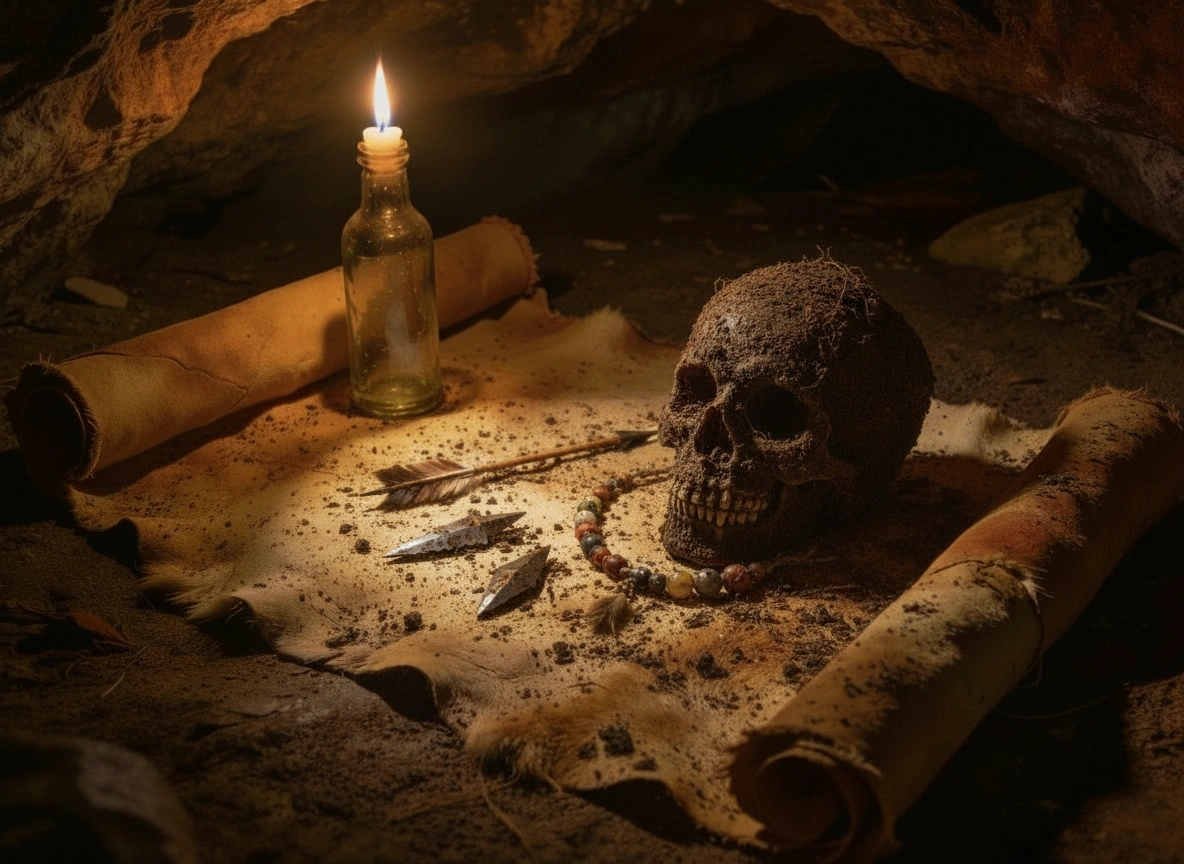
Blowin’ Cave is located in the center of the old Witherspoon place, and was doubtless named with reference to the cool breeze which always issues from its mouth in the Summer time. It isn’t much of a cave, really — not more than two hundred feet long and perhaps fifty feet wide — but it is clean and dry always, except for a little spring that flows out past the big stalagmites at one side.
Old Ike Witherspoon used it as a stable and hay-barn in his day, and later on it served as a garage for the Widder Witherspoon’s shiny little roadster. She always kept her milk and butter in the cave, too, and in hot weather used to move her rocking-chair out there. I stopped in to talk with the old lady occasionally, and always thought that the entrance of Blowin’ Cave was one of the most pleasant spots in the Holler.
Mis’ Witherspoon had lived on the place for nearly forty years, but she came originally from somewhere near Fayetteville.
“She was a right purty gal when she first come hyar,” Aunt Elvy Hatfield told me, “but she shore led her ducks t’ a pore puddle when she married Ike Witherspoon. A skinny, red-headed, possum-faced feller, with two big gold tushes a-stickin’ out — hit allus made me sick t’ my stummick jest t’ look at th’ critter.”
The old woman was always spoken of as the Widder Witherspoon nowadays, but everybody knew that she was really only a grass-widow — “a forsook woman,” as Aunt Elvy phrased it. It seems that Ike simply walked off into the woods one day, and nobody ever knew what became of him. Some people said that he had “follered a Injun trollop” into the Osage Nation. At any rate, he never showed up at home any more, and most of his neighbors thought that the Holler was better off without him.
But all that was long ago, and half forgotten now. Mis’ Witherspoon was a hard worker with a good head for business, and she had prospered mightily since her husband went away. The Witherspoon place was not particularly valuable from an agricultural point of view, but it fronted on the best fishing water in the whole region, and she made some money by selling cabin-sites to city people after the new State Highway came through. The old woman still lived alone in the cabin just outside the cave, although she owned several much more pretentious houses in the settlement. Gentle, charitable, devoutly religious, prominent in church work and in all proper social activities, the Widder Witherspoon stood mighty high in the Holler.
“That ol’ woman,” said Aunt Elvy, “is a saint on earth” — and this conviction seemed to be shared by the entire population. Her only weakness, so far as I could see, was a sort of mania for match-making; she was always trying to bring “nice” young men and women together, and crying up the advantages of lawful wedlock.
About the time I first came to the Holler, the farmer boys discovered that some tourists would pay cash for “Injun relics” — arrowpoints, spear-heads, flint knives, stone mortars and the like. Most of these objects were scattered about old village sites and camp grounds along the streams. Later on it was found that some of the dry caves contained relics of a different and much more ancient sort, and this discovery brought a party of professional archeologists into the region, who hired workmen and made systematic explorations of the caverns.
These fellows sifted tons of ashes, and took out a great number of animal bones, flint weapons, hoes made of mussel-shells fastened to wooden handles, water-tight vessels of basketry daubed with pitch, clay pots of various shapes and sizes. They unearthed many human skeletons, too, doubled up in shallow pits lined with buckskin. Some of the bodies were wrapped in robes made of feathers twisted on strings, others were clad in deerskin tanned with the hair on; many wore sandals woven of grass, and crude straw helmets. The scientists called these cave people Bluff-Dwellers, to distinguish them from the historic Indians of the region.
Before the Summer was over, more or less digging had been done in all of the local caverns save one — and that one was Blowin’ Cave. The Widder Witherspoon would not permit any excavation there, and she was not tempted by offers of financial gain, either.
“I don’t hold with this hyar grave-robbin’,” she said calmly, “an’ I ain’t a-goin’ t’ have none of it on my place.” She listened patiently to the arguments of the archeologists, then remarked: “I cain’t see as it makes no difference how many thousand years them bones has been a-layin’ thar. A thousand years ain’t no more’n a day in th’ sight o’ Gawd, an’ we’re all pore critters, anyhow. I reckon when th’ Day o’ Jedgment comes, them Injuns ’ll git right up an’ march t’ Glory ’long with th’ rest of us.”
And so the grave-robbers went their several ways, but before they left one of them told me that Blowin’ Cave was the most promising shelter in the entire region, and probably full of valuable Bluff-Dweller remains. As time went on, I read several magazine articles about the prehistoric inhabitants of the Holler and its environs, and became more and more interested in these matters.
One day, when the Widder Witherspoon had gone to visit some of her kinfolk, I went into Blowin’ Cave and dug into the ancient ash-heap, just at the edge of a big stalagmite. About two feet below the surface my pick crashed into what seemed to be a human skeleton. Profiting by my observation of the professionals, I worked very carefully now, using my fingers and a thin splinter of wood.
Presently I unearthed a skull, in extraordinarily good condition. Old skulls are usually heavy, being full of dirt, but this one was strangely light. Looking closer, I saw that bits of mummified flesh still clung to it, and even wisps of hair — red hair!
A little shaken now, I wrapped my trophy in an old gunny-sack, filled up the hole, and stamped down the ashes as best I could. I raked dry straw and rubbish over the place, too, so that no signs of my labors were visible. This done, I got out of that cave as quickly as possible, and hurried home through the woods instead of following the new highway.
Back in my own cabin, I cleaned the skull very thoroughly, polishing the gold crowns on two of the incisors till they shone brightly in the lamp-light.
Next morning, however, after due reflection, I knocked out all the front teeth, and scattered them in a tangled thicket behind the house. I broke up the lower jaw, too, and threw the pieces into the river. Thus it was that the skull came to rest solidly on the upper molars and the mastoid processes, and looked very impressive on my mantelpiece. I had splintered the jaw slightly in removing the teeth, and this gave the thing a singularly humorous expression — very different from the grim stare of the perfect skulls one sees in classroom exhibits. The neighbors regarded my new household ornament with scant approval, but they naturally assumed that it was a Bluff-Dweller’s cranium, and I was quite content to let them think so.
One night, when the Hatfields had brought the Widder over to visit me, we fell to talking of the most attractive young girls in the neighborhood. Mis’ Witherspoon, regarding me as an eligible bachelor, was singing the praises of a certain Ellen Lynch, whom I had recently escorted to a frolic on Gander Mountain.
“A young feller should orter git married an’ settle down,” she added benevolently. “Thar ain’t no rale happiness only in married life, nohow, an’ besides —”
Just then a half-burned piece of chunkwood crashed out upon the hearth, and a brilliant flare lighted the cabin for a moment. And in that moment it seemed to me that Ike Witherspoon’s toothless grin became just a little wider than usual.