Chapter Twenty-One: The Pyramid
The Purple Knight Chronicles
Night Two
The next night, four men were sitting around the scarred oak table in the captain's cabin, and the lantern hanging above the table quivered with the shuddering of the ship. The men were smoking, and the smoke swirled around their faces and beneath the lantern. On the table were four plates, empty except for olive pits, cheese rinds, bread crusts, and the inevitable curl of fat. Beside the plates were wet circles left by tall steins of beer. A story had just ended and the laughter had subsided when, as if a vote had been taken, the men lifted their steins and drank.
McQuary was there, of course, in his dungarees and flannel, and sitting across from McQuary was Captain Trotter; the captain claimed as his right and portion the only chair with a padded seat and arms. His captain's coat hung from a hook by the portal, and he wore a cotton shirt with white chest hairs bristling from the open collar and loose pants that tied with a string. On McQuary's left was First Mate Alistair Baxter, a grim man who smirked rather than laughed. Baxter's face was riven with deep lines beneath the corners of his mouth, and his brown eyes receded into dark sockets. He was the kind of fellow who becomes less happy the more he drinks, and even now he was slipping into melancholy. On McQuary's right was "Doctor" Turner—naval cooks were addressed as "doctor" in those days—a young man in his twenties with a stain splattered apron and a kerchief tied about his head. Doctor Turner had a greasy beard, and when he drank, the beer left foam on his mustache. His eyes were merry because his story had amused the others, and he drained his stein and thumped it down on the table. The other men set their glasses back on the table, too, but not as triumphantly, and Captain Trotter said, "That was a good tale, Doctor Turner. A right jolly story. But let me tell you all a story I've never told before."
Baxter and Turner sighed inwardly because Captain Trotter always prefaced this particular story with the claim that he had never told it before. In truth, he had told the story many times, and they knew precisely what he would say and how he would say it. But Trotter was the captain, so what could they do? Listen and pretend they hadn't heard it before; that's all they could do. To prepare himself for the tale ahead—and to create some dramatic tension—Captain pulled the string on his tobacco pouch and began to pack his pipe. Doctor Turner took the opportunity to refill the steins from the beer barrel. For his part, Mack leaned forward with earnest curiosity and asked, "What happened?"
Trotter began by describing how his ship, the Hispaniola, had been stuck in the equatorial doldrums when a stiff wind blew up from the Orient and drove the Hispaniola into the remotest expanse of the southern Pacific. He said, "It was the damndest wind I ever saw. No clouds, no rain, just a steady, gusting wind—cold, too, though it was mid-July—and it kept driving us southeast, always south, as if it intended something for us. We sailed before that wind for two full days when we saw . . . it." For added effect, the captain took a bite from an apple and crunched as he spoke. Occasional bits flew from his mouth to land on the table, and a fleck landed in Doctor Turner's beard. "The lad in the crow's nest was the first to spot it, and he hollered down, 'Cap'n, there's something in the water ten degrees to port.' The First Mate, John Carter was his name, was on the fo'c'sle with a scope, so I called to him, 'Carter, draw a bead and tell me what you see!'"
"Carter looks through the scope and finally says, 'It's damned strange, Cap'n! It looks to be slick and black as a dorsal, but not like any I've seen before. And it's not moving, not so much as an inch!'
"By now, the wind was shifting to the north and driving us due south, so I yelled up to the crow's nest again, 'What do you make of it, boy?'
"The look-out covers his eyes and says, 'It might be a fin, I reckon, but a damn big'un if it is, way too damn big for a shark or a whale killer. And the water around it appears to be boiling.'
"'Boiling?' I asked. 'What in God's name are you talking about, "boiling"?' I was losing my patience, so I go up to the fo'c'sle and says to Carter, 'Hand me the damn scope,' but when I looked through it, I was as flummoxed as they were. I said, 'That can't be a fin. The base is too wide, the peak too tall, and it's too, how to say it, geometric, too triangular. We better tack to starboard or we'll for certain wreck on the shoals.' You see, that's what I thought the 'boiling water' was, shallows around a mountain peak.
"I handed the scope back to Carter, and he says, 'I'm tellin' you, Cap'n, that's a fin if ever I saw one. No rock could be that slick and smooth.'
"'By the devil, Carter,' I says, 'that's no fin! Look at the water churning around the cursed thing! I'm telling you, we're about to run aground!'
"But Carter, he says, 'As long as we're swearin' by the devil, how in the devil can there be a mountain and shoals out here in the middle of the wide Pacific? There's nothin' but water any direction for a thousand leagues.' He looked through the scope again. 'Maybe it's an iceberg that broke loose?'"
"But we both knew it wasn't the latitude for icebergs, and besides the thing was as black and sleek as if it had been cut from shale and polished, too. So, I take the scope again and make out that it wasn't a triangle exactly but a pyramid, a perfect pyramid. The water was churning more than ever like Satan himself had put the ocean on to boil. I tell you, boys, I never saw anything like it before or since."
Mack was fascinated. "What was it?"
"If there's a hereafter, that'll be my first question to the Almighty, that is, if I go skyward." And here the captain crossed himself.
"Anyways, I handed the telescope back to Carter and said he might be right, but we dare not risk running aground. So he called out to the crew below, 'Trim the sails,' and to the helm behind, 'Lash the wheel! Tack to starboard! Tack to starboard!' The wind was still stiff from the north, and we were like to sail past the thing, but then the wind pivoted to the west and drove us broadside right toward the thing! By this time, the pyramid was visible to all of us, and the men rushed to the gunwales to make out what it was. The boy in the crow's nest liked to burst a vessel from yelling. Then he started jabbering crazy talk—'It's the gable peak of auntie's house' and 'It's the Father, Son, and Holy Ghost!' and 'That's the hat my grand-pa wore.' Poor lad was never the same thereafter."
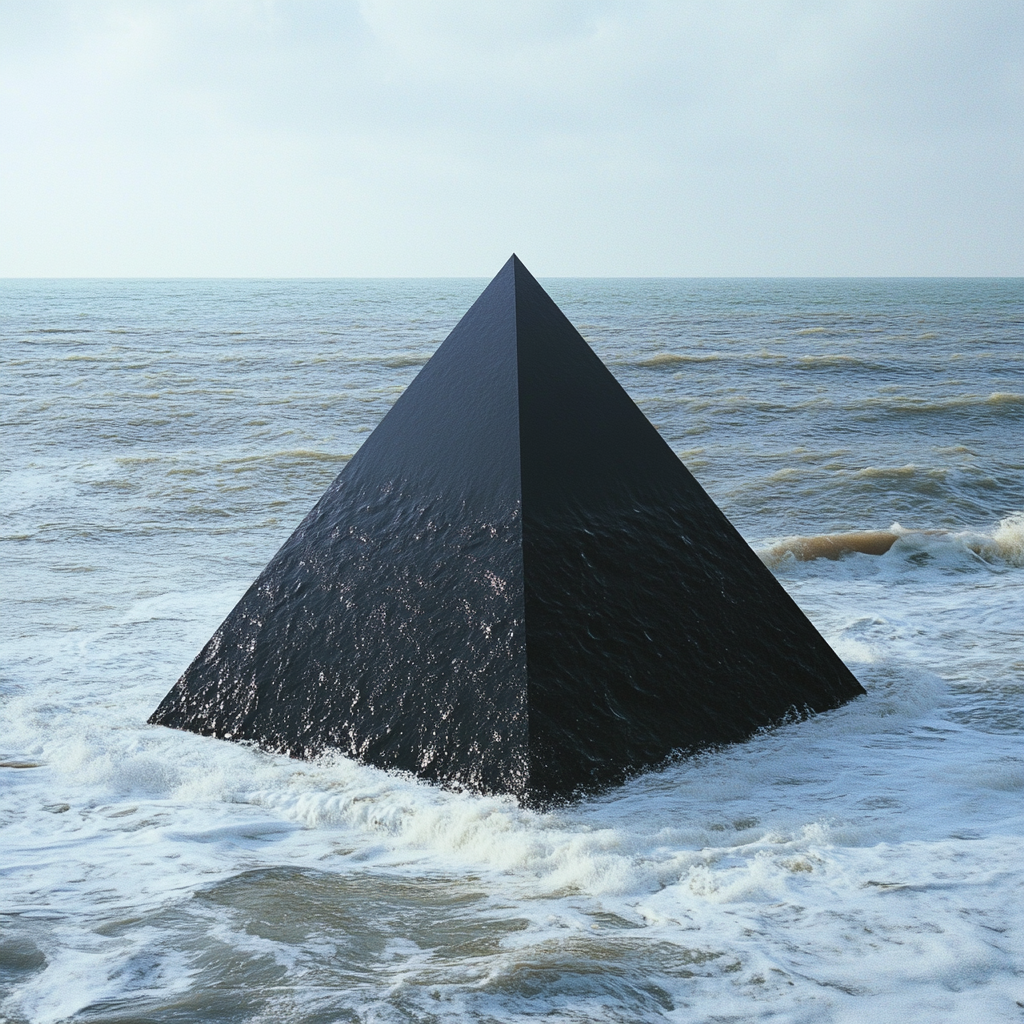
Theophilus Trotter dropped the apple core on his plate and lifted his glass to drink. The Indrani was shuddering as she churned eastward through the night. Cuba lay astern, and Gibraltar was almost two weeks hence, so for the moment, the ship was alone in the vastness of the Atlantic. The lantern vibrated and swayed above the table, and through the portal came the smells of saltwater and coal smoke and the cool ocean breeze. Trotter leaned forward and set his elbows on the table. As if he were divulging some sacred truth, he whispered, "What happened next, boys, I'll never forget. While all of us were watching and wondering what sort of thing it might be, that pyramid rose up out of the water. The sea was churning and boiling as it lifted, but when the thing cleared the waves, the ocean calmed, and it just floated in the air, not more than a few feet above the water, a black pyramid suspended above the waves, perfectly still and the water running off and dripping. Some of the men fell to their knees, and some took out knives. Then the craft dumped something from its base—a reddish slurry of fish guts and bones and such—and then it began to spin, faster and faster, until it was like a top, spinning so fast that it looked like a globe instead of a pyramid. Then, I swear on my mother's grave, boys, that spinning top began to fly upward"—and Trotter held out his fist and lifted it slowly to demonstrate the rising motion of the thing—"upward, but not quickly upward, no, gently and smoothly, like this, higher and higher, and then it came directly over our ship and cast a strange shadow on us, like we were in an eclipse, and the boy in the crow's nest started screaming and cowering in the basket because he was so damn near to it he could've reached up and touched it. There was no fire or steam or engine that I could see, just a wild spinning top and a low hum that went with it. Then it shot straight up until it was nothing more than a black dot against blue sky, and then . . . it vanished." With a sudden gesture, the captain opened his hand and let it drop to the table.
"We were looking up at the sky, wondering what it was we'd seen, and we thought the thing was gone, when from the stern we heard a wild thrashing in the water. We ran aft, and there the pyramid was again, spinning in the ocean and creating a great pinwheel that was turning into a whirlpool. I feared the ship would begin to run around the lip and slip into the vortex, but I knew no commands to free us from such an unworldly circumstance, so I stood and watched with the rest. As I say, in the middle of the funnel spun the pyramid, when the four sides opened like some kind of black flower with the petals peeling back, and God as my witness, in the middle of the flower sat a purple man on some kind of stool like a gyroscope because he wasn't spinning with his craft; he was perfectly still. He was opening and closing his hands, that's all, there was no wheel nor levers nor reins nor anything I could see, just his long fingers opening and closing, and he and I, we looked at one another, the captains of our ships, and he didn't smile nor sneer nor scowl or anything, his face like the Sphinx of Egypt. But me, I was terrified, I'll admit it, boys, I was frightened to m'bones.
"I was still leaning on gunwales and looking at the apparition when . . . I heard something in my head. I don't know how else to say it, but the voice was as clear as if one of you sitting at this table called my name. And the voice said, 'Bear witness to what you have seen today, Theophilus, for someday my comrades and I will emerge from the depths and reclaim the world you took from us in your hunger. We will bring you life not death, and peace not war, for we will teach you self-control. For by the time of our advent, you men will have so ruined your world that you will spew out gladly what you consumed so greedily. Return to your harbors, and tell the world what you have heard and seen. I will come again.'" And the craft sealed up once more and sank beneath the waves: The great funnel closed, the waters settled into a washing ripple; and the Hispaniola wallowed in the uneasy waves.
"And that's my story. Is it a story of hope? Or a story of despair? Did my crew and me suffer from some strange delusion? I don't know. I dare say, I'll never know. But now you, too, must tell others what I have seen and let them sort it out for themselves."