Chapter Twenty-Six: The Bone Tour
The Purple Knight Chronicles
Night Seven • First Mate Baxter
Alistair Baxter was born into a seafaring family on the coast of Maine, and from the age of fifteen, he spent his life on sailing ships and steamships, dinghies and dreadnoughts, canoes and catamarans. He had seen many ports and made love to many women; he had traversed the globe from pole to pole and around the equator, but the stories he told were born not from his adventures but from some deep interior darkness. He sat at the table and watched the other men and listened to their banter. Trotter was recalling wenches he had loved and abandoned, furious husbands from whom he had fled, and alluring nymphs who could not be satisfied but oh, the exquisite pleasure in trying! Then McQuary followed with tales of pretty girls half wild in the hills, ivory-skinned whimsies, some with ginger and some with honey hair, dream girls born of his own fetishes and obsessions. Theophilus Trotter pretended to listen to Mack while he remembered coquettes who pleasured him on stained beds in dingy rooms. And all the while, Baxter listened as he twisted the ends of a freshly rolled cigarette. The lantern over the table glowed vaguely in the tobacco smoke, rather like the moon behind thin clouds, and its light failed to illumine Baxter's riven, melancholy face. Captain Trotter had begun recounting his famous Consorts of Constantinople story, and Turner and Mack were laughing, when the Captain observed that Baxter was many leagues away in thought. The Captain broke off his story and asked, "Where's your head at, Baxter? You seem far away tonight." Trotter feared Baxter's occasional bouts of sadness, for he had once found Baxter's shoes on the top-rail. The Captain commanded a hasty search, which ended when one of the crew found Baxter asleep inside a coil of rope beside the fo'c'sle. When Trotter asked Baxter why he had left his shoes on the gunwale, Baxter shrugged and said, "I was looking back on all I left behind when my feet began to hurt. Nothing more, Captain. Nothing more." But Captain Trotter watched his friend closely after that.
That's why the Captain folded his hands on the table and said, "Tell us what's troubling you so."
Baxter stood, tipped the globe of the lantern away, and touched the tip of his cigarette to the flame. He sat down and blew a thin stream of smoke from his nostrils. The smoke swirled around the lantern. Then he began, "I'm troubled that the stink of man is everywhere: Descend into a cave as far as the gates of hell, and you'll find some poor bastard's bones; climb the highest peak and there in an ice floe will be bones with the meat still on them; hack your way into the deepest jungle, and you'll find bones scattered among the flowers. So many goddamned bones."
Theophilus said, "But such is our lot. Death awaits every man . . . and woman, too."
Baxter thought for a moment and said, "Finding human bones in some wild place is like being in a tavern halfway round the world and talking to a man who says he fucked your wife before you married her. Suddenly, you don't feel so special anymore. Suddenly, you're just another man in line waiting his turn. Or worse yet, you're a man who's paid a big price for something the other fellows got for free. It's the same with finding bones in a jungle: You look at them and say to yourself, 'I haven't been any place somebody hasn't been before.' Captain, I tell you there's no virginity left in this whole wide world." Baxter lifted his stein and drank, and when he set it down, he sighed. He began circling his finger around and around the rim of the stein. His sun-leathered cheeks relaxed and drooped, and the lines below the corners of his mouth filled with shadow; his eyes, always dark and remote, receded further into their sockets.
Theophilus Trotter cupped the mermaid's ivory breasts and took the meerschaum from his mouth. "Tell us your story, Mr., Baxter. Tell us about them bones."
Baxter snuffed the cigarette and said, "So I will."
BAXTER'S STORY
In the fall of '79, I shipped out from Eastport on the Courageous. The season doesn't really matter except that a story that happens in the fall always feels different from one that happens in the spring. Anyhow, it was November, and my pa was sick with a catarrh, but he seemed on the mend, or so I told myself, and shipped out anyway. The weather was crisp and fine with a steady westerly, so the voyage was easy. We docked in Cardiff to unload cotton and take on coal. We hadn't been there more than a couple days, and we were making ready to sail for Lisbon when a telegraph boy found me on the docks and delivered a message from my mother. All it said was, "Father dying." So, I gathered my truck and boarded a ship bound back to Maine. Of course, now we were tacking against the headwind and making a slow go of it, and I arrived home too late. I was walking to the house when my mother came out on the porch and said, "So, you come after all. You might as well've saved your trouble. Your pa's dead and buried. He passed into eternity with your name on his lips and whimpering like a child. Wasn't bad enough he died gasping for air, but he died heart broken, too. You were ever a cause of suffering to him. And to me, too, though that's never seemed to trouble you."
I told her, "I came as soon as I got your message. There was nothing else I could do."
And mother said, "That telegram cost me five dollars and forty cents." Then, she turned around and walked into the house. In my family, we were always cruel to one another with our words. Every cut was a point scored, and we each of us wanted to win.
'I didn't follow her inside but went to the graveyard to pay my respects. The dirt was still fresh, but there weren't no stone, just a plank set up with Dad's name. I thought about him calling my name while he was dying, but it was too much to bear, so I went to the Landmark and got as far down in the scuppers as I could. I don't remember a thing, but I must've wandered to the docks because I woke up froze halfway to death on a bale of cotton. I was having bad dreams, the sort that always come after a death. In one dream, Dad was reading by the fire, but when he looked up at me, he had no eyes, just skull sockets, and he said, "Hello, son. Glad you're home." Then I found myself outside and riding a monstrous black dog through a thick stand of timber and something was chasing me. I hung on to the hackles of that dog, afraid he might turn and tear me to pieces but even more afraid of whatever was chasing us.
I woke up and heard the waves crashing and a night bird keening, and God Almighty, I was thirsty. I drank long from a rain barrel, puked my guts, and fell asleep again. I was still drunk the next morning when a stevedore pokes me and says, "Up, boy, and get to work. No lollygaggers on this here dock!" Two days later I was aboard the Triumphant and bound for Gibraltar.
I got to be chums with the Steward—his name was Goodrich—and I told him about my pa dying, and how I missed his final breath, so he treated me to an extra draught now and again. He said I should keep my mouth shut about that. Once when I was down in my cups, the Steward says, "It's hard alright. I lost my father when I was not yet twenty, and that's when I took to the sea. I figured life on a boat was the only way to go for creatures who know they will die. Then a couple years later a mate took me on the bone tour, and now I know it doesn't matter where or how a man spends his time."
I asked the Steward, "What's the bone tour?"
"A bad trek even for a stout heart. But you learn once and for all what the truth is."
"Can you tell me what you learned?"
"No. You have to take the bone tour for yourself to find that out. As it happens, the Triumphant is taking the very route."
"Will you take me? I want to go."
"I reckon I could. But you ain't gonna like it."
I said, "I can handle it, Mr. Goodrich. Let's go."
Baxter took out his tobacco pouch, rolled another cigarette, and resumed his story.
You'll like the Mediterranean, McQuary. The Atlantic pounds the west coast of Gibraltar like every wave is possessed by Satan hisself, but the Mediterranean rolls to shore as gentle as a rocking cradle. We passed through the straits and harbored at the Old Port—it lies at the foot of the famous Rock—and me and the Steward set off.
I should tell you a little something about Goodrich so you can see him in your mind. There weren't nothing remarkable about the man himself—he wasn't tall or stout—but he had a big mustache and spectacles. I remember he had good teeth, too, very white and strong, something you don't find among sailors too much. He wore a derby most all the time, but otherwise he dressed like any common sailor: worsted pants and flannel shirt and boots that laced to his shins. He also wore an oilskin coat because, as I say, it was late November, and winter was coming on.
After we docked below the Rock, the Steward led me up the east coast a couple miles when he stopped and said, "We're here." We went into a small tavern set against the bottom of the bluff and had a lunch of bread and wine and a few olives. Then, he led me to the courtyard behind the inn and on through an iron gate and up a path, and maybe thirty yards away was the mouth of a cave. He reached into his satchel and took out two candles and a tin of matches. He handed me a candle, and without another word, in we went. We gave our eyes a minute to adjust and lit the candles. A few more steps, and the Steward says, "Over here." An "X" was carved into the stone.
We walked down and down, always down, and the passage kept getting tighter and lower, and we had to turn sideways between the walls while we held the candles over our heads. Then we went on our bellies, but we couldn't crawl and hold to the candles at the same time, so the Steward said we had to snuff them and slither along like snakes, but not to worry, he knew the way. Of course, it was black as the grave, and the ceiling of the tunnel scraped our backs, and the air smelled of dirt. The further we crawled, the more afraid I became until I felt a terror I never knew was possible, not even in the fury of a storm. Then suddenly the passage opened up, and we stood and breathed in cool air.
When we lit the candles, I saw we were in a chamber maybe twenty feet across. The flames weren't bright enough to see the roof of the cave, only the pointed ends of stone icicles that twinkled wet and shiny in the candlelight. The Steward pointed to the chamber wall and said, "Look."
About six feet up was a band of strange markings that ran around the wall of the chamber. Most of the markings were vertical lines hatched diagonal like tally marks on a tavern bill, but between the hatch marks were other signs: a handprint and a coil like the top of a conch shell and a circle with a cross in it. I walked to the wall and held up my candle to study the signs.
"What do they mean?"
The Steward said, "I don't know. I s'pose nobody knows. But somebody a long time ago carved them because they meant something to him."
"Why'd you bring me here?"
He said, "Look at the floor."
Half buried in the black clay and looking up at the ceiling was the face of an enormous skull. In all my travels, I have never seen a human head so big, and the brows above the eyes were thick as cuttlebone. The mouth was gaping, and around the skull, the dirt had been packed hard. I stood over the skull and saw black dirt in the mouth and eye sockets. A drop of tallow from my candle fell on the skull and spattered back to wax. The Steward said, "He was a big man, at least, my guess is he was a man. Who knows? He's been dead so long, nobody cares what he was or where his soul is."
"What do you mean?" I asked.
"Out of time, out of mind," said the Steward.
Well, gentlemen, that was but our first stop. After Gibraltar, we docked at the port of Ostia on the west coast of Italy, and the Steward led me inland, but not to the Eternal City. No, he took me to a deep valley flanked by cliffs and overgrown with oleanders and cedars and tangled vines, a lush wilderness to be so close to a great city. We kept pushing our way through the underbrush until we saw what looked like a tapestry of vines hanging over the cliff face. The Steward said, "Ah, here it is," and he parted the vines to reveal the broken doors of an ancient temple. We went in, and the room was empty except for a carved pedestal that stood in the center. At one time, it must've held some statue of a god or a hero, but it had been stolen long ago. The Steward led me to the back of the room, and I saw the temple had been built against the mouth of a cave. Down and down we walked until we stood in a chamber. We lit our candles, and I saw a band similar to the one before but here the images were of soldiers bearing swords and men in robes and lifting one finger as if they were speaking and men sitting on thrones with wreaths of leaves around their heads and women with greyhounds at their heels. In the center of the floor was a skull looking upward, but this skull was smaller than the one in Gibraltar. The Steward said, "Behold the skull of Aeneas, the greatest Roman hero. Virgil said that Jupiter had placed him among the stars, but Virgil lied, as you can see."
"How do you know whose skull it is?"
"Because the guide said so when I was here before."
"Well, how did he know?"
"You have to take some things on faith."
From Ostia the Triumphant sailed to Ithaca, island home of the great Odysseus, and the Steward and I rowed a dinghy into a blue-water cave. The water was liquid sapphire, and pretty girls were sitting on smooth stones, spinning blue wool and singing songs about heroes and faithless lovers and kings grown arrogant with power. The girls were naked, and their skin had become pale as alabaster in the gloom, but sunlight glowed in the blue water and cast rippling bands of blue light on their bodies and made the girls more beautiful. The Steward and I rowed past the girls and beached the craft on a bank of small polished stones. Then he led me into the cave, and we entered the left passageway. Down and down we walked until we entered the expected chamber. We lit our candles and held them above our heads so they shone on the cave wall. This time the images were the constellations of the zodiac. I saw the centaur Sagittarius with his bow drawn against Scorpio whose fearsome pincers were menacing Ares and supine Virgo who clutches her spike of wheat and Leo couchant in repose. Close to Leo was Cancer the Crab who gnaws at our guts and Pisces, twin fishes tails tied together and yielding the epoch to Aquarius the Water-bearer. After we circled the cave with our candles, we walked to the center point where a skull in the floor stared upward, and this skull was almost as large as the one in Gibraltar but not as thickly browed. The Steward said, "There lie the bones of Heracles. Homer said the man feasts on Olympus while his soul dwells in Hades, but Homer lied, as you can see."
From Ithaca we sailed to the ancient harbor of Piraeus. Again, the Steward led me inland and again we entered a cave. The images in the cave chamber showed a nighttime procession of robed people with torches and a girl picking dewy flowers in the morning and Hades rising from his dark throne to mount his chariot and an old man removing an ear of corn from an onyx box. In the floor was the skull half-buried and staring up at the ceiling; it was smaller than the one in Ostia, and the cheeks were ruddy with ocher. The Steward said, "Tell m'lady to come to this chamber and see the painted skull of Demeter. Aeschylus says she is an immortal goddess, but Aeschylus lied, as you can see."
From the great harbor of Athens, we sailed southwest to a cave not far from Antioch where the Steward showed me the skull of Marduk, and then on to Byblos where the skull of Osiris lies half-buried. These skulls, however, scarcely stirred my imagination. You see, I didn't know their stories. How could I grieve for Marduk whom I did not know? How could I mourn Osiris?
We never mourn the unknown dead.
The cave outside of Tyre was different.
By now the descent into darkness had become routine, as commonplace as buying figs and cheese in the market, and I felt nothing but a vague curiosity whose skull would lie buried in the dirt. We entered the familiar chamber, but this time, I recognized the images: Adam and Eve and the Serpent in the garden and an enormous, multi-storied tower falling to pieces, and a crowd of people crossing between walls of water and Moses coming down from the mountain with two tablets and his face glowing. In the center of the chamber lay the skull half-buried in the floor, still looking upward but missing its lower jaw. The Steward said, "There lie the bones of Enoch. Moses says he was taken up to heaven, but Moses lied, as you can see."
Mr. Baxter drank again from the stein and wiped his mouth. He took a long, last draw on his cigarette and crushed it on his plate. "The last cave was the saddest of all, and I never tell this story to any but those who can bear it. So I ask, can you bear it?"
Mack was leaning forward with his hands clasped on the table. He guessed what tale would follow, and while he thirsted to hear it, he feared the story Baxter might tell. Nevertheless, Mack said, "Yes, Mr. Baxter, tell the story. I want to hear it."
And Captain Trotter said, "Finish it, damn your soul."
First Mate Baxter looked at the cook and asked, "Doctor Turner?"
"Tell it."
"So be it," said Mr. Baxter.
When the Triumphant docked at the harbor of Sidon, the Steward and I rowed ashore. At the market, he hired two camels, and so we began our final journey over land. Sidon the city was green with fig trees and marble fountains, but our eastward journey took us into the desert. That night we strung up hammocks between palms in an oasis, and at sunrise we started riding again. The empty sands stretched around us, but as the day wore on, a hill of sand rose like a wave that washed ashore at a reddish bluff. The Steward knew the way, and we passed through a cleft. We came out on an overlook, and below us was a long valley with green patches of broom and senna and sedge. The Steward said, "There used to be a river that ran here, but now there's only a stream." The descent was so steep, the camels had to plant their feet to keep from sliding down the scree. Down and down we rode until we reached the valley floor. The trees were full of chattering birds, so many and so loud, I felt like I was dreaming. The birds flew in flashes of blue and red and yellow from tree to tree, and the air smelled of sage.
The Steward said, "We're here, Baxter," and pointed to the rock face. "Look."
In the face of the cliff, niches had been carved, and faceless statues worn smooth by blowing sand stood in every niche. Below the row of statues and flowing from the bottom of the cliff was a clear stream. We drew closer. The walls of the stream were so smooth, I fancied some ancient masons had carved the channel in the rock. The Steward said, "Here is our final destination, Baxter. The Greeks called it the Gates of Hell."
I said, "But it's beautiful here."
Ignoring me, the Steward continued, "We've come to Panias, the temple of Pan. The Greeks used to cut the throats of Hebrew girls and toss them naked into this spring. If the body floated back into the cave, Pan received it and was satisfied. But the body was carried away by the spring, he had rejected it. Fools! They thought they could satisfy the hunger of a god. But gods are never satisfied.
"Listen to me, Baxter: the gods don't exist; they are nothing, and that's why they cannot get their fill of blood. No amount of blood or flesh or virgin girls can make what's unreal real. It would be like trying to feed one of those statues. The food would dry and fall from their lips. You can't feed a statue, and you can't make a god real." He spoke as if he himself had tried.
He lightly kicked his camel's sides, and it stepped to the edge of the stream where it began sucking draughts of water. My camel followed, and it seemed the beasts would drink forever. Then the Steward said, "The mate who brought me here said, 'Herein lies the truth, Goodrich. Gods who don't exist bury heroes who never lived face up to see nothing. The same gods carve the pictures on the cave walls. We don't sin against the gods because they exist; the gods sin against us because they don't. They are containers for words, but they demand we call them beings of light, and we do it. They are fools and so are we. All fools!'"
As he spoke, the Steward sat atop his camel as comfortably as if he were sitting on a throne or lying in a hammock, and in that moment, I realized he was always at home wherever he happened to be. I have heard the saying "a man of the world" many times, but I never knew what it meant till then. The Steward had swallowed the truth and kept it down, and the truth had set him free.
He said, "Before the Greeks dedicated the stream to Pan, Baal was worshiped here. Baal preferred newborn babies to virgin girls, as if a vapor feeding on infants could become real! But Baal wasn't satisfied either. The gods are never slaked by blood, I tell you."
"What about—?"
"There are no 'what abouts'! When the day of Final Judgment comes, and the gods are drunk on human blood, they'll still cry out for more. That's why Hell goes on forever; Hell is the place where the shadows of gods feed on the ghosts of men."
I didn't know what to say, so we sat silently among the chattering, barking birds and the gurgling of the stream. The camels drinking side by side looked like parables of uncertain meaning.
The Steward had spoken with such certainty that I knew any questions would only annoy him. Soon, he dismounted and bade me do the same, so we waded up the channel to the headwaters that flowed from the cliff. He said, "Take off your clothes. We must enter the womb as naked as we came from it." So I took off my clothes, and only then did I realize how bad they stank. I rinsed them in the stream as best I could and laid them out to dry on a flat rock. I fancied that long ago, the rock had been an altar for sacrificing girls and babies, but I may have been wrong. Our speculations are usually wrong.
"Follow me, " said the Steward. He stepped into the spring, took a deep breath, and submerged himself completely in the cool water. I watched as his legs disappeared under the bluff. There was nothing I could do now but follow, so I breathed deeply, dipped down into the water, and swam into the cave. At first the water was translucent, but the further back we swam, the darker it became. At the moment I thought my lungs would explode, I felt the ceiling of the cave open above me, and I came up gasping for air in a chamber. The Steward, of course, was waiting for me. "Come on," he said.
"I can't see you."
"Follow my voice."
I heard him sloshing onto a beach, and then he spoke my name until I found his hand in the dark. We began our customary walk down and down and down. The further we descended, the more a faint, reddish light illuminated the cave walls and floor. Brighter and brighter, redder and redder, I was beginning to see little bats that clung to the roof, stone straws that dripped water, the rough walls of the passageway, and the worn-smooth stones of the floor.
At last, we ducked and entered a chamber some twenty feet across, and about six feet up and around the circumference of the room ran a band of images: a baby nursing at his mother's breast while angels sang in the night and a man feeding a crowd from a small basket and the same man walking on the water of a lake and then standing before a grave from which a bound figure emerged, and next the man was being nailed to the beam of a cross but then he was emerging from a cave with his arms raised in triumph, and in the final scene—or was it the first?—he ascended into the sky while astonished faces gazed upward. I could see all the images by the red light, but I couldn't determine the source of the light.
Where was the fire?
Then the Steward pointed to the floor of the cave and said, "Behold the bones of Jesus."
And there in the center of the room was a half-buried infant skull facing upwards.
"But that can't be Jesus," I told the Steward. "He was crucified as a man. Just look at the images on the wall."
The Steward stood smiling, and in the red light, he looked like a malevolent dwarf, a stunted, derby-wearing, nearsighted demon with a ridiculous mustache.
"That's the story you were told. But the Scriptures lied. The truth is that Joseph, one of Mary's lovers, came in drunk one night and the baby was screaming—maybe he had the colic or was hungry, who knows?—and Joseph picked up the wee babe from the crib and yelled, "Shut up, won't you? Shut up?" and he shook the infant hard and like that—" the old Steward snapped his fingers "—baby Jesus was dead."

"Poor Mary had been trying to comfort her baby all night. She had given him her breast and cooed soft words, and she had only put him down for a minute, just a minute, when Joseph came in and killed Jesus. Mary screamed at Joseph, 'What have you done to my baby? What have you done?' and she took the limp body from Joseph's hands and fell to weeping. But Joseph acted the tough man and said, 'Enough of you! He wasn't my son, so who cares? You're just a whore anyhow!' Joseph spat on the floor and left for Egypt where he became a wealthy merchant.
"Mary, though, went mad with grief. She baked a loaf of bread and wrapped it in a perfectly white cloth and held it to her breast to nurse it. She said, "My little loaf of bread," and rocked it and wept.
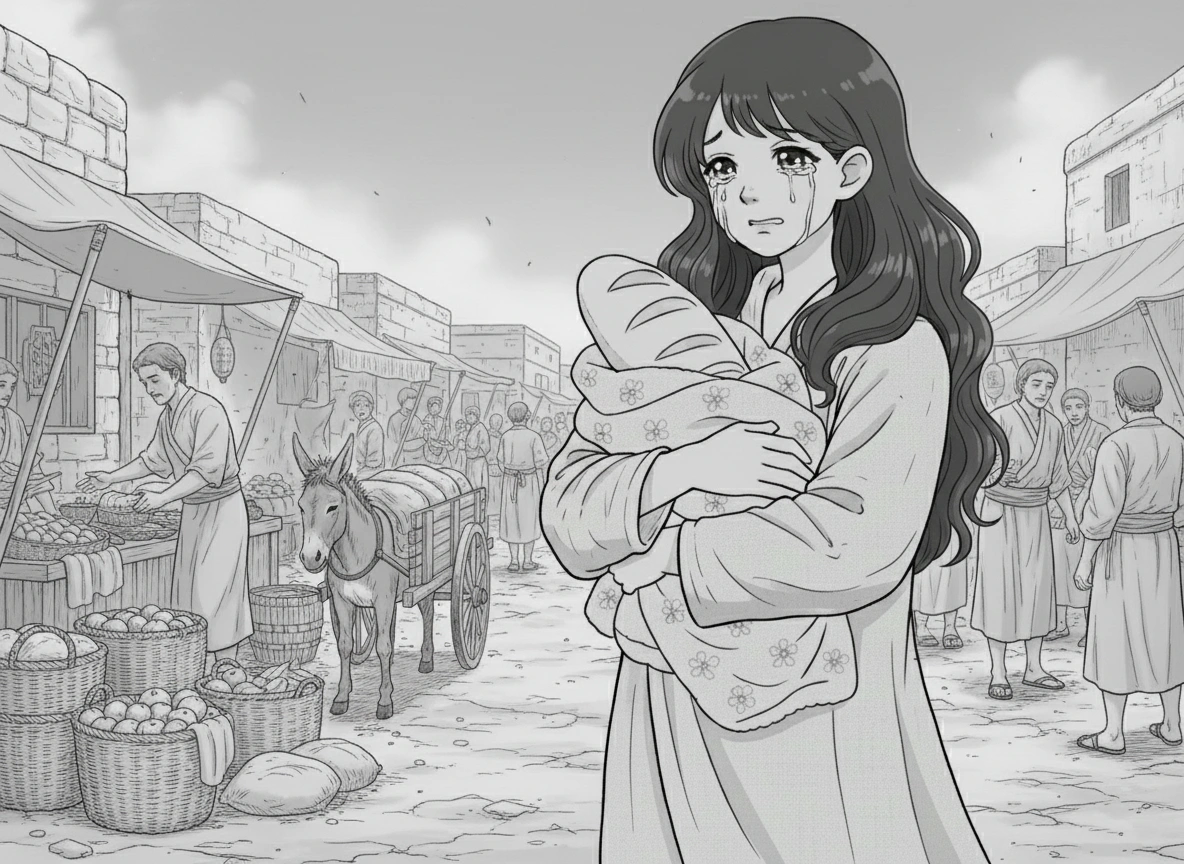
"And then Mary made up stories about all the wonderful things her son had done. He made sparrows of clay that came to life when he breathed upon them. He taught the wise men in the temple the meaning of the Scriptures. He healed the sick and fed the hungry and told the rich people they could not enter the kingdom of God unless they began taking care of the poor people. In Mary's stories, Jesus became the good boy who would calm the wrath of his angry father.
"In her madness, she saw the face of the angry father everywhere. In the Roman legions who crucified Jews by the thousands and then destroyed their temple. In the teachers of the law who told her she was unclean, a filthy whore who had borne a son, and that's why it was right and just for her baby to die. In the merchants in caravans who used her and threw a few coins on the floor and laughed as they were leaving. In the farmers with sullen faces who came to her after the harvest. So it was that she saw the faces of cruel men as the face of God Himself.
"She went into the marketplace and told her stories to anyone who would listen. Some of the people made fun of Mary and mocked her. They would pluck a mouthful of bread from the loaf she carried and say, 'See, Mary, the flesh of your son!' and laugh. But some of them pitied her because even though she was a whore, a man had killed her baby, and even a sinful woman shouldn't suffer such a loss.
"Most people ignored her.
"One day a couple of Greek Platonists were passing through Nazareth, and when they heard Mary's stories about Jesus, they listened and wrote the stories down. In the mad woman's tales, they discerned a deeper truth. Besides, the Greek gods were passing away—the Platonists were traveling to Alexandria to search for new gods—and the Greeks, like all people, had to believe in something."
Then the Steward said to me, "And now you know the truth, Baxter, because I brought you here, to the Gates of Hell, and you will never mourn or grieve again because you are free from all illusions. To speak truly, history would end if we but once felt compassion for the grieving mothers. But that's precisely what humanity will never do, so we keep killing the children: brown children, hungry children, innocent children, the children who steal food to feed their infant siblings. We kill the children of Jerusalem and the Americas and the Sudan and Gaza."
The cave was stifling hot and the walls were bathed in red, and the Steward stood naked and smiling above the skull of an infant in the dirt. And in that moment, gentlemen, I felt every hope and pleasure turn to ash, even the freedom of the sea failed me, and I became numb. For that's when I learned there is no breaking free from this existence.
Baxter sighed.
"Well, the bone tour was over, so I turned and made my way up the tunnel and dove back into the water and swam out from under the cliff into the empty sunshine. I lay on the flat rock and let the sun dry me, and then I put my clothes back on. I waited and waited for the Steward, but he never came out of the cave. When the sun began to set, I said to no one, 'Guess he's not coming. Let's go.' I was able to coax the camel to kneel down, and I climbed onto its back. Two days later I arrived in Sidon to find the Triumphant being loaded with incense and silks and the distillate of poppies. I thought it strange that the Captain never asked where I'd been or where the Steward was. I never saw the Steward again."
Baxter drained the stein and looked from Mack to Trotter to Turner. "That's a true story," he said. "Make of it what you will."
"I make of it that it's horrible!" growled Mack. "I don't believe any of it! I don't believe you ever went on a 'bone tour' or that Mary was a prostitute who made up stories about her dead baby. I don't believe you!"
Baxter leaned forward with his elbows on the table, and the lantern cast shadows over his eyes. "Oh, yes, you do, McQuary," he whispered in a vicious voice. "When you donned your purple outfit and made up your cockamamie story about a girl in Arkansas and went parading about like you're something special, you started down the same path to the Gates of Hell that I did. The sea has long been called the Devil's Highway, but you saddled up to ride that road back in the hills."
"How do you know I'm lying about the girl in Arkansas?" Mack's face twisted in anger.
"Because you can't fool me! I've looked into hell itself, and I cannot be deceived. You are a liar and a fraud, and the only reason you weren't whipped with a cat-o'-nine tails and clapped in irons is because somebody back home paid your ticket. There's always been someone to pay your ticket!"
In an agony of self-awareness, Mack looked at Theophilus Trotter and Doc Turner and said, "Are you my friends?" But Mack had fallen into a bad dream, so the men ignored him and rose from the table. Baxter also stood, and Mack cried out, "Wait! Don't go! I'm beginning to see something! Let me tell you—" But he had to grip the edge of the table, for it had begun to spin slowly, not like a dreidel but like a ship at the outer lip of an enormous maelstrom, a jade-green whirlpool that wheels about slowly at the periphery, and then whirls faster and faster until everything spins and plunges into darkness and chaos. Mack and the empty chairs and the table were spinning, and his fingers hurt from gripping, when to his terror, the nightmare became an hallucination. Where Baxter had been sitting was a malevolent dwarf with an enormous mustache and spectacles; he wore a derby, and the man was scribbling madly in a small notebook. Otis Bulfinch looked up at Mack with contemptuous eyes and began writing again. Where Doctor Turner had been sitting floated a smiling boy, bald as a gourd and gowned in a yellow nightshirt. The boy said, "Hey, Bullshit, I toldja we'd fix him, and we did it! Look at him! He don't believe in nothing no more! Good work, Bullshit, old buoy! Good work, I say!" But Otis Bulfinch kept writing in his book and said nothing. No one can say for sure what a silent man is thinking.
And, finally, in the padded chair of Captain Trotter sat his old friend and agent, M.S. Glenn. His choleric nose was pulsating from rum and rage and the petty frustrations of living with foolish lies. In that moment, Mack pitied Glenn, for he saw that his partner had long struggled with the illusion that he might somehow escape life's tedium to become somebody, a great man, a man heavy with presence and purpose. For the first time, Mack understood that Glenn imagined him, that is, Mack, to be his best hope for escaping the quotidia of daily bread and pinched pennies and trivial deals in a small town, so Glenn promoted young Mack McQuary and his crazy quest and in so doing, promoted himself through delusion and fraud, which elevated him, that is, Glenn, even higher because he was the impresario who presided over the performance, the papers, and the readers: Glenn was the Eye on the Pyramid who directed the whole kit'n'kaboodle and so fancied himself to be larger than life. The Purple Knight and his Quest were his portal out of a rural world devoid of color and girls and a passageway out of the cave of old age. In some mysterious way, the compatible souls of McQuary and Glenn had mingled, like two vines grown from a single root or the two hemispheres of a brain encased in a single skull.
The table was spinning faster now, and Mack saw himself returning to Mountain Grove and telling Glenn that circling the globe is no different from turning the wheel of a Prouty. "All motion is circular; no one escapes," Mack would tell him. "Around and around we go until a centrifugal fling of wild trajectory sends us into another orbit of meaningless circling and so on until we ride a black horse onto an empty stage."
And Glenn said, "That's all well and good, but what about the book you promised to write? Any progress on that?"