Chapter Thirty-Five: The Return of the Prodigal
November 7, 1898 — Lebanon, Missouri
The windows were open and permitting a cool breeze as the clock on the mantle chimed twelve. Mack was sitting on a familiar settee in an unfamiliar parlor, furious at the trick his father and mother had played on him. He was jouncing his knee up and down and clenching and unclenching his jaw when he said, “The least you could have done is wait until I got home before you moved. I felt like a fool when I rode into Neosho, and complete strangers were living in our house.”
His father broke in, “So, this is our fault? Did you ever think about calling us to let us know when you’d be home? Or, oh, I don’t know, sending a telegraph? Or even posting a letter? Besides, how were we supposed to let you know we were moving when we didn’t know where you were? We did the best we could and left our new address with the Smitty’s. That seems to have worked well enough because you’re here.”
“I just feel like the butt of a bad joke.”
Mack’s mother snapped, “You feel like a bad joke? How do you think we feel? When we lived in Neosho, people were always asking about you and your ‘quest’ and ‘the girl in Arkansas’ and where you were till it nearly drove us mad! Why do you think we moved here anyhow?” Mack remained silent, so she answered her own question, “We did it because of you, because of you and your lies!
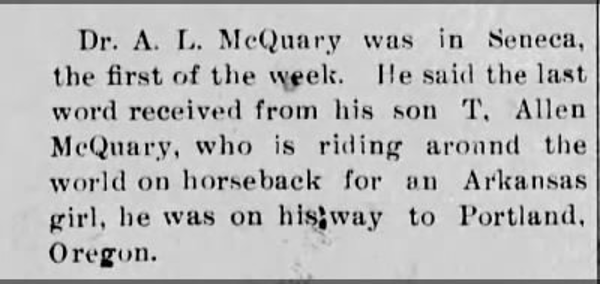
“How do you think your father, a minister of the Gospel, felt, lying for you for months on end? Not a has day passed without some reporter coming by to ask us questions. And then yesterday one of them came here looking for you! We can’t get away from them!”
“Which paper? Did he say?”
“The Springfield Leader.”
“What was his name?”
Alice said, “Bulfinch, I think. I didn’t write it down.”
“Did he say he was coming back?”
“Yes.”
“When?”
“He didn’t say.”
“Christ!”
A.L. pointed at Mack with a condemnatory forefinger and said, “You watch your language, young man! You may have seen the world, but that does not give you license to blaspheme in your mother’s presence.”
But Alice said in a mournful voice. “Allen, you cannot imagine how your shenanigans have disrupted our lives. Our friends keep hounding us; we live with the constant possibility of being discovered; and worst of all, for eighteen months we lived with the fear that you might have been hurt or worse. We never heard from you, not a single word, until you arrived in Astoria. Aren’t there telegraph offices elsewhere in the world?”
“Telegraphs are expensive, Mother.”
“Oh, they’re expensive? We were worried sick, and you were worried about spending an extra two bits.
“It costs a lot more than two bits to send an international telegram.”
“And you have the gall to accuse us of abandoning you! You used to be our pride and joy, but now—”
Mack had never seen his mother this angry, and it scared him a little, so he changed his tone. “Mother, I didn’t know which way I was going or when I would get home. How could I tell you where I was when I still didn’t know where I’d be the next day?”
“We only wanted to know if you were alive!”
“Didn’t you read the papers? I was in all the papers.”
A.L. stood up and swept off his spectacles. “Listen, Allen! Your mother and I are sick to death of papers! And we’re sick to death of your schemes! Before you left, you told us it was all a joke. That no one would really believe it. Well, you were wrong. People did believe it, and they still do. What are we supposed to tell them? This is not just about you and your life. This is about us, too. You’ve put all our reputations on the line!”
“Did you see my scrapbook? Isn’t that proof enough that I’ve been around the world?”
“Of course, we’ve seen your scrapbook! How could we not with you pushing it under our noses all the time? So you circled the globe on a tramp steamer. Good for you! The question for us is not whether you did it, but the reason you gave for doing it!” A.L. leaned forward and thumped his forefinger down on the coffee table. “Why do you think anybody will ever trust you again after they learn the truth about your ‘bride in Arkansas’? And how am I supposed to preach on Sunday mornings when the people in my congregation discover my son is a liar and a rascal? How long do you think it will take them to figure out that your mother and I were hiding the truth to protect you? Because the truth will out! It always does. Only a fool thinks he can hide the truth forever.”
Mack’s cheeks flushed, and he leaned forward. “I made my bed, and I’ll lie in it! Figure out for yourself what you’ll say! You are not my problem!”
Mack stood and turned to leave, but his father said, “Don’t you turn your back on us!” Mack paused, and A.L. said, “You heard me. We’re not finished here.”
Mack sat on the settee and with exaggerated patience said, “If the truth comes out—and I don’t believe it’s as inevitable as you say—just act as surprised. That’s what I would do!”
His mother interrupted, “We know that’s what you would do! You don’t have any problem acting. We know that!”
Mack clasped his hands in his lap and lifted his thumbs. “I guess you could tell people you tried to talk me out of it, but it didn’t work—which is true—so you decided to wash your hands of the whole thing—which is not true. Because for whatever reason, the truth is, you played along with the whole thing.”
A.L. shouted, “What were we supposed to do? We’re not the kind of parents who would call the local newspaper and tell them our son is a liar!”
Mack smiled. “And there’s your problem, Father! They say the apple doesn’t fall far from…”
Mack’s mother rose to her feet, and the tears in her eyes made them glisten with rage. “I’ve had enough from you! Don’t you twist our love for you into an excuse for your lies! I’ll tell you what we’ll do: Nothing. When a reporter asks for a statement, we won’t oblige him. When someone in town asks about you, we’ll tell them we don’t know where you are. And we won’t know because you’re leaving Lebanon tomorrow morning. If we’re called to testify, we’ll plead the Fifth Amendment. We won’t say a damned thing! And I’m not apologizing for my language either, A.L.! I’m sick of acting like we’re so all-fired pure and perfect.”
A.L. put his glasses on and took his wife’s hand. “Now, Alice, we have to act that way. People expect more from all of us” (this said with a quick, fierce glance at Mack) “and we have to act our part, not for ourselves but for our church family.”
Alice said, “They expect too much.”
“Perhaps, but that’s the way it is. For their sake, we have to appear to be good, so they can believe they can be good, too. People have to believe in something.”
Mack looked at his father in disbelief. “Wait. How is what you’re saying any different from what I’ve said and done for the last eighteen months? Why is your pretense any better or moral than mine?”
Alice arose and said in a fierce whisper, “I’ve heard enough from both of you!” To Mack she said, “You will stay in your room for the rest of the day and talk to no one. Then, tomorrow you’ll leave, I don’t care where you go. Go to your friend in Mountain Grove—what’s his name?—Glenn—and laugh about how you’ve made fools of everyone. Write a book together and fill it with lies. Sell it for ten dollars a copy; I don’t care. Just go. And then after a few months, if things have settled down and people have forgotten your stunt, you can come home, and we’ll figure out what to do next.”
When Alice finished speaking, Mack walked to the window where he looked out on a corridor of maples still flaming crimson and orange. He said, “I thought it would be fun. It was fun. I saw things I never thought I would see in my lifetime. I sailed around the world, just like the heroes in Verne and Twain and Stevenson. Wasn’t that a good enough reason make up a story—a story people love, by the way?” Mack turned to face his parents. “It’s true. People love my story. I’ve seen them break down in tears when I tell it.”
His father pursed his lips and stood by his wife. “Your mother is right. Go to your room, pack your things, get some sleep, and leave in the morning. We’ll patch things up some day.”
“This is some fine homecoming!” Mack whined. “I’ve been around the world, and you’re turning me out like I’m some kind of tramp who’s not even your son.”
Alice said, “I’ll fix breakfast before you go. Your father will give you some money. You can ride wherever your whim takes you. In the meantime, if anyone happens to ask for you, we’ll say you’re not feeling well.”
“Say whatever you have to, Mother. As long as you believe it, it’s the truth, right?”
“Whatever you say.”
Alice went into the kitchen, and A.L. followed her. Mack could hear them mumbling as he went upstairs to the unfamiliar room they said designated as his. He lay on the bed with his fingers laced behind his head and stared at the ceiling. Soon he was asleep and sailing aboard the Kinghu Mari: Her bow was splitting the waves, and the spray stung his face. He said aloud to no one, “I will never be free again.”