The year was 1996, and I was in the fourth grade when Dad lost his job working for the City of Springfield. I still don't know exactly why he was fired, but one night I overheard Mama say to him, "Well, at least you didn't go to jail." That's never a good thing to hear about your beloved father. We struggled along for a while in Springfield, but he finally landed a job at the Tucson Foods, Inc., poultry plant in Noel, Missouri. I don't know what he did there, but he kept his job this time, so he must have behaved himself. When Dad came home from work, he trailed in the smell of raw chicken and chemicals. When we lived in Springfield, I would run up and give him a kiss, but not here, not in Noel. The smell made me gag. In fact, the odor of raw chicken and chemicals possessed the whole town, especially in August, when it settled on the streets with a stench like rotting dog and vinegar and milk clotted in the sink. Only the flies loved the Noel Funk, and you couldn't eat a cheeseburger at the Bluffside Café without swallowing a couple of flies.
Noel, Missouri, has (or had) three claims to fame. The first is the name: Noel. Back in the depression, the postmaster came up with the idea of promoting Noel as a Christmas town. He talked the city council into sending a 300 pound fruitcake to a lady named Kate Smith, who was a popular singer in those days, and somehow that worked. Pretty soon, letters poured into town from kids wanting toys from Santa Claus, and a Christmas committee was formed to answer each one. It wasn't long before tourists followed the letters, and in the first decades of the 20th century, Noel was a beautiful, happy, prosperous little town in southwest Missouri.
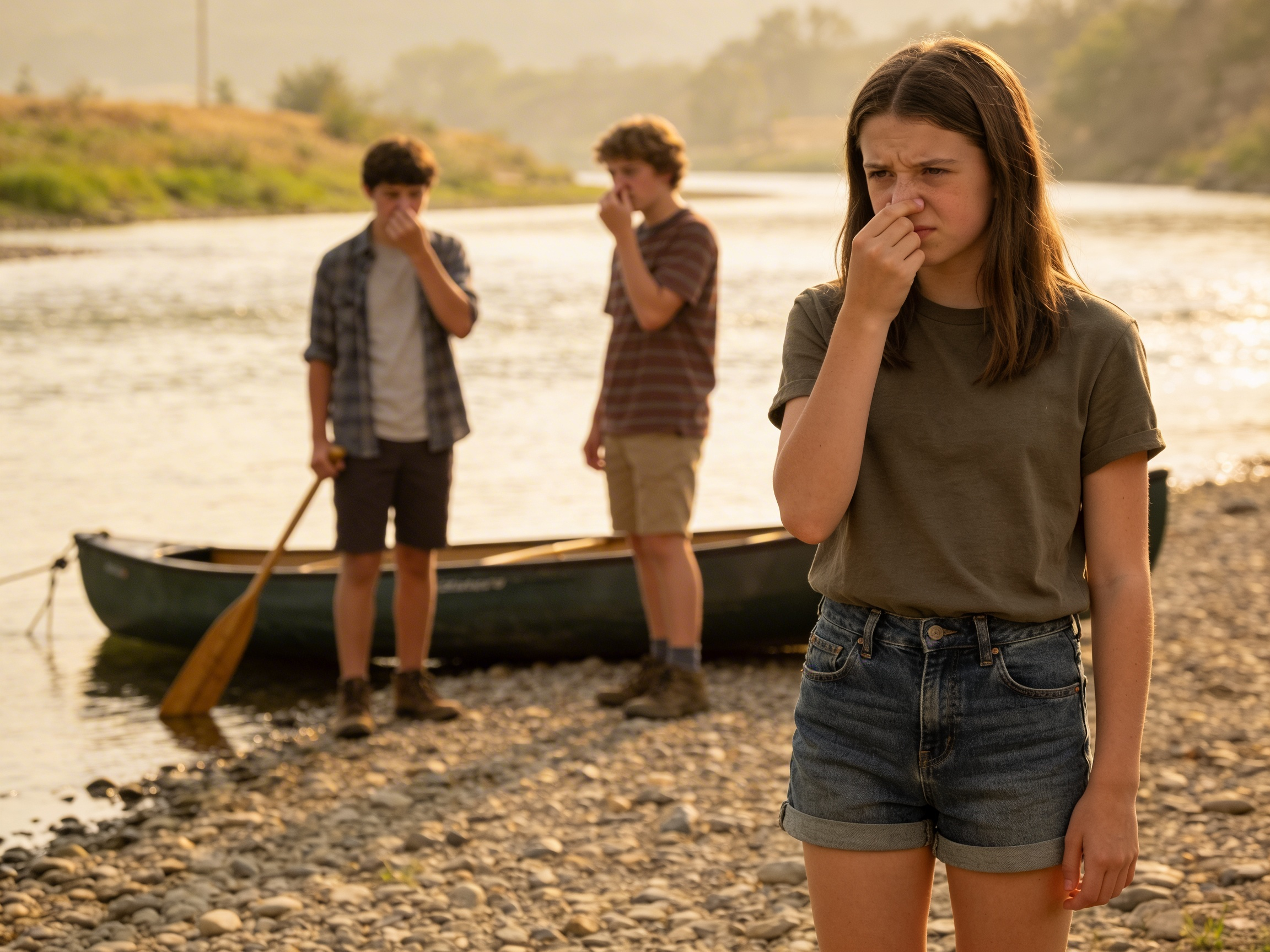
Our second claim to fame is the Elk River. Back when Noel was beautiful, happy, and prosperous, tourists would rent canoes—no one had heard of a kayak in those days—and float the clear, blue-green waters of the Elk from Ginger Blue to Noel. Even in the late 90's, I'd go down to the river and watch the canoes rasping onto the gravel bar and the beautiful young people climbing out, laughing and slapping water on one another with their paddles, that is, until they got a big whiff of the Noel Funk. Then, they held their noses and said, "My God! What's that smell?" Inevitably, a couple of dead fish and an oil slick would float by, and the kids wouldn't be laughing too much after that. Sometimes, the beautiful people would go to the Bluffside and eat flies, but for the most part, they just wanted to get out of town.
I guess the third claim to fame is the poultry plant, which, of course, was responsible for the bleaker aspects of Noel mentioned above. Trucks loaded with despondent chickens, beakless and bloated from hormones with their heads sticking between the bars of their tiny cells, backed up to the loading docks where Somalis and Mexicans unloaded the crates for other men inside to process. I never stepped foot in the plant, so I can't describe to you what happened in there, which is probably for the best or you might never eat another piece of chicken. I heard enough about it from Dad to become vegetarian. I thought, if that's how they process chickens, then processing beef is probably even worse. I'm not morally opposed to eating meat—I believe humans evolved as carnivores—but it's the mistreatment, the brutality of the whole system that nauseates me.
Well, that and the smell.
About the Somalis and Mexicans: I know it's not "politically correct" to describe people by their physical characteristics, and I understand why, given America's history of discrimination; nevertheless, some physical traits do apply. For example, most of the Somalis were tall and thin, and they kept entirely to themselves. The Mexicans were, by and large, shorter, thicker, and tended to be more sociable, though I never had close Hispanic friends. I did take Spanish in high school, so I could carry on simple conversations, but that was about it. Then there were the white men like my dad who ran the poultry plant and seemed to be a combination of the two, physically speaking: They were tall with thick torsos and managed the workers by yelling and gesturing at them. I would like to say that these three groups got along, but it just wasn't so. They slung the age-old epithets of "lazy" and "stupid" and "arrogant" at one another, and a deep suspicion separated them into sullen camps.
But that was nothing compared to what happen next.