After Violet left me for a fellow she thought was rich but turned out to be as broke as I was (with the added inconvenience of being fifty years older than me), I fell into a deep hole. Violet's brother said I had to move out of the apartment over his garage, and I remonstrated, “But, Parker, she left me. Why should I have to move out?” He said, “Because you’re six months behind on your rent, and the only reason I didn’t kick you out before now is because of Violet.” That made sense, so I packed what little I had in a cardboard box and left. Life can be damned hard.
That night, the priest at St. Elizabeth’s let me sleep on a pew, and before I turned in, I rummaged through a closet in a room labelled “Sacristy”. I found a green robe on the floor, a busted-up easel, a music stand, and a roll of cream-colored wrapping paper. Hmm, I thought, opportunity knocks but once. So, I wrapped the easel and the stand and the roll of paper in the robe as best I could and stuck the whole thing under my pew. That night I slept the rest of the righteous and buggered off early the next morning with the bundle under my arm.
I was walking down Spring Street when I saw one of the downtown stores was being remodeled. In the street was a dumpster full of pieces of dry wall and empty plaster tubs, but also some half-empty paint cans. Nobody was around—still too early for work—so I scavenged a few cans of paint: orange and yellow and red and green. A plan was taking shape in my mind. I poked around behind the store and found a piece of plywood leaning against the bluff, and that’s where I stashed my church stuff and the paint cans. Then I started down Spring Street again. I saw through a window that one of the hotels had a coffee urn and some sweet rolls set out for their guests, so I darted in to borrow breakfast and slipped back out.
To tell the truth, there’s nothing much worse than being broke. It’s like you’re at the bottom of a cistern looking way up to the light. And leaning over the edge of that cistern and looking down are faces, and the faces are saying things like, “It’s your own fault—you don’t want to work,” and someone else says, “The Gospel says we should help that man, but I think it’d just make things worse for him—God helps them who help themselves,” and a man with a bowtie says, “Education is the answer.” But when you’re at the bottom of the pit, you just want something to eat that’s not stolen from a buffet or retrieved from a trashcan and some place to sleep that doesn’t have rocks. They say “Necessity is the mother of invention”; I say that necessity is a mother all right.
I brushed the crumbs off my lap and watched the sparrows hop up, snatch a crumb, and fly off. I thought, His eye may be on the sparrows, but ain't nobody looking at me. I am invisible to everybody but the cops. Anyhow, I started down Spring Street again and was passing an art gallery, when I saw a lady flipping over the CLOSED sign to OPEN. I greeted her, and we started a chitchat, and I told her I was looking for a place to display my art, and does she know of any galleries in the vicinity?
“What do you do?” she asked.
And I said, “I concentrate on the pure potentiality inherent in a poly-dimensional universe.” She tilted her head as if interested, so I went on. “Just as the potential for consciousness precedes the full flowering of consciousness, so does ‘form’ pre-exist ‘formation’ as pure potentiality. The work of the artist is that of practical husbandry: ‘Pre-form’ blossoms outwardly into the ‘In-formed and Embosomed, Unbounded yet Delimited.’ Everything pre-exists itself, necessarily but not sufficiently, so the artist must project backward in time to fertilize the pre-conscious womb in perfect freedom—” You get the picture. I learned to talk like that when I audited an art class at the community college in Fort Smith. It’s like speaking in tongues: easy once you get the hang of it.
She gobbled that gibberish up like a piggy at the trough and invited me into her shop where we talked some more. I pretended to be interested in what she had to say, and she gave me more coffee. Then she wrote her address on a piece of paper and invited me to her place for dinner. That night we had lasagna and Caesar salad and French bread, and we had some wine, and there were candles on the table. She was a nice lady. She asked if I needed a studio, and I said, “No, the world is my studio,” which also seemed to impress her. I thought about finagling a little affection, but she was pushing fifty, and pushing it darned hard (ergo, the candles). Besides, I was pretty much worn out from my string of romantic failures and the travail of penury, so I wanly smiled and told her, “The universe o’erwhelms me, and I fain would lie down.”
“Would you like to stay here? After a bath, of course,” she said, which sounded way too much like a seduction, but I did in fact need a place to sleep, so I had to come up with something quickly.
I spread my arms in a cosmic gesture and said, “The karma, the Asha, the feng shui of your abode is like unto a maternal embrace, and, yes, to sleep, perchance to dream, is a consummation devoutly to be wished.” Then I took her hands and gazed into her yellow sclera. “Alas, sweet lady, aestheticism and asceticism are like two bosoms, and as Freud long ago postulated, the repression, uh, of one bosom leads to the eruption of another. Bosom.”
She studied me with suspicion after that disaster of an analogy and finally said, “You can sleep on the couch.”
Morning. Raisin Bran and coffee and a piece of toast with butter and grape jelly. I asked her, “Do you have any masking tape?” She said, yes, and gave me a roll. Then I was off.
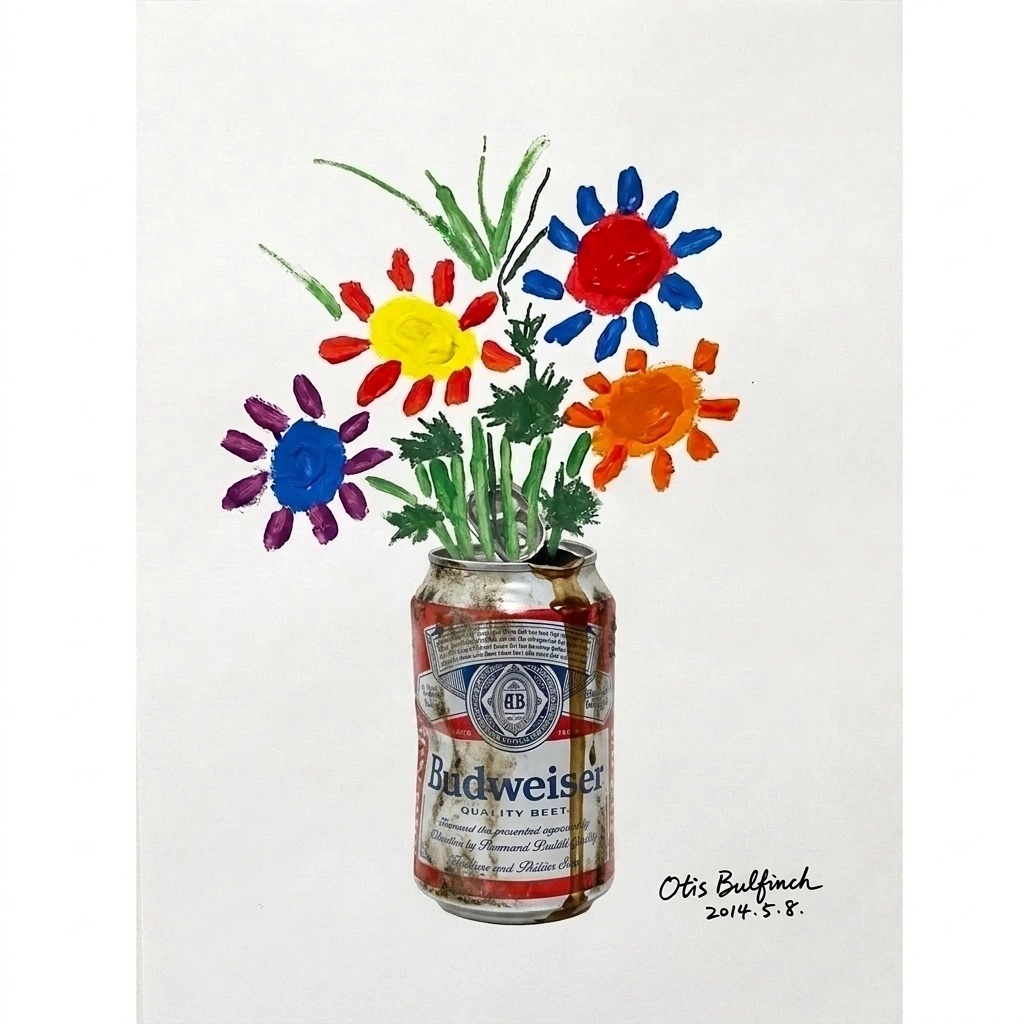
I gathered my bundle from under the plywood and made my way to Basin Spring Park. This is what I did: First, I set up the easel because nothing says you’re an artist like an easel. I positioned the music stand next to the easel and turned the tray until it was flat like a little table with a lip, and then I donned the choir robe. I started looking around for a vase and found a beer can someone had used as a spittoon. (If you’re not from the Ozarks, you might not know that a principal sign of gentility is a tobacco-spit can. If the spitter is in the woods, it makes no difference if he or she spits on the ground. However, if the spitter is sitting in a park in the middle of town, it does. A person who spits a brown puddle between his or her feet has no sense of decorum inasmuch as he or she creates a potential hazard for small children, dogs, and the elderly.) I emptied the can of its viscous liquid, picked a nearby flower, stuck the flower in the can, and set them on the music stand. Then I laid out a long piece of paper on the ground in front of the easel. After I pried off the lids, I set the paint cans at the top of the paper. I put the lids by their respective cans and dribbled a pool of paint on each lid. I imagined my preparations as analogous to setting an artistic altar. Then I went into full-bore mystic artist mode. I began pacing around the flower and the beer can, staring, drawing back, leaning in, kneeling, tiptoeing, and pacing again. I exclaimed, “Achtung!” and I sighed, “Meine Leibe!” I flourished my robe. I knelt before the paint cans and touched my head to the ground. And then I began to paint.
What I did was to pat my hand flat in the paint and then stick my hand on the paper. My outstretched fingers became the petals and where my palm hit became the center of the flower. Seems like I remember doing something like this in kindergarten. After I made the petals all around, I dipped my thumb and fingers in the paint can and proceed to daub a different color in the center of the flower. Then with my forefinger, I painted weird crap around the flowers: symbols, paisleys, faces, what-have-you. It didn’t take long for a crowd to gather, if for no other reason than to see a grown man in priestly garb dabbling his hands in paint.
It took me about ten minutes to paint my first masterpiece, and I was more or less able to attach it to the easel. Of course, the corners kept curling down, and I realized I would need some kind of board to mount the pictures on. I hadn’t thought of that yet. But the main thing is, I had launched my artistic career. Sometimes the petals were yellow and the center red, sometimes green and orange—it didn’t matter. Once I dipped my hair into blue paint and used the top of my head to smear a sky on the paper. That’s the closest I ever came to using an actual brush, and the crowd loved it. I didn’t sell any pictures—I priced them a thousand dollars and up—but if I put a cigar box on the pavement, people would throw in a couple bucks. Once a Chinese businessman and an Arab oilman got in a bidding war, and the price went up to a hundred thousand dollars—a sum that would have permitted me to retire in rural splendor. But they got pissed off at each other and stormed off, leaving me to call out, “What the hell just happened?” My next flower was black and gray, and a girl with green hair bought it for ten dollars.
I learned a lot about art, too. After several interminable conversations with people educated in the arts, I learned that I “instantiated a variety of artistic expressions”—to wit: the original beer can and flower? Found art. My public presentation? Performance art. The paintings themselves? Primitive art. Or abstract art. Or Dadaist art. Or Folk art. I had become an Incarnation of Instantiation! Hallelujah. I slopped the high-brows with the same swill I had given Anne (she was the lady at the gallery; I confess that we did start a little fling—it’s hard to resist a hot supper), and once they started me talking, I was off and running, rather like a Baptist preacher asked to say the blessing at a potluck supper.
This all happened back in the Seventies. I was making upwards of forty dollars a day with my finger painting and cigar box, and you have to remember that back then, the minimum wage was about three bucks an hour. My artistic career ended pretty anti-climactically. I was swishing around and slinging paint on a piece of paper, when I accidentally knocked over a couple paint cans. The paint got on the sidewalk right as a policeman came along. He threatened to fine me and throw me in jail, so I had to quit. By that time, Anne was as disgusted with me as I was with her, so I was out on my ass again. But I landed on my feet because not long after, I met Ellie. And Ellie changed everything.