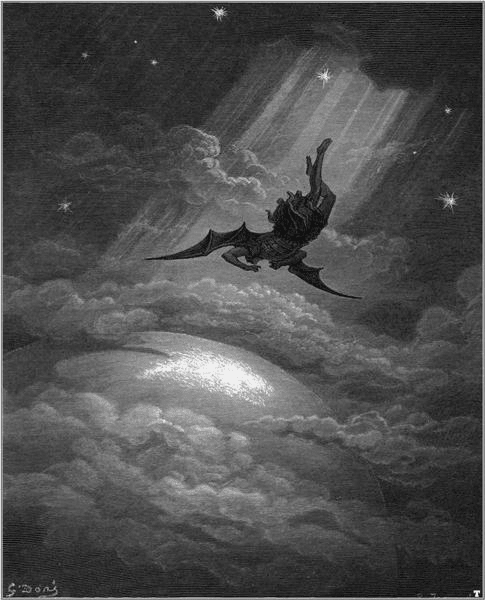
Satan flying toward earth by Gustave Doré
So, as I was saying, I lied my way into teaching a Lit. class at Calico Rock College where Dr. Watts required us to read a lot of heavy stuff: The Catcher in the Rye, Of Mice and Men, Where the Red Fern Grows, and some poems that didn’t even rhyme and made no sense whatsoever. Here’s a poem we had to read that you’ve probably never seen before:
so much depends
upon
a red wheel
barrow
glazed with rain
water
beside the white
chickens
I mean, really.
I got through the class by reading a couple paragraphs from a story or a few lines from a poem and looking over the top of my fake glasses and asking, “Tell me, Miss (or Mister) So and So, what do you think it means?” I learned early on that asking questions about meaning gets students “engaged,” and “engagement” is all that matters because “engaged” students give a teacher high marks when evaluations roll around. And a good evaluation meant you might get invited back to teach again (an easy 300 bucks). And teaching meant more girls to look at and maybe fool around with.
All of this material was supposed to prepare the class to read a real doozy, Paradise Lost, an interminable poem (which didn’t rhyme either) by a fellow named John Milton, a prissy old blind man who still managed to churn out about a million lines. For weeks we slogged through a tar pit of words: We saw Satan waking up in Hell and then Satan rallying a bunch of devils and next thing you know, he was flying through chaos to Eden, where for some reason, God let him hop over the wall and light in a tree, in spite of the fact that God had posted a band of angels at the gate to Eden, but those angels weren’t worth a damn, not so far as the story went. I did like the part where God created Eden and all the animals and, of course, Adam and Eve, who were the stars of the show. (John Milton kept trying to pawn off the “Son” as the real star, but I was never convinced.) I really liked the description of Eve. She was a babe, according to John Milton. Anyhow, my students and I slogged and slogged until we finally got to the part where Satan enters the Serpent and tempts Eve to eat the “fallacious fruit.” Satan triumphs, Adam and Eve are kicked out of Paradise to walk “hand in hand with wandering steps and slow,” and the rest of humankind gets to suffer forever for something we had no choice in.
Anyhow, I asked the class, “Why did God station angels at the gate to Eden if Satan could just leap over the wall?”
Silence. (There really is only one answer to that question: “I dunno.” But nobody wanted to say it out loud because everybody wants to sound smart.)
Then I asked, “Well, why do you suppose God lets Satan get away after the angels catch up with him?”
Silence. The unspoken “I dunno.”
“Let’s try again. Why didn’t God tell one of the angels that Satan was slipping back into Eden through the river?”
Silence. Dunno.
“C’mon, people, work with me here. Is God the hero or the villain of Paradise Lost? What do you think?”
Everett Melton raised his hand. Everett was always raising his hand and blurting out stuff, and the other students pretty much hated him for it. Truth be told, I didn’t like him very much either.
“What do you mean?” Everett asked.
“Well,” I answered, putting on my best sage-on-the-stage airs, “John Milton makes out like God is the hero because He sends the Son to save us, but on the other hand, God created the problem in the first place by allowing Satan to escape hell and enter the garden. So, is God the hero or the villain?”
Quite a brouhaha followed, with most of the students stepping up to defend God—naturally enough, because if God is the villain, we’re all screwed, and what’s the point of anything? Finally, for the first time that semester, little Amanda Perkins raised her hand.
“Miss Perkins?” I asked.
“Why would you even ask us such a question?”
“Well, because John Milton himself raises the question.”
“No, he doesn’t. It’s clear as day: He says, ‘They were free to stand and free to fall.’ The decision was theirs to make, not God’s.”
“I don’t think it’s that simple, Miss Perkins.”
“And I think you’re just a rabble-rouser. You’re just trying to make us doubt what we already believe to no good purpose. Pastor Collins down at the First Baptist Church tells me everything I need to know from the infallible Word of God on how to be happy and get to heaven. How are you going to do better than that?”
“Uh . . .”
And without giving me space to answer, Amanda said, “You know what I think? I think you’re like the fellow who bulldozes a hilltop to build a golf course and then calls himself a conservationist when he’s done. He’s just trying to eat his cornbread and have it, too. In the same way, you’re troubling our settled faith to make us educated—whatever that means—and then calling yourself a professor. But what exactly are you professing?” She drew breath and then asked, “How much do you get paid?”
“That’s none of your . . .”
“Say, it’s a thousand dollars a month,” she interrupted. “Is it worth it? Is it worth a thousand dollars a month to trouble our faith, so you can buy some more of those tacky clothes you wear?”
The class was quiet as an early snowfall.
I said, “But Paradise Lost is a great work of art, and great works of art make us question . . .”
Again, she interrupted. “There isn’t but one question worth asking, ‘How do we get to heaven?’ And there isn’t but one answer: Jesus. You got no right to mess with that. ‘For God so loved the world, he sent his only begotten Son, that whosoever believeth in him shall not perish but have everlasting life.’ There’s your answer.” And with that, Amanda sat back down. You could hear the hum of the fluorescent lights, it was so quiet.
I was nonplussed, so I gave up and became quiet myself. I shut the book and gathered my coat and papers and left the classroom. I didn’t say a word. I got in my car and sat there with the motor running, and pretty soon I saw the kids leaving the building. Then I heard car doors opening and shutting, and before long, the parking lot was empty except for me and a banged-up Pinto. I leaned my head on the steering wheel when I heard a tapping on my window. I looked up to see Amanda standing there. I rolled down the window.
“I’m sorry if I hurt your feelings,” she said.
“It’s okay. I think you’re right. There’s no point in asking questions such as that.”
“Can I get in?”
“Huh?”
“Your car. Can I get in?”
“Why?”
“I thought we might pray together.”
“That’s all?” I asked.
“What else would there be?” Amanda asked.
“Sure. Get in.” And so, we prayed in the parking lot, and then Amanda got out and waved good-bye. Soon enough, the Pinto was gone, and I was by myself.
Amanda is what it means to be a true Ozarks hillbilly. We believe a lot of different things—some admirable, some odd, and some outrageous—but we tend to leave one another alone. However, when somebody comes along and tries to meddle in our minds, to prick our balloons, and to upend our convictions, we face them and say, “You’re just trying to make us doubt what we already believe to no good purpose.” So, tonight I raise a frothy glass to Amanda Perkins: May she someday be surrounded by grandbabies in a snug house on the gentle slope of some green hill. And here’s to my she-bear Ellie: She saved this old bullshitter from himself, though I dare say I didn’t deserve it. Kind of like Jesus did. And there’s no question about that.