For the rest of that year, I wandered, which for some reason has a romantic sound as in “I wandered lonely as a cloud” or “The lonely wanderer prays often for compassion” or “Not all who wander are lost.” In reality, wandering for me was just aimlessness and immaturity. I did hole up for the winter in Fort Smith where I worked as a clerk in a convenience store. The manager let me sleep in a rusty RV parked behind his house. The rent was forty bucks a month, but it had running water, a flush toilet, and an electric heater, so I could have done worse.
I practiced my guitar a lot that winter. Bob Dylan had wandered into international fame back in 1963, and I learned the words to “Mr. Tambourine Man” and “A Hard Rain’s A-gonna Fall” and, of course, “Blowin’ in the Wind.” I could even sing like Bob Dylan (or so I imagined, but then, who can’t sing like Bob Dylan if they’ve a mind to). Oh, yeah, and I turned 18, which was supposed to be some kind of milestone but all it really meant was that I could legally buy cigarettes and get drafted. I liked Lucky Strikes with their nutty flavor and nicotinic jolt. I still do from time to time.
And I pondered Jean Wallace’s prediction. I had found Onyx, though it was a dog named after a camp named after a creek and not a town. But there was no broken down cabin or two boys named Ephraim and Manasseh with whom I was supposed to “wrassle.” I guess Jade’s dad’s beard could be described as “ornery,” but I couldn’t tell if Mr. Stone was part of the prophecy or if I was just trying to force the pieces to fit. Most prophecies are like the borders of a jigsaw puzzle.
Story the First
A fellow named Carl worked the evening shift, and we became friends. Carl worshipped—literally, knees bent, arms raised, head bowed worshipped—Iron Butterfly, and he taught me how to play air guitar to In a Gadda Da Vida. He said the name of the song was supposed to be “In the Garden of Eden,” but the band was so stoned that the lyrics came out “In a Gadda Da Vida,” a bit of pop trivia that Carl tried to parlay into the impression that he was worldly wise. But Carl was like me: He didn’t know shit.
Here’s everything I knew in 1967:
I knew Bob Denver played Gilligan and that June Wilkinson had big tits and that Ann-Margret played Mrs. Robinson.
I knew that Bob Dylan wore Ray Ban sunglasses.
I knew that Pap and Ma were worried sick about me.
I knew that Jade Stone was in Forum, Arkansas, and I wasn’t.
I knew that I thought about Jade every night.
I knew I was attracted to girls who were, Jade notwithstanding, by and large indifferent to me.
I knew I got kicked out of school.
I knew I wanted to be somebody other than who I was, but who that might be, I did not know.
I knew that I hated the clarinet.
Oh, yeah, and I knew that I didn’t want to go to Vietnam.
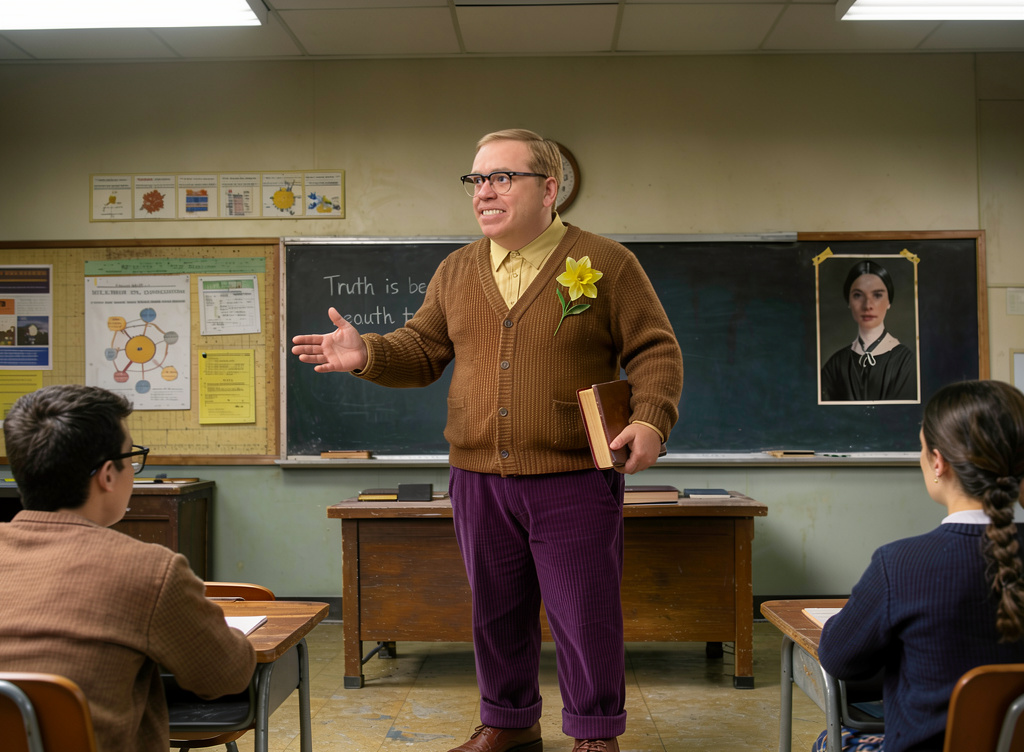
In January I took a three-week night class in creative writing at Westark Junior College. The teacher, Mr. Barnham, was a pudgy, cream-colored man who fancied himself quite natty in his saddle oxfords, purple corduroys, and coffee-colored cardigan with the inevitable silk flower. Mr. Barnum’s face was unremarkable except for two protruding teeth that rested on his lower lip and a pair of horn-rimmed glasses like the ones worn by engineers at NASA, the combination of which made Mr. Barnham look like a rabbit who could do math.
On the third evening, we, my class and I, learned to our astonishment that what we had taken to be his teeth were really dentures. Mr. Barnum was teaching us how to write poetry, and in an effort to inspire us, he began quoting Keats’s famous dictum, “Truth is beauty, beauty truth,” when for some ungodly reason, he popped his teeth out with his tongue and then sucked them back into his mouth with a noticeable click and concluded, “That is all ye know on earth and all ye need know.” It happened in one hideous instant, and the whole class gave a little jump in their seats, and one girl in the back said, “Holy shit!” From that time forward, we never knew when it might happen again. One minute it would be Wordsworth and Whitman, and the next a sudden eructation of teeth followed by a quick slurp and click, whereupon Mr. Barnum would resume his yammering as if he hadn’t just scared the hell out of us. When he finished, he would take off his glasses, rub the lenses with a handkerchief, and ask a deep question: “What do you suppose the poet means when he says ‘The ‘world is too much with us,’ Miss Edwards?” Or “Miss Springer?” Or “Miss Latshaw?” Or whichever girl he happened to be ogling at the time. “Now, class, take out your pencils and notebooks and compose a list about the ways the world is too much with you. Then make it rhyme.”
I’m embarrassed to say that the only thing I remember from that class is Mr. Barnum’s dentures. (That I didn’t learn anything about creative writing should be apparent to you by now. Like, what happened to Carl?) Nevertheless, I continued filling up notebooks with observations about truthful beauty and/or beautiful truth and the all-too-present world, as well as a short story about a brilliant but vicious rabbit with retractable incisors it would thrust into its victims, “killing them instantly.” (Imagine my surprise when Monty Python released the “Holy Grail.” I think they stole my idea, but I could never prove it.)