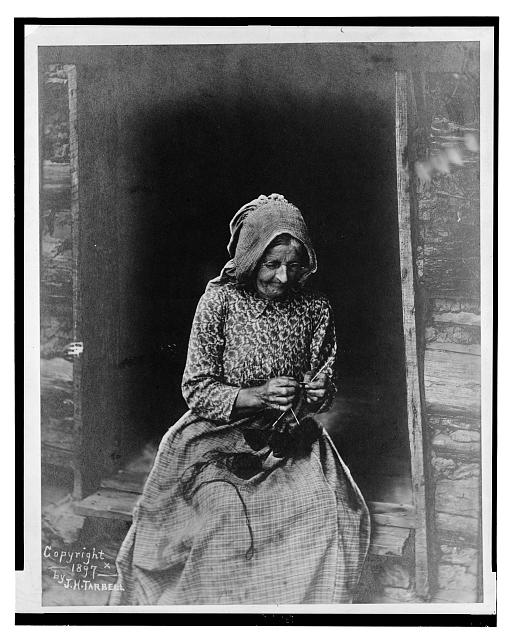
On the crest of Bradshaw Mountain, near Green Forest, Ark., lives an old woman named Angie Paxton. The Widder Paxton was born in the shadow of the rugged peak upon which she lives, and in all the seventy-odd years of her life has never been further from home than Berryville, about 20 miles away. She can read the newspapers, however, and she talks with the people who come to see her, and probably knows as much about what is going on in Carroll County as any of the smart-alec politicians at the County seat.
Many of the hillfolk believe that she knows more, much more, for Angie Paxton is a clairvoyant, a fortune-teller, an adept in magic black and white. She has, according to her neighbors, the Gift of the Second Sight, the ability to communicate with spirits, to understand the past and read the future by some supernatural power. Some people go so far as to call her a witch, although this is not a term to be used lightly in the Ozarks, even today.
People come from miles around to consult her about their love affairs and business problems, and she has been particularly successful in recovering stolen property. One of my friends lost a valuable foxhound, and after a week of fruitless quest he drove nearly 50 miles to consult with the Widder Paxton about it.
“Well, sir,” he told me several months later, “soon as Angie knowed what I come for, she started a-conjurin’ round with some little sticks, an’ big old buttons, an’ I don’t know what all. An’ then she drawed some funny-lookin’ marks in the dirt an’ all like that. She talked a lot of foolishness, too, but finally she says my dawg is tied up in a berry-shed due east of my place, across two clear creeks. An’ moreover she says it was stole by a little low feller, who’s been a-livin’ with a big fat slobby woman!
“Soon as I heard that, I knowed it was old Poody Buggem what done it. I suspicioned it was him, anyhow, right from the start. Me an’ some o’ my kinfolks went over to his place, an’ sure enough there was Bugler, big as life an’ twice as natural! Old man Buggem says he seen a stray dawg around lately, but he never paid it no mind. He says some o’ the children might have shut it up in the berry-shed, maybe. We couldn’t prove nothin’, o’ course, so I never argued with old man Buggem—just took my dawg an’ ambled on home. But there ain’t no doubt in my mind that the whole thing happened just like what Angie said.”
I met the Widder Paxton only once, in company with a very attractive girl from Berryville who volunteered to “carry” me up to the old woman’s home on Bradshaw Mountain. Just east of Green Forest my charming guide lost her way, and we were forced to depend on information supplied by the hill people along the road. Some children told us that Angie was not living in her own cabin, but could be found at the home of one Ab Taylor, a bit farther up the ridge. A man who rode down a little cowpath confirmed this, adding that he didn’t think we could possibly get up to Taylor’s place in an automobile. “That there road,” quoth he, “is a son-of-a-bitch!” He took the words right out of my mouth!
And so it was that we left the Ford at the edge of R. E. Hall’s pasture, and traveled the last mile or so on foot. A steep rocky trail it was, too, but indescribably beautiful. Great oaks and hickories and cedars and white walnuts loomed on either side, with a thick carpet of ferns underneath.
There is very little underbrush in these hills, because the turkey-hunters insist on burning it off every Autumn. They think that this procedure attracts game, and somehow benefits the wild pastures. And maybe it does, for all I know. Anyhow, Bradshaw Mountain is a tough hill and hard to climb, and before we reached the top I wished for a miniature camera, instead of the heavy Graflex I was carrying.
Once on top of the mountain, however, a cool breeze struck us and everything was fine. Taylor had planted a little patch of corn, a few rows of tobacco, and about an acre of tomatoes. The tomatoes were his only “money crop,” and under a tree was a great pile of homemade crates in which they were to be carried to the canning factory near Berryville. These boxes were not made of sawed lumber, but of white-oak slats, split out with a mallet and frow.
The house was a comparatively new building of unplaned slabs from the sawmill, the old log cabin having burned down some years before. The roof was made of old-fashioned shingles or “shakes,” split out with a frow like that used in making the tomato-crates. There were not many windows in the Taylor house, only one door, and no screens at all.
Angie Paxton sat on the edge of the little porch as we approached. She greeted us politely enough, but without any particular enthusiasm, and fixed me with a sharp black eye.
“Them fools down to the store told ye I was a witch, didn’t they? Well, I ain’t no such a thing. I’m a fortune-teller.”
I said nothing, and after a long pause she spoke again. “Want to get your fortune told, I reckon?” I answered in the affirmative.
“Well, I’m a’goin’ to tell yourn first,” she said to me. Then she turned to my companion. “You go down to the spring an’ git yourself a gourd of water, an’ don’t come back till I holler.”
The pretty girl from Berryville seemed a little surprised at this, but walked away without a word.
“Young man,” said Angie as soon as the lady was out of hearing, “I’m a-goin’ to tell you somethin’ that you might not want that there gal to know ’bout.”
She handed me a saucer, and a cup with some wet coffee-grounds in it. “Just turn that there cup round a few times, an’ then dump the grounds out in the sasser.”
While I was doing this, Angie gazed indifferently away over the treetops, then picked up the saucer and studied its contents.
“Been married twice, ain’t ye?” she ventured.
I nodded.
“Got two children, ain’t ye?”
“No children,” said I.
“Well, ye soon will have, then,” was her reply. “The least ’un will die young, but t’othern will grow up an’ be a credit to ye.”
Looking into the saucer again, she shook her head solemnly. “It seems like you been a-gittin’ purty thick with a red-headed woman. I’m afeared you’re goin’ to have trouble with your wife, an’ maybe some o’ your kinfolks. But ever’thing will turn out fine, so don’t you do no worryin’ ’bout it. There’s a dark man a-foolin round, makin’ out like he’s a friend o’ yourn, but he ain’t. You’re a-goin’ to make a lot o’ money—more’n you ever had before, anyhow. You got a long life o’ peace an’ plenty ahead of you, an’ if you don’t have a good time it’s your own fault. Here, shake them grounds up ag’in,” and she handed me the cup.
I “shuck ’em up ag’in” and dumped the grounds out into the saucer as before.
“Now make a wish, an’ ask a question,” cried Angie. “Keep the wish to yourself, but ask the question out loud.”
I made a silent wish easily enough, and was instantly assured that it would be granted in due time, but the question “out loud” was another matter.
“What is the date of my birth?” I asked finally.
The old woman shot a startled glance at me from under her shaggy brows, then bent over the coffee-grounds in the cracked saucer.
“Well,” she said at length, “the place where the date ought to be is a little muddy, but it’s plain to be seen that you’re forty-one year old now, an’ maybe three-four months extry.”
This answer impressed me very much indeed, for I was exactly 41 years, three months, and 12 days old at the time. I would never have believed that a stranger could estimate my age so closely. It did not please me very much, either, because I used to be rather proud of my youthful appearance.
Angie perceived instantly that she had scored, and decided to end the interview on a triumphant note.
“I reckon that’s ’bout all I can tell you this evenin’,” she said. “You go down to the spring now, an’ send that gal up to the house. Soon as I get done with her, I aim to lay down an’ rest a spell. I ain’t so young as I used to be, an’ these here readin’s tires me out somethin’ turrible.”
Down at the Taylor spring I took a drink of moonshine from my pocket flask, with a gourd-full of spring water for a chaser. I still remember it as the coldest and sweetest water that has passed my lips in many a day. The whiskey wasn’t so good, but it was the best I could get in Berryville.
When Angie had finished with the young lady’s fortune, I returned to the house. The girl seemed very pale and silent, evidently much impressed, while Angie was obviously pleased with herself.
“How much do we owe you, Mrs. Paxton?” I asked.
“You don’t owe me nothin’, young man. Not a single solitary cent. My power is a gift, and gifts can’t be sold for money.”
“But surely, Mrs. Paxton,” I protested, “you can’t afford to give your time and strength to help every stranger who comes along, without any payment at all.”
Angie looked at me sharply, with a twinkle in her snapping black eyes.
“Sometimes,” she said slowly, “if a feller thinks he’s got his money’s worth, an’ can afford it, he gives me a quarter. But it’s allus a free-will offerin’,” she hastened to add, “’cause I don’t never charge nothin’ for tellin’ fortunes.”
I gave Angie a 50-cent piece, and was surprised to see my companion, who is not inclined to extravagance in these matters, hand her some more money. The old woman thanked us gravely, bade us good-bye, and went into the cabin without another word. It is very bad form, in the back hills, to watch a departing guest out of sight.
My pretty girl was sober all the way down to the car, and all the way back to Berryville. I tried to cheer her up by poking fun at the pretensions of fortune-tellers in general. I laughed at their patter of dark men and light women, but omitted any reference to the old woman’s lucky guess about my age. Finally I asked the girl outright what Angie had told her, remarking that I needed the information for an article I intended to write about backwoods fortune-tellers.
She refused flatly to tell me anything about it, saying that the “reading” had reference to her personal and private activities, and that nothing was to be gained by discussing such matters, anyway.
“But surely,” I cried, “you can’t be taking this damned fol-de-rol seriously! Surely you realize that this poor old woman couldn’t possibly know anything of your affairs!”
She looked at me with round, frightened eyes.
“I’m not so sure as you are,” she said soberly. “I’m not so sure about anything.”
All this happened a long time ago, and a lot of water has run under the old bridge since we climbed Bradshaw Mountain that morning. And I’m not so sure about anything myself, nowadays.