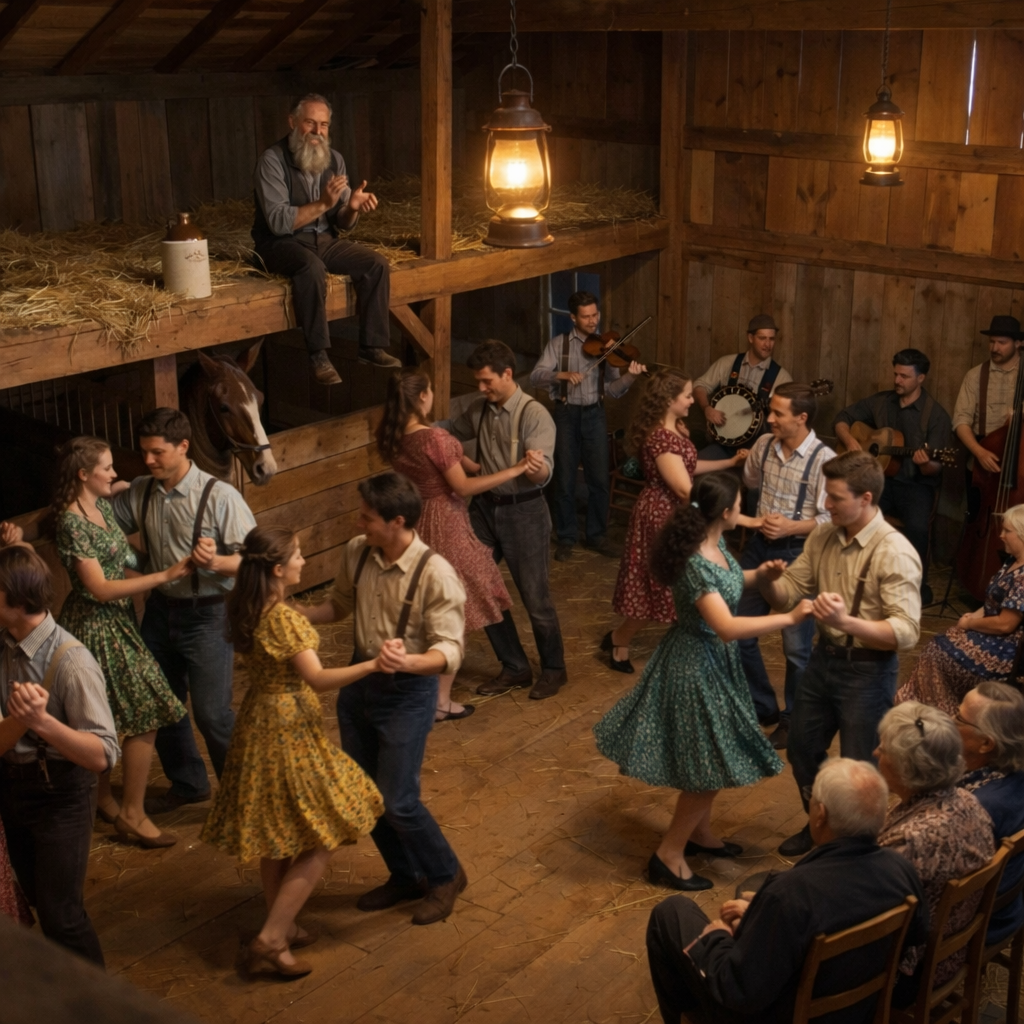
No one waited for an invitation to attend the big barn dance at the Walker farm, but all who were able to come were present. They came in carriages, wagons and on horseback for miles from all directions. This one big social event of the community was held in October, 1878. Even with the absence of telephones as a means of communication, everyone knew that the dance was to be held. Even the Davis gang, ten miles to the east, rode their sweating horses into the yard, tied them to a post and proceeded to join the festivities.
The barn floor had been swept clean of all straw and chaff. In one corner sat a barrel of cider with tin cups tied to strings and suspended from its sides. Everyone could partake freely of the cider. In another corner of the large driveway of the barn sat an old reed organ with several chairs for the fiddlers and other musicians. Along the side of the room, benches were formed by placing heavy boards on blocks of wood, sawed at the right height. These seats were placed for the older ones who attended and did not care to join in the dancing.
The dancing began early with three sets on the floor. As the evening passed, the laughter became more boisterous and many of the dancers showed the effects of too frequent partaking of liquor much stronger than cider.
Occasionally a dancer became extremely jubilant or, perhaps affected by the surplus of the strong liquor he had consumed, would seek peace and quiet by stretching out in the hay loft or in a manger to “sleep it off.” The vigilance committee, composed of older and more sober men, would immediately seize the intoxicated culprit and carry him outside by his arms and legs and douse him headfirst into the cold water of the horse trough, which stood by the side of the barn. This would either cause the offender to sober up immediately or he would become indignant and leave for home.
During the evening one old gentleman, who possessed a luxuriant growth of beard, became highly jubilant. From this growth of whiskers protruded a black, evil-smelling pipe. The old man became so happy that he forgot to keep his pipe lit. Suddenly he thought of his pipe and proceeded to strike a match to light it. His attention was attracted in another direction as he struck the match. In his excitement the match came in contact with his whiskers and they burst into flames. Screams were heard from the women and the men rushed to assist the unfortunate one. The blaze was finally extinguished, but not until it had burnt off almost all of the gentleman’s beard.
The young folks resumed their dancing and it seemed that things had about returned to normalcy again. Just then a young mule, having become nervous with so much excitement in the barn, broke from its stall and came charging down the dance floor, scattering dancers to the right and left. The mule was seized by some of the boys, who began the task of trying to get the stubborn critter back into its stall. The mule braced its front feet wide apart and refused to budge. Some of the boys pushed; some pulled; yet the mule maintained its stolid resistance. While these efforts were being made, there came a voice from down underneath a pile of hay:
“Balance all.”
Loud laughter arose as someone scraped away some of the hay to reveal Lawrence Shores buried beneath the pile. Lawrence had been “calling off” and was perched on a high stool when the critter broke in upon the scene. In the scramble to get away, Lawrence had been upset from his high perch and completely buried under the hay. His mind had been too befuddled with strong drink to know exactly what had happened. As soon as he had partly recovered his senses, he shouted the next call of the dance:
“Balance all.”
It was near three o’clock in the morning when Joe Brownwell, an old man of the neighborhood, told all present that he did not believe in such “carryings on.”
“I’m goin’ home,” he told the dancers. “I’m not goin’ stay here an’ get drunk an’ —— an’ —— dance all night. I’m goin’ home.”
With this he staggered out into the moonlight and after much groping about, saddled his mule and headed toward home. The road to Joe’s home led for some distance through the wooded hills.
After the exodus of Joe, the dance again resumed its hilarity. It seemed that all interruptions had ceased.
Such was not the case. The fiddlers were in full swing in “Money Musk” and the stamping of feet, the clapping of hands, and the swing of the dancers had reached a crescendo when someone shouted above the bedlam:
“Whoa —— Whoa —— I tell yo’ —— Whoa.”
There were screams of women and shouting of men and a general scampering of people in all directions as Joe dashed onto the barn floor on his mule, which skidded to a stop.
Joe was wild-eyed, bare-headed, with disheveled hair and clothes awry as though he had been wrestling with someone. Men seized his mule by the reins and assisted Joe to alight.
“What is it, Joe? What scared you?” asked one of the older men.
Joe could not talk. He staggered to a bench and slumped into a heap. Some of the boys led the mule off the dance floor and others gathered around Joe.
“What ails yo’, Joe?” insisted a man, shaking Joe’s shoulder.
Joe gulped two or three times and in a subdued voice began:
“Ize goin’ down the wooded road when I seed someone comin’ toward me carryin’ a lantern. When I came to whar they war —— it wuz a —— it wuz a——” Joe looked around in fright, “hit wuz a —— rabbit. That thar rabbit swung his lantern and shouted, ‘Whoa,’ to muh mule. Muh mule stopped dead still an’ that thar rabbit sed ter me, sez he, ‘Joe Brownwell, doan yo’ go home. Yo’ bain drinkin’ an’ yo’ wife is a waitin’ fo’ yo’ with a rollin’ pin as big as yo’ leg. Doan yo’ go home, Joe Brownwell.’ I could hardly believe hit,” finished Joe weakly.
Joe slumped into a huddle on the bench almost in a faint as a titter arose from the crowd grouped around him.
Luke Brownwell, a distant relative of Joe, elbowed his way through the crowd and said:
“What was that, Joe? Tell me what happened.”
Joe was overwhelmed at the sight of Luke and laid his head on Luke’s shoulder and began to cry. Luke finally coaxed him to retell his tale. This time Joe enlarged his story.
“I wuz goin’ down ther wooded road,” began Joe, “when I seed a lantern comin’ down ther road. Hit war someone carryin’ a lantern. The lantern came closter and I seed hit war a bar carryin’ hit. Yes sir, a bar, a great big bar. That thar bar set his lantern down and said to me, ‘Joe Brownwell, doan yo’ go home. Yo’ bain drinkin’ an’ yo’ wife’s waitin’ fo’ yo’ with a shotgun an’s goin’ kill yo’ ther minit yo’ go home, yes sir, a shotgun. Doan yo’ go home, Joe Brownwell.’ I wants yo’ alls ter go home with me so’s she won’ kill me,” pleaded Joe. Silence reigned for some seconds after this plea.
“Ha — Ha — Ha — Ha — Haw — Haw — Haw — Hawr — Hawr”
The shrill laughter came from the top of the high stool as Lawrence Shores held his sides and doubled over in his merriment. Everyone looked at Lawrence in amazement. After a while Lawrence straightened up, pointed a long, slim finger at Joe and shouted in his high-pitched voice,
“Now we knows yer drunk, Joe Brownwell. We all knows yer drunk, we all knows as well as yo’, yo’ doan have no wife.”