From Vance Randolph’s definitive collection of Ozarks folksongs and ballads, Ozark Folksongs
In the early days very few of the Ozark villages were able to build churches or support resident pastors, but each settlement was visited at intervals by a circuit-rider or saddle-bag preacher. Nowadays there is some sort of a church-house in every mountain hamlet, and many have regular ministers, usually of the Baptist or Methodist persuasion.
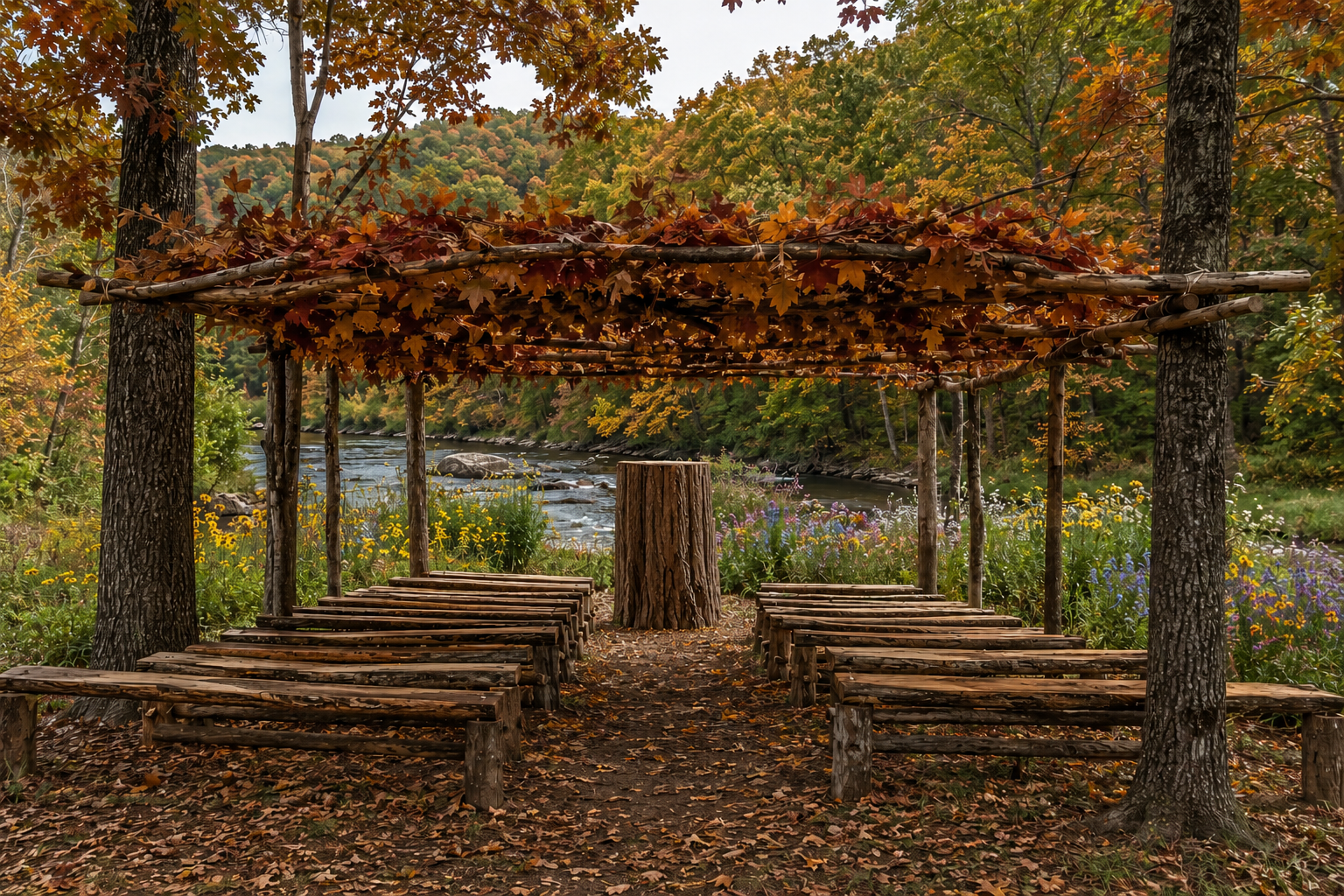
Infinitely more diverting, however, are the itinerant evangelists known as “brush-arbor preachers,” who do not come to the village churches at all, but hold forth in the traditional fashion at the camp-grounds. A typical camp-ground is a sheltered cove near a big spring, where a large brush-arbor or “tabernickle” has been set up in a clearing. There used to be a famous camp-ground near Forsyth, Mo., where it is said that the joyful shouting of the converts could be heard for more than a mile. The place is still known as “Happy Holler.” The tabernacle is usually nothing more than a framework of rough poles, roofed over with leafy branches, and lighted by gasoline flares or torches.
Inside the tabernacle are two groups of rough wooden benches, without backs or arms, separated by a broad aisle; the men are supposed to sit on one side of the aisle, and the women on the other. The pulpit is built upon a little platform at one end of the arbor, and at one side of the pulpit are two or three benches reserved for the more influential and devout Christians of the neighborhood—this place is called the “amen corner.” Just in front of the pulpit is a long, low seat known as the mourner’s bench.
When the news of a camp-meeting has been “norated round,” whole families come in covered wagons, on horseback and afoot, bringing bedding and cooking utensils, with sufficient food to last several days.
A typical service at one of these places begins by the parson calling out to some influential worshipper: “Brother Whatley, spos’n’ we sing a couple o’ hymns.” Whereupon Brother Whatley rises from his seat in the amen corner and says: “Brethern an’ sistern, the parson asks that we sing a hymn or two, an’ it shore is a pleasure for me to lead you-all at this here meetin’ tonight. Let’s sing one o’ them good ol’ songs we all know—‘How Tedious an’ Tasteless the Hours.’ Harumph! Do mi sol do! Do mi sol do!” And with this he waves his arms vigorously at the congregation, and all sing at the top of their voices.
After the singing of two or three hymns the preacher requests another loud-voiced brother to lead in prayer, which he does at considerable length, with the various deacons calling out “Amen!” and “Bless the Lord!” and “Gawd grant it!” at appropriate intervals. When the prayer is over the evangelist steps forward and swings into his sermon, which is regarded as the most important part of the service. The mountain preachers are fundamentalists to a man, and most of their sermons are of the hell-fire-and-brimstone sort—exhortations to abandon all newfangled follies instanter, and return to the good old-fashioned religion of our sturdy fathers. I have stenographic reports of several of these sermons, but there is no room for long quotations here. The following paragraph is chosen almost at random from a brush-arbor denunciation of the higher learning:
“Some folks set a powerful store by this here eddication, but I tell you-all right here an’ now that readin’ an’ writin’ an’ cipherin’ ain’t never got no sinners into Heaven yet, an’ don’t you never forgit it! Hell’s chuck full o’ schoolmarms, an’ they ain’t no lack o’ doctors an’ lawyers an’ other eddicated fellers thar, neither! I got a purty good eddication myself, an’ I kin read the Word, but book-larnin’ is a mighty juberous gift now, brethern an’ sistern. Hit shore is!”
The typical mountain preacher concludes his fiery sermon abruptly, and immediately calls for another hymn. Brother Whatley leads off with a mighty shout of “Bless the Lord!” and then swings into “The Old Time Religion” or “I’m Bound for the Promised Land.”
And so it goes, far into the night. Finally the evangelist decides to end the meeting. “If thar ain’t no give-outs,* brethern an’ sistern, let’s all stand up an’ be dismissed . . . An’ now may the grace o’ Gawd an’ the communion o’ the Holy Sperrit rest an’ abide with us one an’ all, we ask it for Christ’s sake, amen.”
The foregoing account gives a glimpse of the ordinary uneventful brush-arbor worship, such as a casual tourist may see for himself in any of the more isolated sections of the Ozarks. There are, however, occasional meetings of a much more sensational type, and if one wished to emphasize the more outlandish and fantastic side of the Ozarker’s religious life he would have no difficulty in collecting plenty of data for the purpose. Even in the comparatively conservative Baptist and Methodist churches there is no lack of hysterical “shouting” which can be heard for half-a-mile or so, and at some of the backwoods revivals there is even less of decorum and restraint.
This chapter is made up of songs which are, or have been, sung at religious meetings in the Ozarks, although it must be admitted that some of them have very little apparent relation to religious matters. Nearly all of the churches in the Ozark settlements today are using more or less modern hymnbooks, and the old songs are now heard mostly in the backwoods districts. But they are still remembered by many middle-aged people, even in the larger towns, and the introduction of modern music is still bitterly resented by the old-time pillars of the mountain churches.
The Dying Youth
Belden (JAFL 25, 1912, p. 18) reports this piece under the title “Awful, Awful, Awful” from a Missouri scrapbook which dates to the early 60’s. Tolman and Eddy (JAFL 35, 1922, p. 323) reprint the song as discovered by Belden, with an additional stanza which they recovered in Kentucky. Campbell (The Southern Highlander, 1921, p. 186) prints a text which differs in many particulars from the Ozark versions known to me, but is obviously a variant of the same piece. Compare “Death, What a Solemn Call” as reported by Richardson (American Mountain Songs, 1927, pp. 63, 113) which she describes as “one of the most impressive of mountain songs . . . late sung by the present compiler in Alvin York’s church-house.” See also Thomas (The Midland, Jan.-Feb., 1932, pp. 24-27). The “Awful, Awful, Awful” piece reprinted in the Aurora (Mo.) Advertiser, Feb. 9, 1939, is a combination of this item and the “Wicked Polly” song. Belden (Ballads and Songs, 1940, pp. 464-465) offers three texts from Missouri under the title “Death is a Melancholy Call.”
Sung by Mrs. Susan Bailey, Jane, Mo., Feb. 17, 1929.
I saw a youth the other day, All in his bloom, lookin’ so gay,
He trifled all his time away, An’ dropped into Eternity.
An’ it’s awful, awful, awful!
As he lay on his dyin’ bed
Eternity he seemed to dread,
He says oh Lord, I see my state,
I am afraid I have come too late,
An’ it’s awful, awful, awful.
His tender sister standin’ by,
Dear brother, she says, you’re goin’ to die,
Your joys are o’er, your days are past,
You’re goin’ to . . . . . . . . . . . . . . . at last,
An’ it’s awful, awful, awful.
He called his parents to the bed,
An’ in his dyin’ anguish said,
Oh my dear parents, pray for me
For I am bound for Eternity,
An’ it’s awful, awful, awful.
A few more dyin’ words was passed,
These turrible words they was his last,
He says oh parents, fare you well,
By devils I am dragged to hell,
An’ it’s awful, awful, awful.
His corpse was laid beneath the ground,
His brothers an’ sisters a-weepin’ round,
With achin’ hearts an’ wanderin’ minds
For fear their brother was in hell confined,
An’ it’s awful, awful, awful.
Oh my heart aches, oh my breast burns,
To see you all so unconcerned,
Believe an’ repent while you have time,
Or else you’ll be in hell confined,
An’ it’s awful, awful, awful.