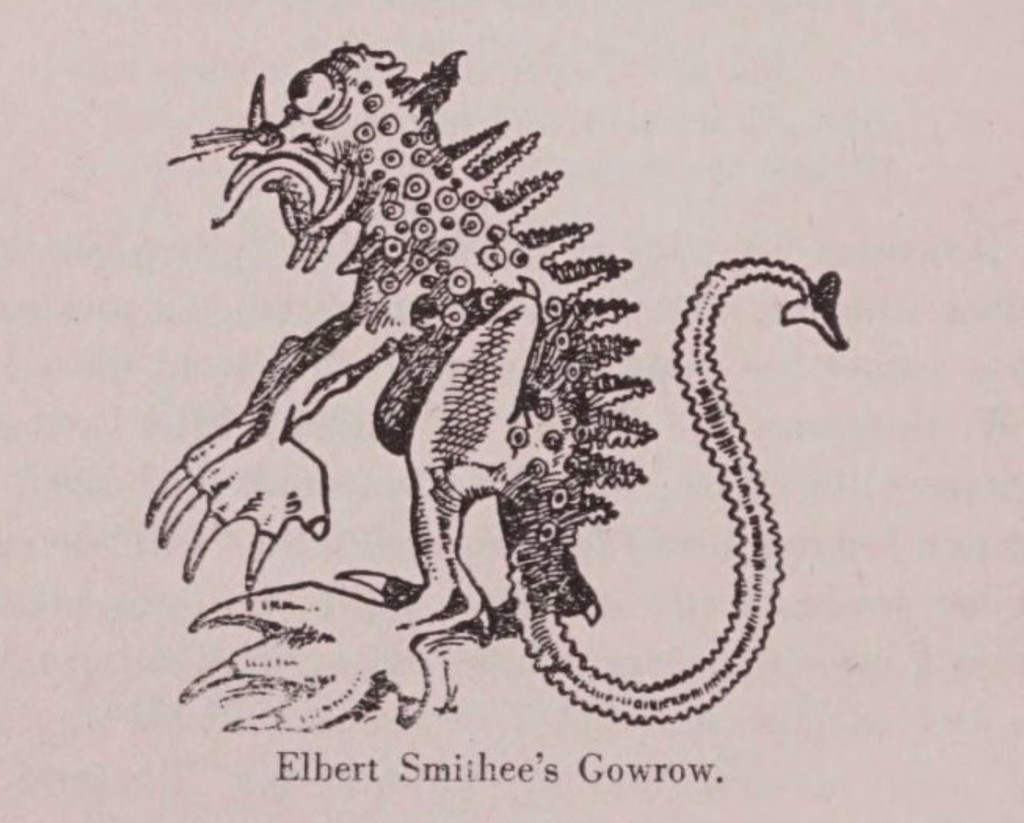
Some time in 1897, there appeared in the Gazette an article and picture which startled, or, at least, was enough to startle, the entire world of scientists, naturalists and zoologists. This was Elbert Smithee’s Gowrow story, illustrated by Elmer Burrus, an expert chalk-plate artist, who was then illustrating the daily issues of the paper, carricaturing the legislative members, and otherwise livening up things with his celebrated specimens of high art. (This was before the present newspaper half-tones came into use). Elbert, a talented writer, had a commercial traveling friend, named William Miller, who had been in the wild and woolly regions of Northwest Arkansas. Miller brought back with him the tail—no, the tale—of a wonderful animal which he said had been killed up there. It was like unto nothing that had ever been seen on land or in sea before. He and Elbert talked about it—over a lemonade. Elbert went out with the boys that night, and, after taking another lemonade or soda and smoking a cigar, wrote up the yarn, drawing profusely on a vivid imagination, warmed and enlivened with good fellowship, to develop any material or immaterial point necessary to embellish it. Then he and the artist got together, and the aforesaid picturegraphist also became enthused over the alleged discovery. The result was that the combined geniuses of the Munchausen-like commercial tourist, the imaginative editor, and the talented artist, inspired by the best at Garibaldi’s bar, evolved the picture represented by the accompanying crude illustration and a story which read like a fairy tale. The wonderful animal was denominated the Gowrow, because it was said to utter a cry sounding like the name when engaged in its terrible work of exterminating whatever live object came across its path. Miller was supposed to have been in Blanco, Calf Creek township, Searcy County, Arkansas, when this horrible monster was nightly slaughtering cattle, horses, hogs, dogs and cats by the wholesale. It had terrorized the community, for those who had seen the ponderous animal were horrified by its hideous shape. Miller organized a posse, armed with shotguns and Winchesters. The tracks of the Gowrow were followed until an enormous cave was found, near a lake. This cave was evidently the home of the animal, as here were found many skeletons, skulls and bones, as well as parts of human flesh of recent victims; but the monster had not returned to its lair. Miller and his posse laid in wait, while trembling in their shoes. Presently the earth swayed as if another San Francisco earthquake were taking place. The waters of the lake began to splash and roar with a noise like the movement of ocean waves, when they realized that the monster was approaching. As it came within range, all hands fired, and, after several volleys were discharged, succeeded in killing it. But it died hard. A couple of huge trees on the bank were lashed down and one of the assailants was killed by it before it breathed its last.
It was stated that the Gowrow was twenty feet in length, had a ponderous head, with two enormous tusks. Its legs were short, terminating in web feet, similar to, but much larger than, those of a duck, and each toe had vicious claws. The body was covered with green scales, and its back bristled with short horns. Its tail was thin and long, and was provided with sharp, bladelike formations at the end, which it used as a sickle.
It was declared that this animal was a pachyderm, and a combination of the hyænidæ and rhinocerotidæ; that it had incisor and canine teeth, which apparently showed its relationship to the ceratorhinus genus, supposed long since to have disappeared from the earth. (Its discoverer was a “peacherina.”)
The bones were to be sent to the Smithsonian Institution, but, strange to say, they have never reached there.
It was a great fake, probably without foundation in fact.