Chapter Twelve: The Road Along Big Sandy
Girls, thieves, and other stories
Saturday, November 11, 1897 - The Road to Pikeville, Kentucky
T. Allen "Mack" McQuary, the Purple Knight of the Ozarks, and Rozinante, his faithful mare, were pricking forth through a forested arch of gold and russet trees. The road they trod, more like a footpath, really, was thick with leaves, some from autumns past and some freshly fallen, and Roz shuffled rather than clopped. Aside from the rasping of her gait, the only sounds were the creaking of leather, the bright chirruping of birds, and the murmuring of the breeze.
From time to time, the Knight would peer through the foliage to see the Big Sandy River sparkling and winking beyond the trees, and far ahead, Mack saw a blue opening where the trees ended and the trail stretched forward into sunshine. Mack began whistling a hymn, which made him think of his father, which roused feelings of disappointment and affection, longing and irritability, a complex of emotions Mack began to untangle once again, for he envied his father's native ebullience and naive faith but had no desire to emulate either.
I'm happy religion works for him, but it's not my fault it doesn't work for me. I don't understand how can he shrink the whole round world and the desire for pretty girls and the steam of locomotives and the speed of telegraphs and the multitudes of stories into one supposedly sacred book? It's absurd, like taking the roaring, twittering, howling ocean of life itself and making it a sock puppet. I don't want to do that! Better to live my own lie out in the sun than to live father's lie in the print shop. And yet . . . and yet I know he loves me in his own way. He and mother could have spilled the beans when I started this whole charade, but they didn't. Maybe they should have. What kind of son am I that I might possibly humiliate my own mother and father by making this story up? Who the hell am I?
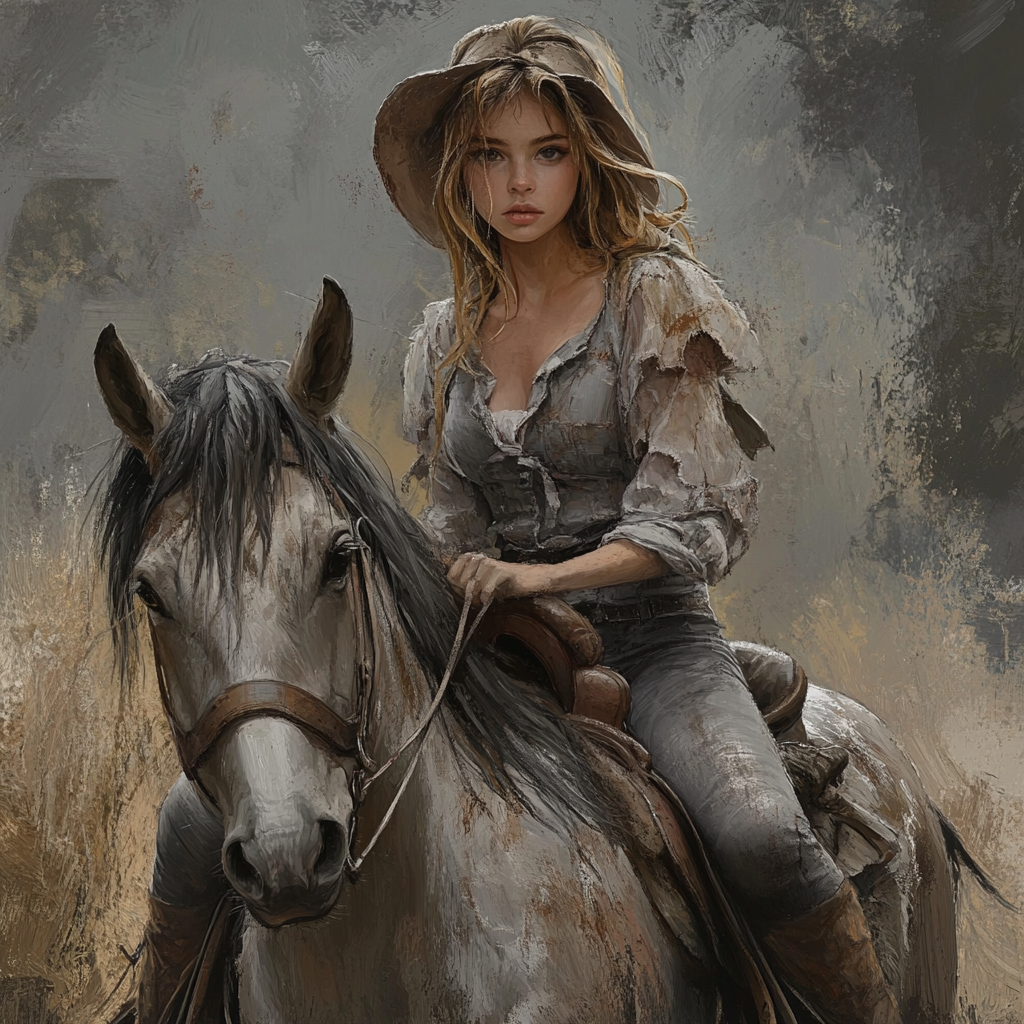
Mack was still trying to sort out his feelings when Roz abruptly snorted and perked her ears and began trotting; the spirit of the autumnal forest had entered her heart, and she tossed her head and began to gallop. Mack clapped his chapeaux to his head and leaned forward, and then all was flying by him in a rush of gold--trees whose limbs spread over the trail and outcroppings of gray stone and squirrels barking from their nests--the forest was a blur until they burst from the trees into an extravagant expanse of pale blue sky. Roz snorted and slowed to a trot, and the spirit released her. On Mack's left, the naked river ran twisting and writhing in the perfectly clean air, and on his right, fields of light brown grass nodded and tossed under the sway of the breeze. Beside the road were a few late straggling flowers of fall: lavender asters and tall sprigs of yellow dock while not too far ahead, a hawk plummeted into a stand of tall grass. In another moment the hawk winged upward with something small and squeaking in his talons. "Attaboy," Mack said, and he remembered fond encounters of his recent past.
To begin, there was Polly in St. Louis. The Knight had just spoken to a thunderous crowd in the Lutheran church and was making his way down the stairs to a reception held in his honor. On the landing stood a girl whose dress was slipping off her shoulders. "Mr. McQuary?" she said with a tremor in her voice.
"Yes?" he asked.
"Would you kiss me?"
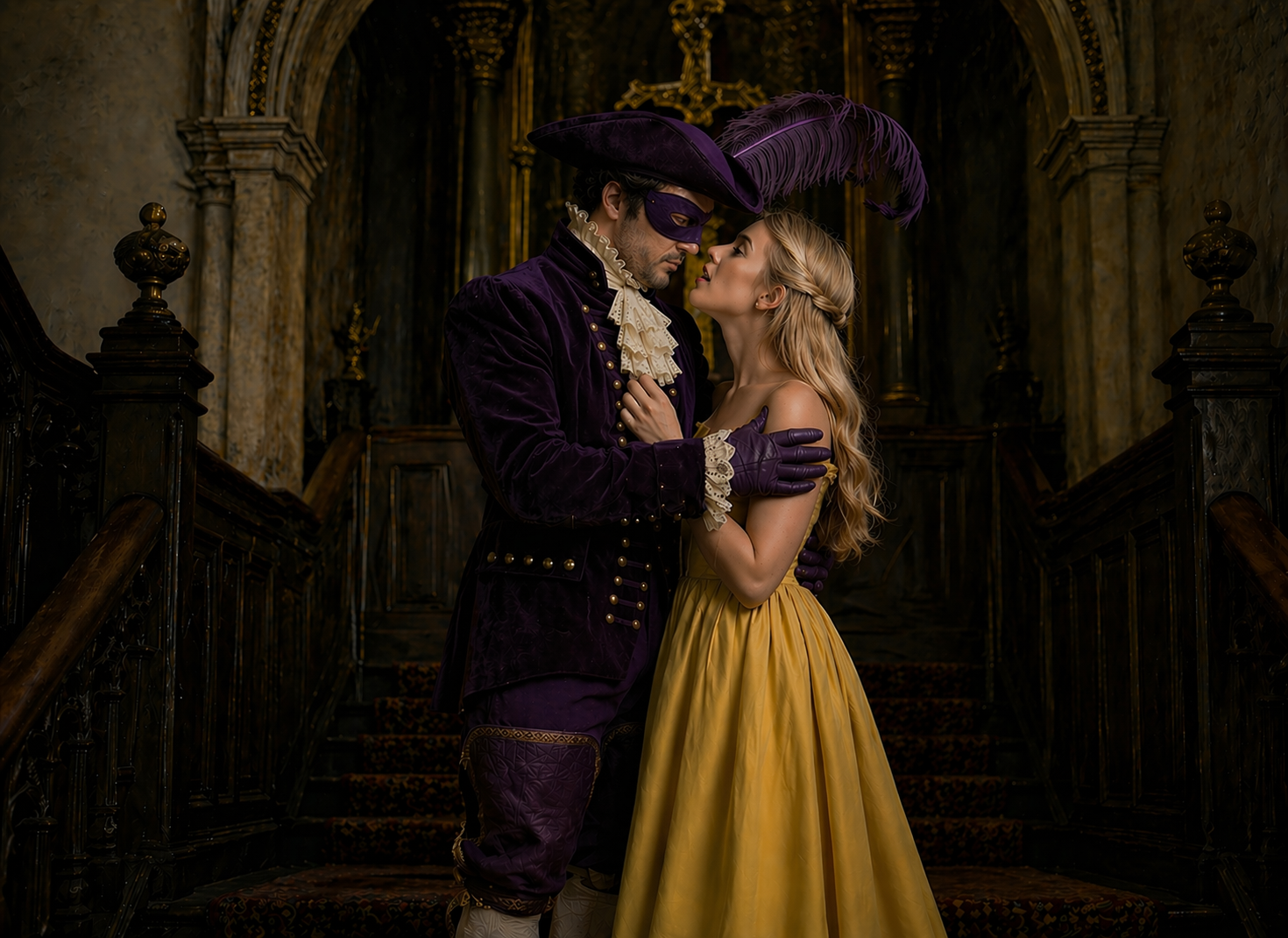
"Oh, my goodness," he said. "You can't be found with your dress in this condition. Here, let me help you." He stepped close to her and put his hands on her naked shoulders. Her skin was smooth, and he gently pulled her sleeves downward until he saw the tops of her breasts. He took her hands and began to gently massage her palms. Then he slid his hands up her arms and neck to her temples, which he rubbed with soft, circular motions. He said, "Look at me, the eyes behind my mask. Shhh. Just look. We need to, uh, fix your dress. Where should we go?"
"In here," the girl whispered. To her right was the closet that held the choir robes.
Voices at the top of the stairs!
"Quick," she said. She opened the door, and there was a momentary rustle of robes–then absolute darkness. Her mouth was wet, and as they kissed, the voices passed by them and continued down the stairs.
"What do you want me to do?" she asked in a husky voice.
That was Mack's favorite question.
Then there was Annie Parnell of Effingham in an empty bedroom at the home of Mayor Parnell. "Where's Annie?" asked a voice in the hall. "I want her to meet the Purple Knight. That's a story she can tell her children." She was already entering the story–or should I say, the story was entering her?– but it wasn't one she would ever tell her children. (Annie was the first to remove Mack's mask and tie it over her own eyes. She was only playing–she giggled at the way his hair stood awry when she pulled the mask over his head–but when the Knight saw her dark eyes looking at him through his mask, he was overwhelmed by a surge of volcanic desire. Down, down, further down, his ardor sucked the girl into a hot-breathed maelstrom of palpations and palpitations and, dare I say it, penetrations. Their thrashing rose and fell while the sonorities of the wise elders and the clatter of coffee cups ascended in a reassuring murmur from below. Then a voice above the hubbub, "Where is that girl?"
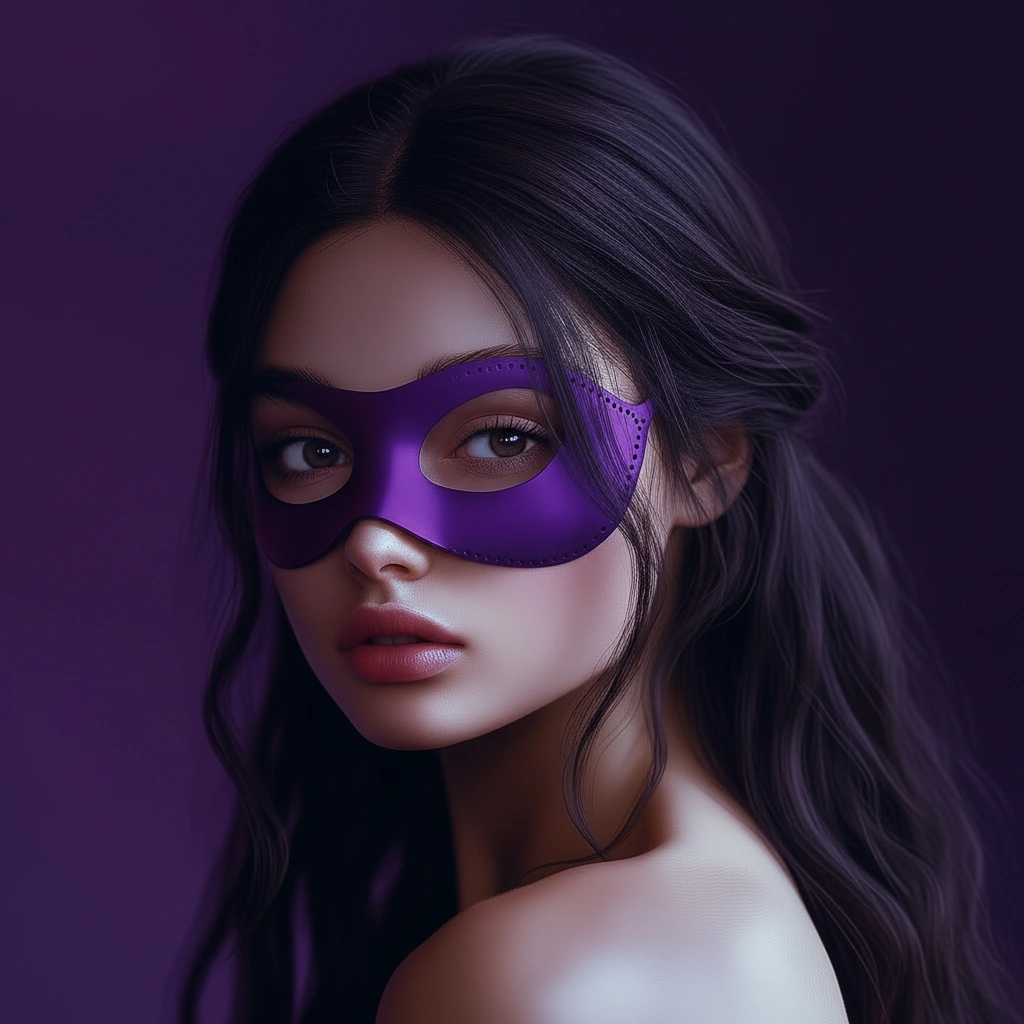
And, of course, he didn't forget Ellen Depew in Cincinnati, who showed the Purple Knight first to his room and then to her knickers. He remembered that Ellen sat on her bed and patted it as an invitation for him to join her. He did, and all in a moment, they became hands and lips and passionate whispers. Suddenly, footfalls! They halted in breathless, heart-pounding silence, and then the light beneath the door dimmed and darkened, and a door closed. A sudden exhalation, a suppressed titter, and the continuation of pleasure.
How delightful were the soft palms, wet mouths, and yielding, supple bodies! How pleasant the moonlight streaming through the window to shine on hair that fell to pale shoulders! What ecstasy to enjoy so completely the innocent girls whose eyes shone with awe! The girls were like cherry pies sitting on a kitchen sill, warm and sugary and anxious to be pilfered.
It's crazy how easy it is, he thought. The purple mask, the doublet and breeches, the sword with an amethyst hilt, the play of hypnosis, the romantic story, and the thousand miles of travel were all it took to breach the ancient proprieties, the rules and prohibitions enforced by vigilant fathers and suspicious brothers, and the deeply sown threats of hell.
Ah, but it was the proprieties, the fathers, brothers, and hellfire, that gave the whole escapade its flavor, its pepper and vinegar and sweet, dripping honey. The proprieties transformed the deception into an adventure, and Mack thrilled at the deep voices outside the door while some pretty girl smoothed out the coverlet and he hid beside the door.
But what would Mack say if he were caught bare-assed–em-bare-assed– between a girl's legs?
He would say nothing because nothing would avail. Disgrace and perhaps death awaited him on the other side of the abruptly opened door.
What fun!
Mack recalled with passing regret poor, sweet Maud, the girl who cleaned rooms in Portsmouth, Ohio, and had "never seed a real Knight before!" She was agog. Agape. Accommodating. When he departed later that morning, she saddled up her pony to follow him.
"Wait up, Mr. Knight! Please, don't leave me!"
Mack kept craning around and telling her to "Go home! Go on home! Git!" but Maud started crying, and he didn't know what to do. So, he let her follow him into the woods where he enjoyed the girl one last time before abandoning her.
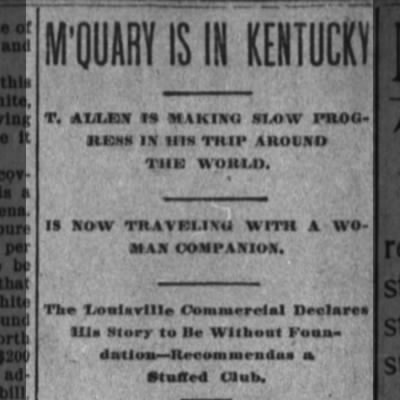
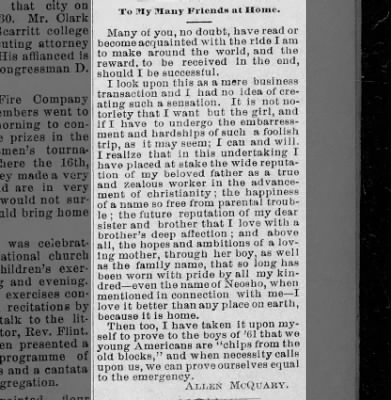
Headline from the Springfield Leader and Press, Friday, Nov. 26, p. 3
Mack loved the word "girl," beginning as it did with a growl and concluding with a curl rather like a wave crashing on a beach: He always preferred a "girl" to a "woman" who is but a "girl" grown frowsy like a blown rose with browning petals, an "old girl" and so no longer a girl at all–the term "old girl" being more suited for a mare than a woman, though the word "woman" is clearly more "mannish" than "girlish" and therefore signifies "woman" as a "woe" to "man."
And, he thought, the word "girls" is much better than "girl" because the plural "s" sounds like a "z." "Girls" evokes the predatory growl of a hungry panther–grrr–followed by a crashing wave–url–and concluding in a satisfied and purring zzz. Gurrrlzz. Tell me, where is the man who doesn't prefer the plural "girls" to the singular "girl"? Nowhere. Such a man is not to be found, though every convention of society exists to persuade a man that "a girl" (singular) is somehow morally preferable to "many girls" (plural), and "a woman" is morally preferable to both. But Glenn was right: "Every story, every real story, is about cherry pie, a singular metaphor for promiscuous pleasure." And that, thought Mack, is the first principle of good business!
Such is the attitude of all young men on an adventure, and young girls would be well-advised to remember that.
The hawk had soared higher until it became a mere speck in the distant pale-blue sky, when it shrieked, a cry attenuated but nevertheless shrill and clear, and Mack discovered he was alone and sitting atop Rozinante who was tugging with her teeth at a tuft of grass. He rubbed his forefinger between the mask and his cheek.
"Well," he said aloud to the autumn emptiness, "I can at least take off this damned thing." The mask had begun to chafe, and even worse, he had spotted a blemish on his nose and a trail of blackheads on his cheeks from the sweat and irritation.
Besides, there's no one here but me and Roz. And the hawk.
In a stern voice, he addressed his mask, "That nothing may mar my perfect skin, I repudiate thee, Mask!" He tied the strings and hung the loop over the saddle horn where the mask dangled, two eye holes looking out at nothing.
Then another thought followed.
I wonder if Glenn is banking the money I send him.
Mack calculated the total amount he had wired back to Glenn to be somewhere in the neighborhood of six hundred dollars. Of course, he kept enough in his saddle bags to cover lodging and meals and occasional emergencies, but it would have been hazardous for him to travel the empty roads with too much cash. Highwaymen and other outlaws nested in the hills and by the creeks, and a Purple Knight was easy pickings for such desperadoes.
Indeed, he had been easily picked back in central Indiana: Three fellows had run out of the woods, shooting pistols and hollering threats. Rozinante reared up, but the Knight held onto the pommel, and she settled down when the leader of the ruffians grabbed her bridle.
Here's what happened:
First, they laughed at his clothes–which the Purple Knight expected because that's what people everywhere did–until they realized who he was, whereupon their mockery turned to respect:
"Hey, Billy, this here's the Purple Knight what was written up in the paper!"
"Hot damn! The Purple Knight!"
"That cartoon didn't do him justice. Did it, Johnny? It made him look . . ."
"Frivolous?"
"Yeah. Maybe. I was thinkin' silly."
"Okay, silly, then. 'Silly' seems mighty close to 'frivolous' to me, but what do I know?"
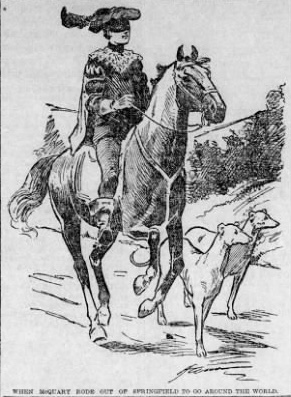
The Kansas City Star, Sunday, Nov. 6, 1898
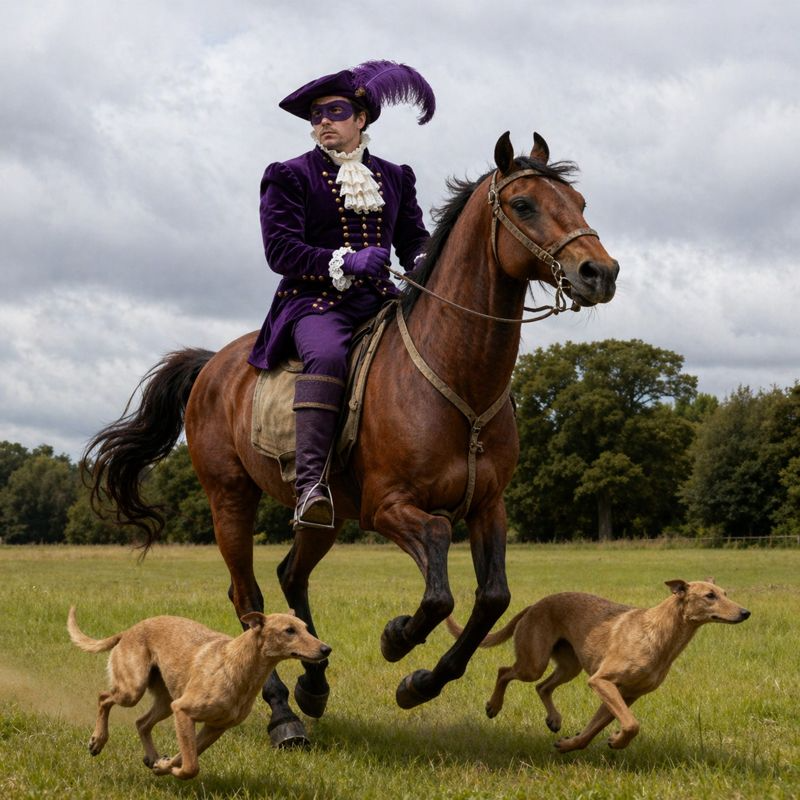
AI rendering of the 1898 newspaper illustration
Then Billy again, "We're sorry to do this, but we're gonna have to rob you, Sir Knight."
"He does look silly."
"Shh."
The Purple Knight said, "Well, you don't have to."
Johnny said, "Kinda, we do. It's our job. You cain't blame us for laboring in our vocation. And it's Shakespeare that said that."
The Purple Knight said, "Oh, all right then. Look in the left saddle bag. The money clip is on top."
Billy lifted the flap of the saddlebag and took out a thin sandwich of cash, which he unfolded. "There ain't but six dollars here."
"My quest requires that I must travel penniless."
Sam asked, "If yore penniless, how come you have six dollars? That there's a contrary."
Johnny said, "Is it a contrary or a contradiction? That always confuses me."
But the Purple Knight said, "I hacked ties for a week outside of Olney, and that's all the money I have left."
Billy said, "A contradiction." Then with some admiration, "Huh. Well, if you can hack a tie, you're more than a suit of purple clothes. I tried it once and thought, 'That's it. No more honest work for me.' That's when I turned robber."
So, Johnny asked, "You got anything else of value?"
"Not unless you want some purple clothes."
The men laughed and said, "No, thankee!"
"I do have my sword from the Knights of Pythias." He started to draw the sword from its sheath, but Johnny said, "Easy, there, pardner! We don't want to have to shoot you dead."
"No, no! I was just showing it to you. Anyhow, I would ask that you don't take it because it's part of my accouterments."
"Yore what?"
"My equipage. I give talks wherever I can, you know, churches, Masonic halls, the Chautauqua, any place that draws an audience, and, I have to tell you, people love the sword. So, I'm asking from the bottom of my heart, please don't take my sword. You can have the dogs, though."
Then men conferred with one another, and finally, Johnny said, "All righty, then. We'll take the six dollars, one of the dogs, and let you keep the sword."
Sammy said, "I told you we don't need no more dogs."
Johnny hissed, "Shut up! I want that dog."
"But we already got five dogs."
The Purple Knight asked, "Could you leave me at least one dollar? I have to eat."
Another conference, and then again from Johnny, "That's fair. We'll take five dollars and leave you one, and here, here's a hindfoot Sammy cut off a rabbit the other day."
"Well, I appreciate that."
"Safe travels, Mr. Knight!" said Billy.
Sammy said, "Tell the little gal from Arkansaw we said, 'Howdy!'"
So, the Purple Knight resumed his travels, happy that he'd wired the bulk of the money to Glenn before he left Hagerstown. He told the story of the courteous robbers to the Baptists in Rushville, and they loved it, but he continued to revise the tale as he traveled. A long journey provides ample opportunities for revisions, abridgements, and fanciful embellishments.