Chapter Thirteen
Our Hero Receives a Lesson in Local Lore
Williamson, Kentucky
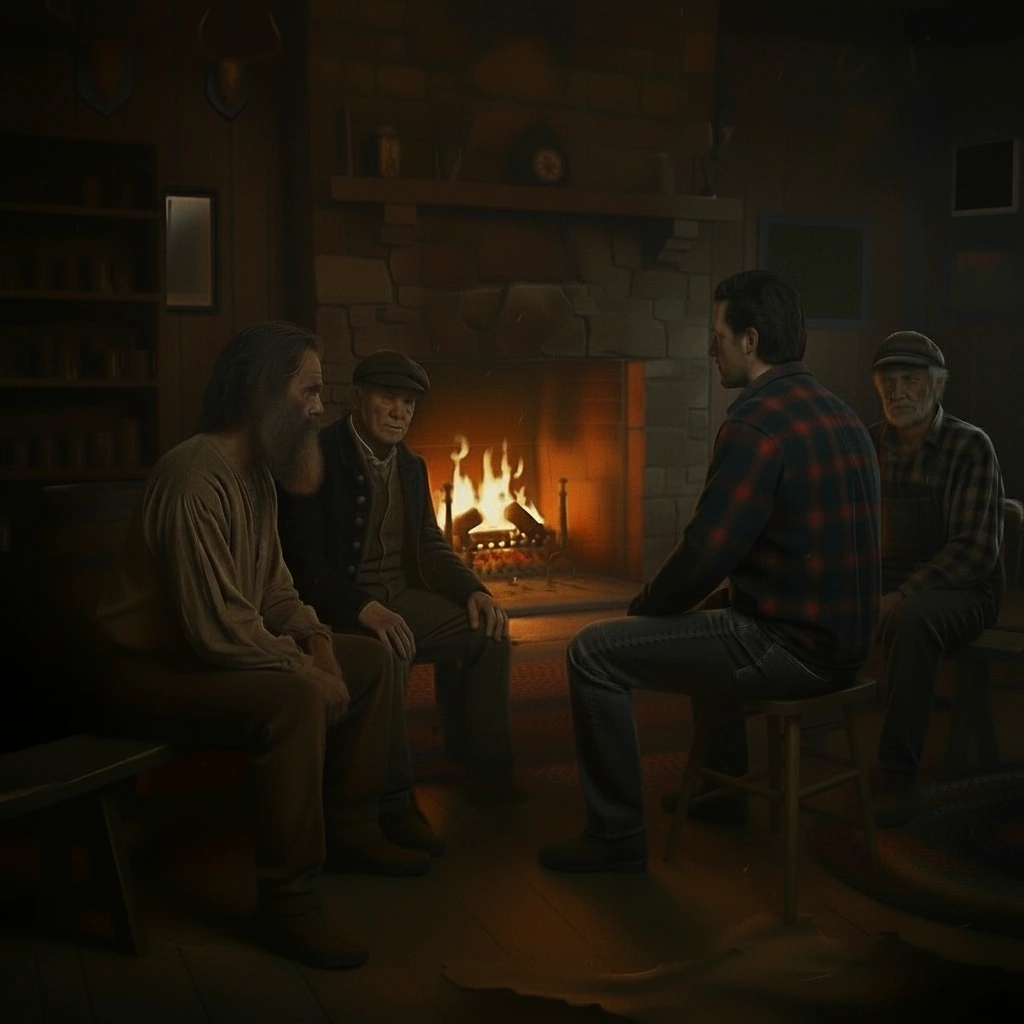
Eight o'clock that night, and Mack was relaxing in the common room of the Broadmoor House outside of South Williamson. The walls were planks snugly fitted, the floors sanded smooth and covered with oval carpets variously strewn, and the hearth was equipped with pokers and long-handled pans; the heavy oak dining table was close to the door leading to the kitchen. Gingham curtains were drawn over the windows: all in all, a warm room in a snug inn that promised good rest. A fire danced and flickered in the fireplace, and a lantern glowed above the table. Three other travelers had pulled their chairs close to the fire, haggard men in flannel, overalls, and jeans dusty from the road. Mack watched the firelight playing on their weary faces as they stared at the flames. He wondered what thoughts and stories played behind their eyes.
Then a noise from the back of the room, and Mack turned to see a girl open the kitchen door and put her head in. He glimpsed brown hair and dark eyes before she retreated, and he felt her sudden appearance as a familiar surge of warmth.
There's a girl in the kitchen!
Kitchens, Mack had read in one of his mother's magazines, are the loving heart of the home, genial rooms redolent of roasts and potatoes, cherry pies and fresh bread, steaming pots of soup and tubs of warm water for cleaning the dishes. Kitchens reflect a woman's desire to care for and please her family and so should be maintained in a state of comfortable tidiness, neither sterile nor cluttered but just right.
Mack, like all men, agreed.
The girl's in the kitchen, and the kitchen's in the girl.
He heard her voice, pleading and insistent, behind the closed door–at least Mack presumed it was her voice–followed by the guttural sputtering of a man–presumably the girl's father–whereupon a woman remonstrated both of them in a vigorous harangue of German and English, the effect of which was to propel the man, who wore a stained apron and greasy Tyrolean hat, through the door and into the common room to ask, "You vant bier, yah?" Mack said, "Yah!" and held up four fingers and then circled his forefinger to include the others.
The man said, "Okee," and left.
One of the travelers, a little man with wild whiskers and arthritic hands said, "Well, that's mighty kind of you, stranger. Thankee." The other men nodded their appreciation.
Mack said, "You're welcome. I figure we could all use some good cheer."
The host returned with two steins in each hand and set them on the table. "Two bits for alles, yah?"
Mack said, "Yah," and gave him two bits with a short bit tip—a dime to those unschooled in 19th century coinage.
The man said, "Bitte! Gott's blessins auf Sie," and left again. They could hear the woman speaking in her sharp-tongued pidgin, and the girl whining, "Mama! Bitte!" Then silence.
The men lifted their steins, drank to Mack's health, and began talking about the sorry condition of the road and how long it's been since they had a good rain and the price of hogs. Suddenly, Mack held his fist to his sternum, barked a peremptory belch, and said, "That's better. Now…what can you fellas tell me about the Hatfields and McCoys? I read about some of their shenanigans in the Big Sandy News, and it sounds like quite a story." The men glanced at one another and pursed their lips and remained silent.
"What's wrong?" said Mack.
An old fellow who wore a faded blue GAR jacket said, "No offense, but you're a stranger same as us, and a pint of beer don't change that. How do we know you ain't kin to one of the factions? Why should we chance on making enemies for ourselves by saying things best left unsaid? When I was in the War, I risked my life too many times to risk it again when I don't have to."
But the wildly whiskered little man said, "Hell's bells, I'll say what I damn well please. M'name's Hamby, Marv Hamby, and I'm a drummer. Pots 'n' pans 'n' ladies necessities are my wares. Now, I may not know any more than what you read in the papers, but I do travel from one house to another in these parts, and people do talk; I won't say their names, but I'll tell you what they told me."
Mack said, "My name's Mack, and I'm much obliged."
So, Marv Hamby told Mack the story of the Hatfields and McCoys, while the other men in the room couldn't resist butting in from time to time to correct a mistake or add a piece of information. Mack couldn't keep all the names straight–who could?–or remember every story about who killed whom or even who stole the original pig. But he did remember Alifair McCoy and the burning house and the jar of spilled milk. He also remembered the names of Jonce and Rosanna and Devil Anse Hatfield, the murderous father who was recently baptized and washed in the blood of the Lamb and was hiding from the law somewhere in the mountains. And he remembered Anse Hatfield's son, Cap, who shot Alifair and her brother dead, though Ellison Mounts hanged for the crime.
Marv Hamby said, "Mr. Cline was Mounts' lawyer, but he was also lawyer to the Hatfield clan, and he tricked the boy into confessing the crime. Cline told him he'd get life in prison at the worst, and it wouldn't be life anyhow cause 'if you keep your nose clean and do what the jailer tells you, I'll get you out in five, swear to God.' Mounts was scared to death of the Hatfields—he had made a deal with the devil, so to speak—so he confessed to killin' those kids. Wasn't two months later, they strung up Ellison Mounts on the courthouse square. Maybe 'twas Ellison's hanging that made Anse feel bad and turned him to religion, who knows? Or maybe Anse ain't turned at all. Maybe him repentin' and getting baptized warn't nothin' but a big show. Why, him and his boys might be somewheres outside this very hotel right now and conjurin' devils by a campfire." His voice trailed off into a whisper of ominous conjecture.
Mack asked a couple more questions and reviewed the various names of Hatfields and McCoys, and finally, he said, "Thank you, Mr. Hamby, gentlemen. That is one helluva story, for sure. Now, it's time for me to go to bed." Mack went to his room and by the light of a candle began sketching the outlines of a story. He wrote words and scratched through words and replaced words with other words until he snuffed the candle, climbed into bed, and rode Rozinante to the inn at the edge of the world. His last imaginary vision before the descent into sleep was of a door in the common room of an inn and brown-haired girls emerging to surround him and swallow him into themselves.