Chapter Fourteen: The Purple Knight Tells a Whopper
How to make bank with other folk's stories
November 14, 1897 • Pikeville, Kentucky
When Mack arrived in Pikeville on Friday evening, he rode down Main Street in full purple panoply and let the people gawk. On Saturday morning, he strode the streets and alleys, introducing himself and passing out flyers. On Saturday afternoon, he besought (successfully) the postmaster to sign one of his certificates (which he carefully pasted into his scrapbook), and that evening he dined on beef and butter beans with the mayor and his wife. Then came Sunday morning, a sunny Sunday and warm for November, and Mack donned his cleanest costume with punctilious, one might even say "pietistic," care.
Church attendance was, of course, required by the contract so that Mack might remain in the trim, morally speaking. Everywhere the contract was promulgated, this stipulation was emphasized. Consequently, the consensus of most folks was "He's strange enough, all right, but he's a church-going Christian, so he must be telling the truth," one enthymeme being that every churchgoer is a Christian, and another that every Christian is honest. Mack was not the first to take advantage of such fallacies and would not be the last. Mack always attended the church at which he would speak for obvious reasons: a ready-made audience, a demonstration that he somehow "belonged," and the support of the preacher. These were invaluable assets in drawing a crowd.
The faithful had begun to gather on the steps of the General Baptist Church, the men staid and stolid in their black bowlers and suits and the women chirping and preening in their extravagant hats and long dresses. The children hopscotched on the sidewalk and chased each other up and down the stairs. The scene resembled an unlikely convocation of crows and songbirds and tittering sparrows, an assemblage of diverse species ushering in God's Kingdom of universal harmony–as long as every bird was General Baptist, of course. Mack watched them from behind a tree. Soon, the men began tapping out pipes and snuffing cigars to follow their women up the stairs. The children were summoned, too, of course, but they pretended not to hear, so the fathers called out harsh words whereupon the children, subdued and sullen, straggled upward where the mothers received them by kneeling to slick errant hairs back in place. Soon, the old story would be told again, and because every hair had been counted and recorded, every hair must be in place. Then the church bells began to chime triumphantly as if the Second Coming were at hand, and–like that!–the stairway was empty. Still Mack waited behind the tree. After the last "bong" faded into the open sky, he crossed the street and walked up the deserted stairs to the sanctuary door.
Now attend to Mack's well-practiced performance.
He waited until the choir finished singing the opening hymn, and only then did he crack the door to enter the church. However, when he turned to close the door, he let the Knights of Pythias sword "accidentally" bang against the door jamb. Of course, that caused the folks to turn around, whereupon Mack heard gasps and whispered acclamations of "He's here!" "That's him!" "The Purple Knight!" He whisked off his chapeaux in a gesture of humility and piety, nodded in embarrassment, and gave a little wave that communicated his apologies at disrupting the service. He even made a show of gripping the sheath of his sword as if to suggest that the darned thing was always getting away from him to bang against door jambs in churches. After this little introductory act, Mack took a seat in the back pew and bowed his head. Mack had learned early on that the posture of prayer tends to divert people from their curiosity and excitement to redirect them once again to the preacher, a man jealous of his centrality. Also, gestures of public piety tended to balance the effect of the costume and the banging around and the circus of his presence.
Lionel Girard, the preacher at the Pikeville General Baptist Church, was a tall fellow with angular features, a well-tailored suit, and a fine head of black hair gone silver at the temples. He was welcoming his flock to worship, but when Mack lifted his head, Pastor Girard interrupted himself and said, "Well, you made it! I received a telegram from a Mr. Glenn informing me that you would be joining us this morning. We're pleased to have you." As if on cue, the congregation turned again to stare at Mack. They looked like a herd of cows watching a passing locomotive.
Mack stood awkwardly, all the while clasping his hands and nodding. He said, "Thank you for welcoming me, Pastor Girard. It's such an honor to worship with you and your congregation this morning. You have a beautiful church."
(Here are two tips for the aspiring fraud: First, use the ambiguity of language to your advantage. The word "church" can refer to the building or to the people in the building. When Mack said, "You have a beautiful church," he was complimenting both the congregation [implicitly] and the structure [explicitly].
The second tip has to do with terms of address, particularly with regard to men who consider themselves superior because of their title, especially titles bestowed by religious ordination. For example, Baptist and Presbyterian preachers prefer to be called "Pastor," Methodist preachers prefer "Reverend," Pentecostal preachers want to be called "Brother So and so," and, of course, Catholic priests are called "Father." One can't really make any headway in this world unless one calls men by their preferred title, regardless of their supposed humility.)
"The Good Lord does provide," said Pastor Girard. "By the way, everyone should know that Mister–it's McQuary, isn't it?"
"Yessir, That's right. T. Allen McQuary."
"That Mr. McQuary, better known as the Purple Knight of the Ozarks, will be speaking here Thursday evening at seven o'clock, so please invite your friends and neighbors to join us. Am I to understand that you'll be sharing your adventures thus far?"
"Yessir," Mack said again. "And I've had some doozies."
Pastor Girard chuckled amiably and said, "We're looking forward to your 'doozies.'"
(Sorry to interrupt, but here's another tip: You employ words like "doozie" at your own risk. Used correctly they communicate a whimsical spirit, but if you overdo it, you'll appear juvenile and so sacrifice your credibility. Mack, of course, knew what he was doing.)
Back to Pastor Girard. "And we might even be able to help you out with a love offering, Mr. McQuary."
Mack smiled warmly and said, "I would most definitely appreciate that. And so would a certain young lady in Arkansas. I'm not sure about her father, though. He doesn't seem to support my success in this venture."
Laughter.
Mack's performance was working with the precision of a Prouty press.
Ka-diddle–ka-daddle–ka-thump–shp!
Mack sat back down–it was time to cede centrality to the man in the pulpit–and Pastor Girard preached a fine message about loving one another and forgiving one another and inviting the Lord Jesus to live amongst us in our trials and suffering. Pastor Girard did not threaten his people with divine wrath. He never raised his voice. Instead, in a voice peaceful and reassuring he said, "The Cross is a door that opens both ways: we walk through the door and into God's grace, and the love of the Father shines through the door to enter our hearts. We find out who we really are when we pass over the threshold of the Cross. And isn't that a question that concerns us all our lives: who are we, really, deep down? Only through Christ will that question be answered."
Mack felt a twinge of conscience, but he repressed it. He had come too far to turn back now. Besides he knew who he was: Like everyone else, he was a liar and a fraud.
The only difference is, I know I'm a liar and a fraud.
After the service, Pastor Girard and his wife, Mary Anne, invited Mack to their home for lunch, and Mack happily accepted. Imagine his joy at finding they had twin daughters, Margaret and Charlotte, who sat at the table and delighted Mack with their silly chatter and laughter and mild teasing. Mack wondered (but for only a moment) if he might somehow persuade the girls into more intimate entertainment when he caught the keen eye of Pastor Girard. The pastor was still smiling, but his was a hard smile with the corners of his mouth pulled back a fraction too far and the wrinkles at the corners of his eyes gathered into suspicious consideration. Mack knew then that Pastor Girard would castrate him with his own Sword of Pythias if he should so much as wink at Margaret or Charlotte.
That afternoon Mack checked into the Westward Ho! boarding house where he lodged for the duration of his stay in Pikeville.
On the evenings preceding the lecture, Mack set up outside a cafe and told jokes to entertain the crowd. Somebody asked for a story, and he said, "Now, you're going to have to come to my lecture to hear my stories. No point in spilling the beans before they're served, now, is there?" The folks reluctantly agreed that, no, it wouldn't be good to spill the beans before they're served. Then Mack said, "Please invite everyone you know to come. I'll be at the Baptist Church this Thursday, and there's room for everybody."
"What time?" asked a girl with blond hair and blue eyes and a pink complexion. She wore a periwinkle dress with a white collar. Mack judged her to be somewhere between seventeen and nineteen years of age. She was perfect.
"What's your name, dear?" he asked.
"Sally."
"Well, Sally, alas that I am pledged to a girl who awaits my return in Arkansas, for never have I seen so fair a virgin."
Sally blushed in reply.

"But to answer your question, my lecture starts straight up at seven. It's free and open to the public. I hope you will deign to attend."
Free and open to the public are the magic words of American civic life. People will come to a rat breeding contest if it's "free and open to the public." Anyhow, Mack told a couple more jokes, and a prosperous looking fellow asked, "May I buy you lunch?" to which Mack responded as he always did, "Why, thank you!" Which is, of course, why Mack had chosen the site of the cafe in the first place. It turns out the prosperous man was Bill Jeffries, the editor of the Pikeville County Post, and he and Mack had a fine time talking about the newspaper business and the advantages of different kinds of presses and the role of sports and popular entertainment in modern publishing and the rise of yellow journalism and, of course, the journalistic commitment to the truth. After lunch, Mack sat for a formal interview with Mr. Jeffries, and the article ran on Tuesday morning.
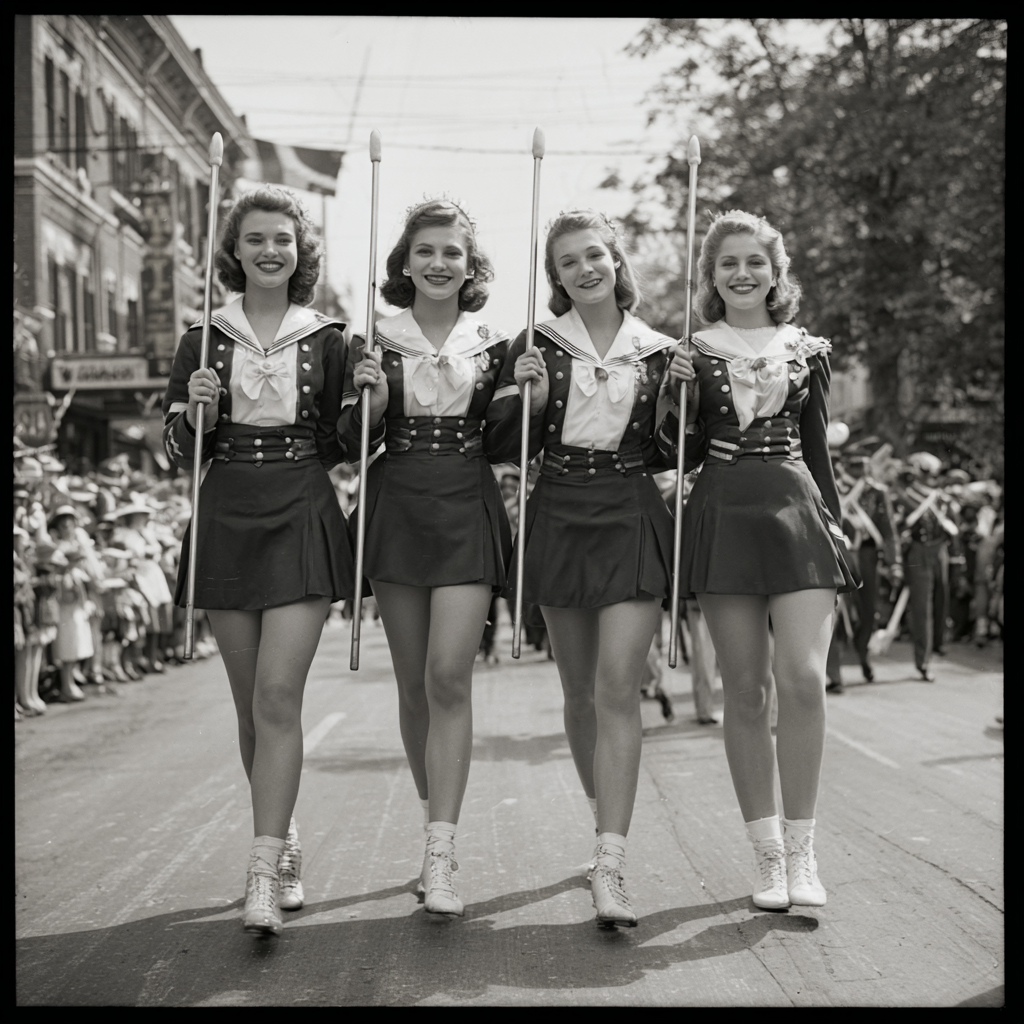
On that same Tuesday, Mack was hosted at a luncheon held in his honor by the Ladies League of Pikeville. He gave a fine after dinner speech about chastity and womanhood and the role of the mother in raising virtuous children, and the mayor's wife bestowed on him the key to the city. Then came Wednesday and the inevitable parade with Mack as the Grand Marshal, of course. Leading the parade were pretty girls in short skirts and holding batons; they were followed by the high school marching band, and finally, came Mack sitting on the upper bench of a stagecoach whence he waved to the crowd and threw peanuts and peppermints to the children. Johnson's Five and Dime provided the treats; Mr. Johnson also paid Mack five dollars to hang an advertisement on the remaining greyhound who lagged somewhat disconsolately behind the coach. The banner read:
"For a doggone good time,
Come to Johnsons' Five and Dime."
The best thing about the Pikeville parade was the girls in short skirts, and Mack watched them with mounting admiration.
Then Thursday night came and the sanctuary of the General Baptist Church bustled with chatter and the grunts of people squeezing next to one another in pews. Mothers were trying to wrap their arms around whole laploads of squirming children, while the menfolk smushed against them. Late comers stood along the back and sides of the church. Mack waited by himself in the chancery and listened to their excited voices as he gathered the energy into himself.
After a hymn and the singing of "The Star-Spangled Banner," Pastor Girard gave the Purple Knight a sterling introduction in which he attested to his good character, elaborated on his single-minded devotion to the "love of his life," and reminded the folks that all people are on a quest for true love. Then, he proclaimed, "Ladies and gentlemen, I present to you: the Purple Knight of the Ozarks!" The Knight strode from the chancery and onto the dais, and the crowd erupted into wild applause and piercing whistles and shouts of "Yea!" and then they were on their feet, clapping and cheering. The Purple Knight raised his hands (but only shoulder high) to acknowledge and receive their adulation and lowered them to bring down the hullabaloo. But it didn't work. The people applauded all the more loudly, so the Purple Knight bowed in a munificent gesture of feigned humility. Again, he raised his hands and again he lowered them, but the swell of applause gathered itself into a roar and mounted higher. Finally, the Purple Knight took his place behind the pulpit and said, "Thank you! Thank you so very much! Thank you." Some of the people began to sit, and the applause dwindled, and the Knight said, "Thank you. Thank you again! Thank you." The hubbub subsided, and the congregation sat.
"I'm happy to be here with you this evening, happier than you might guess after what I've been through. The ferry ride to Ashland was uneventful, and my stay at Catlettsburg was pleasant, but the journey south to Louisa, well, that, my friends, was another story." The Purple Knight paused and let the anticipation hang there. "As you might guess, a purple costume does not always attract favorable attention. Usually, my quest precedes me, and most of the people I meet have read about my journey and know why I have to dress like this. Occasionally, however, I suffer insults and ridicule, verbal slings and arrows I gladly bear for the sake of my beloved girl. As you know, these purple clothes are a sign of romance and true love, the ever fixed mark, as Shakespeare called it, but only to those who know. So it is that I often travel at night in order to avoid meeting people on the road, for I never know when insults will turn to blows and taunts turn into cudgels.
"Well, around two weeks ago, Roz, my faithful steed, and I were making our way by moonlight along the Big Sandy Road. The moon was full and silver light was spilling over the forest, and it was bright enough for me to see the shadows of the trees across the road before me. On my left and between the trees, I could just make out the river glittering with silver ripples, and I heard the occasional splash of a fish as it fell back into the water; on my right were the dark woods. The night was chilly, and somewhere in the distance came the mournful screech of an owl and the squealing of coyotes on a hunt. A typical night in Kentucky, am I right?"
The Purple Knight paused and observed the congregation. The good folks of Pikeville were nodding in agreement. They could see the moon-milky road laced with shadows and hear the distant owl and coyotes. They felt the mystery and menace of the night.
I've got 'em where I want 'em.

Then the Purple Knight continued, "I was riding along feeling reasonably safe until the trees closed in around me, and I found myself in a black forest tunnel. Suddenly, Roz whinnied and reared up–something she's never done–and at that same moment, I felt a cold hand on the back of my neck. My blood froze, and I was almost overwhelmed with terror. Two cold lips touched my ear, and I heard a low whisper, 'Whate'er befalls you, you must go forward.' The hand left my neck, and I reached behind me but nothing was there. Then I felt a slight pressure on my stomach, as if something or someone had put their arms around me and was holding on. I thought I might fall from the saddle, I was so fraught with fear.
"Finally, I mustered the courage to ask, 'Who are you? What do you want with me?'
"'My name,' the voice whispered, 'is Alifair McCoy.'
Again, the Purple Knight paused to let the name work its effect. It was the ghost of poor, murdered Alifaire McCoy!
In a low voice, the Purple Knight continued, "This time, terror seized me completely, for I knew the story of beautiful Alifair–Randolph McCoy's young daughter who had been shot to death in cold blood after the Hatfields burned her and her family out of their cabin. The story goes that she had run outside to throw a jar of milk onto the flames, but when her slight form–she was only fourteen, a mere child–I say, when her delicate body was silhouetted against the leaping flames, someone with the Hatfields–maybe Cap, maybe Ellison Mounts, maybe Devil Anse himself– took aim and shot poor Alifaire dead."
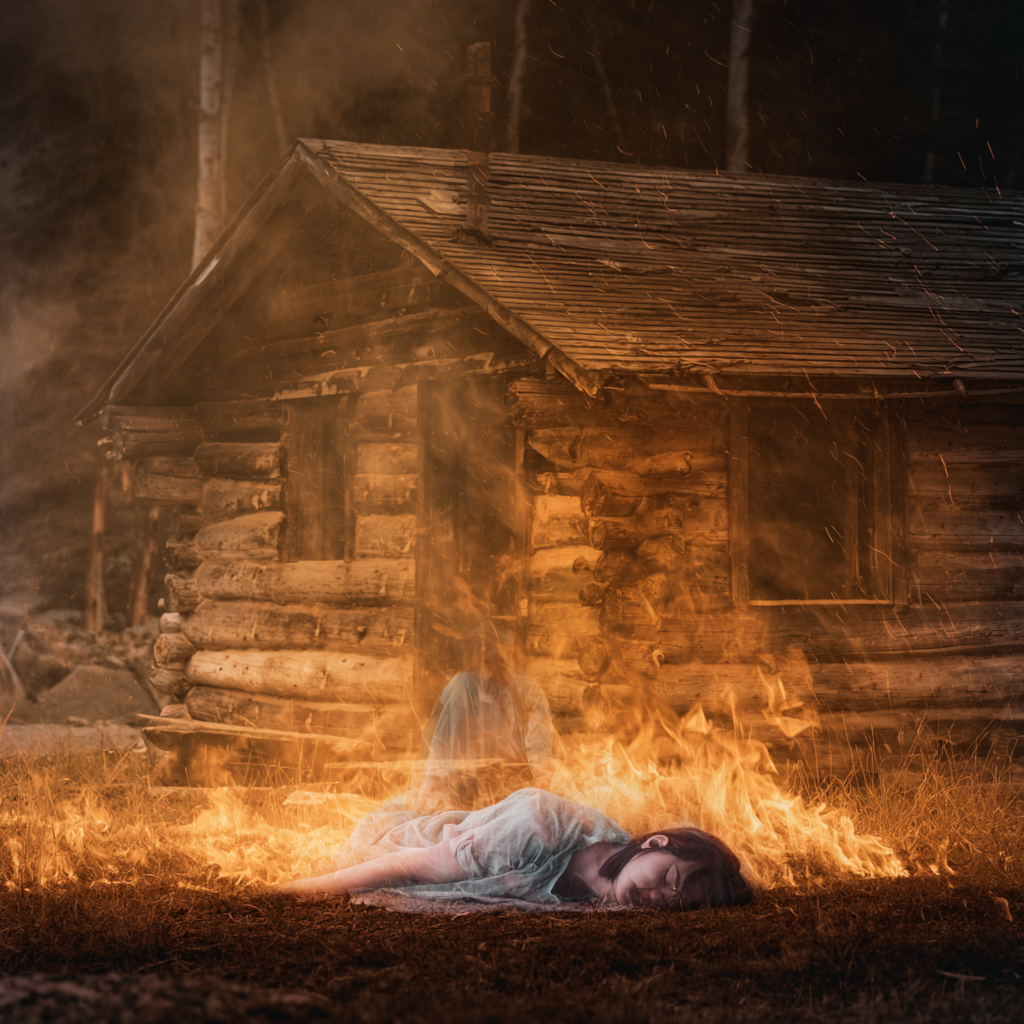
"Her brother Calvin ran screaming to her aid, and in the ensuing hail of bullets, he, too, fell dead. Pitching forward onto her still warm body, he cried, 'Heaven receive our souls, dear sister!' In the meantime, the rest of the McCoy family fled as best they could into the woods, and though the night was bitter and their clothing thin, they survived to tell the world of the cold-blooded murder of the two innocent children.
"But you all know the cruel story better than I ever will, for you have not just read about it, you have lived it." And again, the good folks of Pikeville nodded their heads. Yes, they knew the story of the McCoy and Hatfield feud all too well, and in their minds, they saw pretty Alifair fall to her death beside the cabin. They saw the jar tumbling from her hands, and the milk spilling into the dirt and leaves. They saw her loyal brother running to her side and collapsing on her body. They saw the whole tragic drama backlit by the fire of the burning cabin.
The Purple Knight continued. "So, you can imagine my terror when the voice said to me, 'My name is Alifair.' Deeper and deeper into the dark woods my ghostly companion and I rode, her light hands still pressed to my chest. Then once again I felt the cold lips on my ear, 'Pull up and dismount. I will lead you.' I did as she bade me, and while I was tying my pony to a low hanging limb, behold, I saw a mist hovering in the night. The ghostly soul of Alifair possessed a slight luminescence like the pale glow of a firefly or phosphorus in the blackness of a cave. You may doubt my story and consider it naught but the wild imaginings of an impressionable youth; you may say that all I saw was a stray beam of moonlight through autumn trees, but I swear to you by the Holy Word itself that all I say is true!" So saying, the Purple Knight returned to the pulpit, lifted a Bible, and held it above his head. "As true as the floating ax head of Elijah or the great whale of Jonah or the motionless sun over Jericho, so is the truth of my tale!"
The Purple Knight left it to the good folks of Pikeville to sort that out.
"Deeper into the woods the faint mist led me, and it seemed we had walked for hours when between the trees I glimpsed the bright glow of a torch. The spirit turned to me and whispered, 'We must be very quiet. Come closer.' We crept as quietly as two cats. Then Alifair said, 'Look.' We peered around a massive oak and watched a scene that will forever make my hair stand on end. A gang of men was pushing into a clearing two young people, a boy and a girl, both of them blindfolded with their hands tied behind their backs. In the middle of the clearing was a pile of rocks that resembled nothing less than Isaac's altar, and onto this hideous cairn, men began heaving armloads of sticks and limbs. The young man began struggling mightily with his bonds, but an old fellow with white whiskers said, 'Struggle as you like, Jonce Hatfield, there ain't nothing you can do. It don't matter that you're my son. Maybe your mother played me false. Maybe a witch placed another in your crib. What I do know is you have betrayed your own kin, and sins against blood must be paid for with blood.'
The spirit whispered, "That old man is Satan in human form: Anse Hatfield."
"I gripped the hilt of my sword and said, 'Lord bless us, but such a man would prove to be a fierce foe.'
"Then I heard the girl cry out, 'No, Devil Anse! Take me instead.'
"The old man replied, 'Don't ye worry none about that, Miss Rosanna McCoy,' and he spat the name 'McCoy' as if it were poison. 'You and him'll be bound soon enough in a marriage straight outta hell. That'll teach you both to honor your own blood.'
"I cannot describe in God's holy church the insults and violence those devils inflicted on that young couple, but after they finished, the boy and girl were hogtied and lifted naked onto the heap of wood. Then the men began to light their pine knots one from another until they stood around the altar with their torches lifted high. I knew then I was witness to a ritual from hell, and I trembled for that young couple and truth be told, for myself as well. What was I to do, one man against so many? Then the cold lips touched my ear and said, 'Go forth! I shall tell you what to say.'
"In a terrified whisper, I remonstrated, 'But they'll kill me, too!'
"'No, they will not. I will stand beside you. Go with a stout heart, for if you don't, those children will die the most horrible of deaths, the feud will continue, and innocent blood will soak the earth for another hundred years.'
The Purple Knight paused and began pacing back and forth on the dais. Then he spread his arms to the congregation and said, "I ask you, what was I to do? That I had been led to the central crisis of my life, against my will and without my invitation, was clear. At that moment, I was suspended in indecision, immobile at the threshold between courage and fear. But then I looked down at my sleeves, and in the dim glow of that hellish fire, I remembered, I wear a purple suit. I saw the amethysts in the sword hilt reflecting the fire in glints of purple, and I fingered the embroidered purple sheath of the poinard, stitched by my own true love. Yes, I remembered my Arkansas girl with her violet eyes and innocent trust, and in my heart I felt once more the nobility of my quest. I was traveling the world for the heart of one lady, that's absolutely true, but the knightly code also demanded I defend the honor of all ladies! That's what a man, a real man, should always be: A defender, a protector, and a bulwark, a man to be trusted! In brief, I remembered who I was. So as even as those devils were lowering their torches to burn alive young Jonce and Rosanna, I heard the voice whisper in my ear, 'Now! Now you must play the man!' With that, I mustered all my resolve, all my courage, and all my strength, and stepping from behind the tree, I said in a loud voice, 'Cease your Satanic sacrifice, men of the devil, and remember Christ our Lord!'"
"Their descending torches were suspended, and with a sweeping motion, all eyes turned to fix on me. The two young people cried, 'Who is this who comes to save us? God be praised!"
"But Devil Anse cackled, "Ain't nobody saved nobody yit. Looks like Lucifer'll have yet another soul come dawn. Git him, boys!"
"My heart was pounding in my chest, but I unsheathed the Sword of Pythias, and by the light of their devilish conflagration, the blade shone like a flashing arc of fire. 'By God, Lucifer will never have my soul. Do your damndest, you demons, for here I take my stand!"
Yes, Mack said "damndest" in the church, and he observed with smug confidence the indignation of many mothers and the furrowed brows of some fathers and the astonishment of girls whose pink mouths made perfect "o's." He saw the various reactions but knew the good folks of Pikeville yearned to hear the conclusion of the story; indeed, more than anything else in their lives at that moment, they had to know what happened, so Mack knew they would overlook his indiscretion.
Then, in a re-enactment of his heroic resolve, the Purple Knight faced the congregation and clenched the hilt of his sword. He lifted his chin. He paced. He held the people a moment longer, and then in a rush of words, he said, "The men around the altar pulled their knives–I thank God to this day that they were armed with blades and not guns, for I would surely have been shot to pieces–and rushed at me with their torches held high. One man whose face was twisted in hatred lunged at me; I caught him by the throat with my left hand and with my right impaled him with my sword. Then I kicked him off my blade, and his body sprawled backward against the gang. I took advantage of the confusion by slashing with all the power of this my arm." Mack drew his sword and held it aloft. "A man raised his hand against me, and a moment later, that same hand lay bloody on the forest floor, still clutching a knife. The man gripped his bleeding wrist, and I said unto him, 'Better for thee to enter the Kingdom of Heaven with one hand than to enter hell with both.' He cursed me in the name of Beelzebub, so I slashed again, and his head fell beside his hand. Another man grabbed me from behind and put his blade to my throat, but the ghost of Alifair shrieked, and when the ruffian turned to see who or what made the sound, I grabbed his hand, twisted it about, and thrust his own blade deep into his stomach. The man slumped to his knees, and behind him stood Alifair faintly shining. Then she moaned, 'Turn around!' and all of them were upon me.
"You may have heard of the whirling dervishes of Arabia. Well, I must have been possessed by that very spirit for I was tornadic in my violence. Heads toppled from necks and arms from shoulders. On the ground were scattered some six or seven bleeding corpses, so the few remaining men dropped their knives and torches and ran screaming into the woods. 'He's the devil incarnate,' they cried. But, no, I was possessed by something far greater: The Spirit of our just God had strengthened my right arm and, as he did for King David, he gave me victory!
"But there was no time to exult, for I looked up to see Devil Anse cackling and touching his torch to the dry wood. He said, 'You may of won the battle, Purple Stranger, but you lost the war!' The wood on the altar caught and burned.
"That's when I heard the voice of Alifair say, 'Throw your sword, and I will guide it home.' So, raising the Sword of Pythias over my head, I hurled it, and it flew flipping through the air, hilt over point, until it sliced the tendons of Anse's upper arm and stuck quivering in the bark of an elm. His arm hung limp, and the torch fell to the earth, and the old man howled in pain. Suddenly and with a mania verging on madness, he began pulling at the burning sticks on the altar with his left hand and throwing them toward me. It was his own rage that saved those children from the hellish death he himself had planned! So does evil ever work to its own undoing. The dry leaves on the forest floor caught fire, and all around me small fires leapt and crackled. Soon the clearing would become an inferno. Anse held the final firebrand aloft in his left hand, and still howling, he ran at me with his eyes starting from their sockets and his mouth gaping. Imagine my fear, for I was deprived of my sword, my principal means of defense, and my hand went to my dagger. Quickly, I unsheathed the poinard, but instead of attacking me, Devil Anse fell to his knees before me and cried, 'Have mercy on my soul, for I am a sinner!'
"I said, 'It is not in my power to save your soul; only God can do that! I will indeed spare your life but only if you give your soul to Christ!'
"And he said, 'I will! I swear to God I will! Jest tell me what to do.'
"'Restore to that young couple their clothing and dignity. Repent of your violence, and welcome them into your home. Swear to defend the innocent love they have for one another, for their marriage will bring about the reconciliation of your families! And repent before God of your manifold sins and be baptized!'
"'I'll do it all jest as you say! But I'm a-beggin' of you, don't kill me! I don't want to die.' Whereupon the old man–the inveterate killer and scourge of these Kentucky hills–began to blubber like a little child while all around us, the fires crackled and spread.
"I said to him in a low voice, 'Every man must die in his time. It's only how he lives that matters.'
"Well, I'm a-turnin' over a new leaf,' he said. 'Tonight I give my soul to God Almighty.'
"Once again I heard the cold voice in my right ear, 'Well done, good and faithful servant! Well done. Peace has been achieved here tonight. Before the cock crows, I will commend you to our Father in Heaven and plead for your immortal soul. You have but one more task ere you depart: You must bind the bleeding wound of Devil Anse.'
"I replied to the ghost of Alifair, 'While I thank thee for thy guidance and assistance in this dark wood, I no longer require your mediation or your pleading: My unmerited salvation was bought with the blood of Christ many years ago when my own dear father baptized me in the cold, clear waters of an Ozarks creek. So, go, and rest in peace, gentle spirit.'
"I felt her departure as a sudden absence–I don't know how else to describe it–and now only Anse, the bound couple, and I remained in the forest. I said to him, 'Let me see your arm.' With my poinard I cut the sleeve from his shirt and saw that my sword had cut deep. From my doublet, I took a purple handkerchief to bandage the wound as best I could. And, lo, even as I wound the cloth about his bleeding arm, the blood ceased to flow. I removed the handkerchief and saw the wound was healed completely. Not even a scar remained. Then I told him, 'Healed in body, you must now be healed in soul. Go to those young people and lead them home. For tonight, salvation has come to the Hatfields and McCoys.' I took from him his firebrand, walked to the altar, and with my eyes averted–I could not bear to look upon that innocent couple in their nakedness–I cut their cords with this poinard." And here Mack held aloft the dagger. "Rosanna wept and said, 'Thank you for saving us!' And I replied, 'It was God who saved you. It is God who saves us all.' Then, with my eyes looking heavenward, I took her small hand in mine and raised her up. 'Go to your betrothed. Remain pure, remain holy, and bear children.'
"Then passing by that accursed altar, I went to the elm tree and, like Arthur of ancient times, pulled from its bark the Sword of Pythias. Without a word, I sheathed my sword and departed that fatal glade. The scattered fires that had threatened us were dying, how I do not know, and night was throwing her inky veil over the forest. Soon, Rozinante and I were once again traveling south on the moonlit road, making our way through the shadows to Louisa, south to Pikeville, to you here tonight."
The congregation was silent, but with the kind of hush that precedes an awakening. The Purple Knight watched and waited as the net began loosening, unknotting, releasing the people from his story. Children began squirming in their mothers' arms, and the men felt once more the pressure of their neighbors' shoulders against their own. Someone cleared his throat, and several people sniffed.
Then in stern declamation, the Purple Knight asked, "Does my story sound fantastical? It might, but I ask you, is it really so hard to believe in the power and justice of almighty God, for whom nothing is impossible? As Hamlet said to his good friend Horatio, 'There are more things in heaven and earth than are dreamt of in your philosophy,' and I say to you, 'There are stranger things happening everyday in the lives of your own neighbors than anything the newspapers can tell us about New York or Paris, the Rockefellers or the Carnegies.' Do not be afraid to tell each other your own fantastic stories! Fear not the epithets 'madman,' 'eccentric,' and 'fool.' Tell your strange stories, not to praise yourselves, but to bring glory to our Father in Heaven." The Purple Knight pointed his sword skyward. "It was God who sent the ghost of Alifair to me on that dark Kentucky road; it was God who breathed courage into my heart and strength into my arm; and it was God who seized that old man's conscience with a terror that concluded in his salvation. Praise not the Purple Knight, but Him who sent me! Good night, good people, and God bless you all!"
The baskets that night were once again filled to overflowing. On the morrow, Pastor Girard gave Mack an envelope full of money. Mack counted out one hundred and twenty-six dollars and kept twenty for himself. After a pause, he took out six more. Then he wired the rest to Glenn.
Glenn will be happy enough with a hundred anyhow. I just hope that son of a bitch is putting it in the bank.