Chapter Thirty: The Splendid Victory of Commodore Dewey
The Purple Knight Chronicles
The Second of Two Stories — May 1, 1898
This next story was the creative work of M.S. Glenn, who read about Dewey's destruction of the Spanish fleet at Manila Bay and realized that he could plausibly situate Mack in the vicinity of the battle, nay, on the deck of the Olympia itself.
Was Mack, in fact, at Manila Bay at all?
Who's to say?
No one?
Very well then; let's you and I also put Mack at Manila Bay, and let's further suggest that the debacle disillusioned Mack concerning heroism and patriotism and the glories of war and instead created within him a cynicism that persisted until the very moment he shot himself under the oak tree behind the post office.
After Captain Trotter struck the deal for the purchase of Benjamin Binns, and he and his mates had celebrated one last time with Dame Arabella's sapodilla girls, the crew boarded the Indrani and were again at sea, steaming northward from Java toward the Philippines. Though Theophilus was bedraggled and befogged from the fadoodling and booze, he was nevertheless aware that Spanish ships were nearby, and he had read about the hostility between Spain and America. Everyone had heard about the sinking of the Maine in the Havana harbor, and no one disputed America's right to defend herself. You may recall from Chapter Two that Hearst and Pulitzer and their editorial staff blamed the Spanish in order to sell more papers. Theophilus Trotter, an English captain on an English ship, wasn't concerned about America, the Spanish, or their tiff. He was neutral to their contention.
On the morning of May 1, 1898, the watch descried the U.S.S. Olympia churning toward Luzon some twenty degrees to starboard, and Captain Trotter called out to the First Mate, "Edge forward, Baxter! We're likely to see some good sport here!" The shuddering of the Indrani subsided to a muted vibration, and she crawled north until the Bay of Manila lay due east. "Hove up!" commanded the captain, and the engines ceased their motion altogether. The ship wallowed from side to side in the rolling waves, and the crew of the Indrani stood along the starboard gunwale and waited to see what would happen. The sun shone brightly on the green hills around the harbor, and gulls were whirling and screaming over the Spanish ships anchored there. Through his telescope, Theophilus Trotter could make out the Spanish sailors drinking and laughing. Then he turned his scope to the northeast where the U.S.S. Olympia was steaming toward the bay with her engines pounding and the black smoke billowing, and in her wake followed more ships, all of them churning with the same fierce intensity.
The Spaniards didn't know the American fleet led by Commodore Dewey was steaming southward to kill them, that even as the Spanish sailors were laughing at Marco's story about the girl whose feet got tangled in her las bragas and fell naked into his arms ("¡Que hermosos senos!" he said as he made squeezing motions with his hands), Commodore Dewey was directing his fleet toward the Bocca Grande with noble dreams of slaughter and perhaps an admiralcy in his future. By the time the American fleet veered due south, and Dewey took out his brass telescope to survey the positions of the Spanish ships, it was too late for the Spaniards. Dewey's fleet blocked the harbor entry and trapped the Spanish. The Spanish sailors cursed aloud—no more laughter now!—and hurried to their posts, but the fight was already over. Dewey proceeded to unleash hell on the Spanish flotilla. The Spaniards responded with a single impotent round that splashed into the bay. For the Spanish fleet was old—half of them three-masters and the other half rusty-hulled steamers—and their ships caught fire and burned. The sailors caught fire, too, and many of them leapt burning into the harbor. Marco died crying out for his wife and two sons. But Dewey was relentless, firing round after round, until the shells were destroying floating pieces of wood and bodies already dead. Some of the Spaniards were blown to pieces three and four times over. Clouds of smoke billowed above the harbor, and the gulls circled and cried. So concluded the greatest naval victory in American history.
The Indrani had drifted close enough for Mack to hear the Spaniards' screams and see their battered boats sinking into the bay. Then a light breeze from the mainland scattered the smoke, and no signs remained in the sky though debris still swirled and swished in the bay. Captain Trotter called out, "Start engines!" and the mighty cogs were re-engaged, the screws turned the propellers, and the Indrani resumed her northward journey.
Mack would later tell the Odd Fellows in Kansas that he had been on board the Olympia—that, in fact, he had stood at Dewey's elbow and that it was really he, T. Allen McQuary, and not Dewey who uttered the famous words, "You may fire when ready, Gridley!" After writing the article, Glenn wired it to papers throughout the Midwest; he even elevated Mack to correspondent for the New York World.
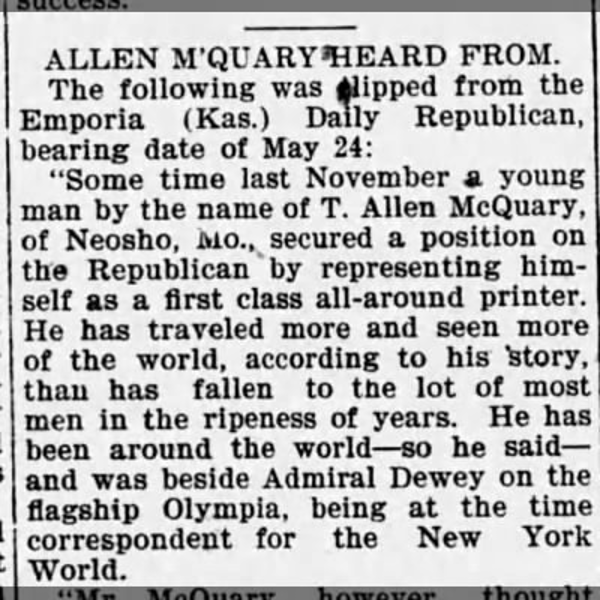
The Joplin Globe, Joplin, Missouri, Tuesday, May 29, 1900, page 5.
When the Indrani docked in Yokohama, Japan, Mack read that four hundred Spaniards perished in the battle. The headlines in The Japan Times, the only newspaper for English speakers, shouted,
GREAT VICTORY FOR AMERICA!
Vengeance for the Maine Achieved!
SPAIN'S ASIATIC FLEET BURNED AND SUNK!
But Mack knew the battle was nothing more than a massacre and an abomination, for he had been witness to the event.
And for what? So America could take countries from Spain that never really belonged to Spain in the first place?
Mack recalled Baxter's story about the bones of baby Jesus and the Steward's words: "History would end if humanity would only heed and pity the cries of grieving mothers. But that will never happen." In far distant Spain—over seven thousand miles from the Philippines—four hundred mothers would eventually hear the news and begin to grieve their dead sons. The fathers, too, would weep, but only in their private studies, for men are fools in public, and they recite maxims about honor and courage and serving one's country. Mothers have never really believed such bunkum, though in their desperation, they sometimes pretend to.
Four hundred men, burning, screaming, and crying out to Santa Maria, died for nothing in Manila Bay. For nothing.