Chapter Thirty-One: The Oriental Art of Bookbinding
The Purple Knight Chronicles
When religion, romantic love, and patriotism sink beneath the swells of cynicism, the heart has nothing left to cling to but hopeless nostalgia. Mack began to long desperately for home: not for the President of the United States or Congress or Admiral Dewey but for the familiar hills and creeks of the Ozarks. He missed his whistling, faith-filled father and his chattering mother. He missed his brother, Lucien, and his sister, Vertrude. He missed his dog. He missed drinking whiskey with M.S. Glenn on a darkling creek bank while the whip-poor-wills chanted their woeful names. He even missed turning the wheel of the Prouty and the open door that let in the breeze and the quiet streets where horses lashed their flanks to shoo off horseflies.
He missed Twain and Verne and Poe.
So, stranded in Japan and lacking resources, Mack eased his heartache, as men have since Eden, through work. Mack took a job at the aforementioned Japan Times where he operated an old Stanhope press, a machine simpler in design than the Prouty and much less noisy. The Stanhope had no rolling drum or rising arms or gripping fingers. Instead, he would set the platen and paper in place and lower a cast iron press to imprint the page. The oiled gears and balanced press were so crafted, so very English, that a Stanhope could be operated in the same parlor wherein reclined the Lady Irene, who was stroking her cat, and neither Irene nor Piddles would have been ruffled. Few machines have ever been more civilized than a Stanhope printing press.
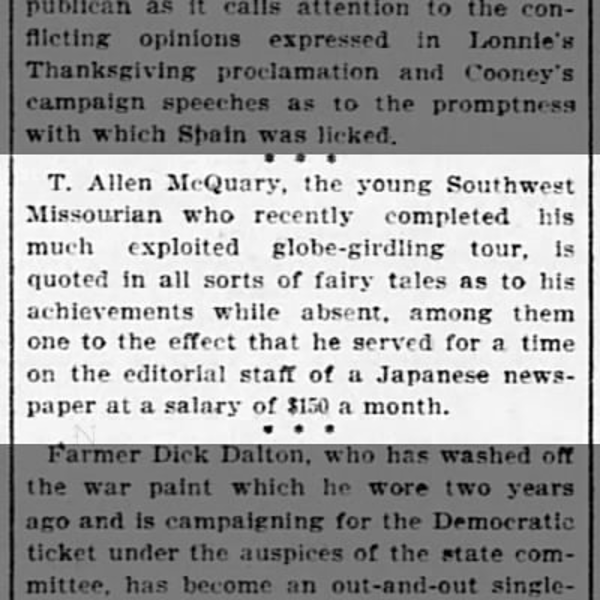
Kansas City Journal, Friday, Nov. 4, 1898, p. 4.
And here's another clipping that purports to substantiate Mack's claims, though it erroneously names the Japanese newspaper as the Gazette.
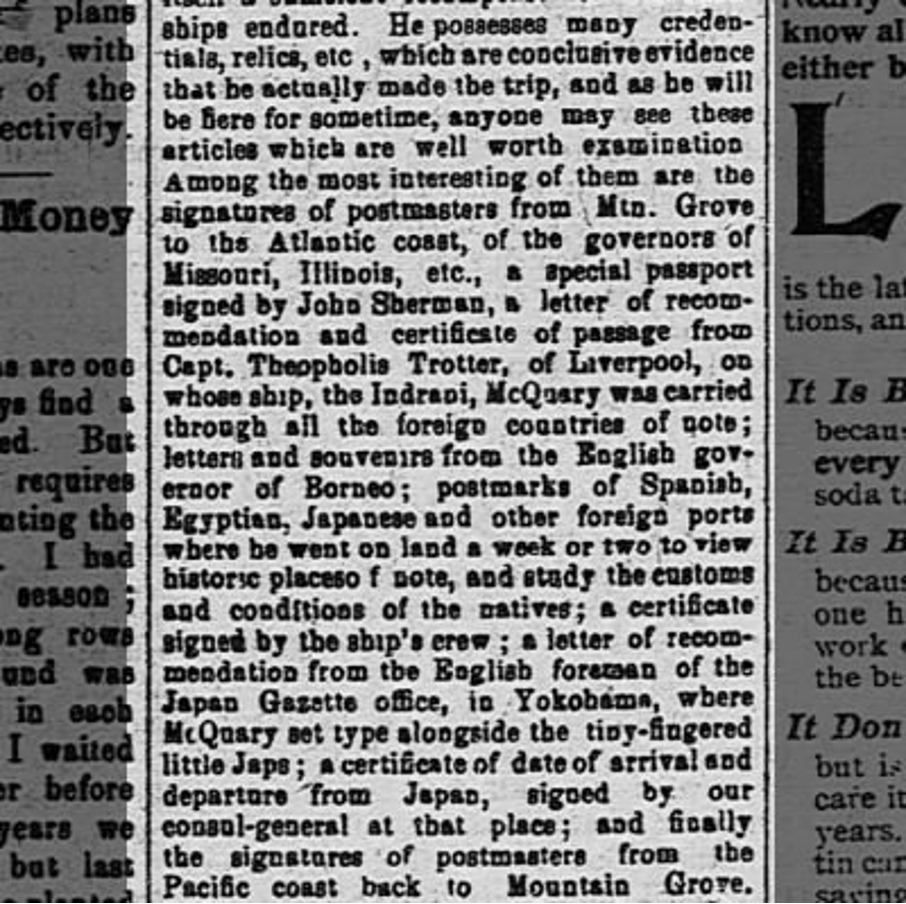
The Watchman and the Southron, Sumter, South Carolina, Wednesday, March 1, 1899, p. 7.
Originally printed in Glenn's Plain Dealer, Mountain Grove, Missouri. For the full article, please go to the Historical Notes associated with this chapter.
While he was working for the newspaper, Mack also apprenticed with an ancient Chinese woman who taught him the art of bookbinding, a process that distracted Mack from his homesickness and gave him a measure of peace. (Actually, Mack never knew the old woman was Chinese. To him she looked Japanese and so must be Japanese, and he couldn't tell Mandarin from Nihongo, and to be honest, he thought all Asians were the same, so it didn't really matter.) Mack liked the feel and texture of washi paper crafted from mulberry bark and hibiscus and hydrangeas, and he liked the sweet smell of the paper bleached by sun and rain. He liked the faintly fetid odor of glue exuded from rabbit guts, and he liked stitching the heavy leaves with their pale butterflies, budding cherry trees, and hatch-marked characters into quires and the quires into chapters. When Mack finished binding a book, he would open it and stick his nose into the crease and inhale the various scents. They reminded him of wild Ozarks pear trees blooming in April and dank, half-rotted leaves by an Ozarks creek, which reminded him in turn of fishing trips with his father and brother, and the fishing trips carried him back in time to sitting on his father's shoulders and clinging to his ears as they walked through gold-green Ozarks woods.