Chapter Thirty-Four: The Purple Knight and Otis Meet Again for the First Time
A Turning Point
For several months, Otis Bulfinch had been having nightmares, but his most recent dream was the worst. He dreamed he had died and been laid to rest in a piano crate, but even though he was dead, he could still think, and he kept trying to cry out, but he couldn't. The Purple Knight was standing by the crate, and he said, "He'll get hurt if we don't pack him good." So the Yellow Kid and Hennessey and Dobbins and MS Glenn and Randolph Hearst and Joseph Pulitzer and Admiral Dewey began wadding up newspapers and stuffing them around Otis until he couldn't move. He tried to turn his head to read the papers, but he couldn't make out the words because the papers were too close to his face, and the words were almost coming clear when someone stuffed more papers beside his head. Soon the newspapers covered him, but they kept packing more and more newspapers in a crate that was big enough to hold a fat lady from Nodaway County, so it took a lot of papers. Finally, he heard McQuary say, "That should do it. Let's nail on the lid." And Otis felt the crumpled paper press against his face and torso and legs as they placed the lid on the crate, and he heard the dull thud of hammers, and he tried to scream, but the newspapers were in his mouth. Then he felt the crate being lowered in the grave and the thump of something landing on the lid, and he knew it was more newspapers—not wadded up, but stacked and bound and dropped as bundles on the crate until they filled the grave. He was being buried in newspapers, and far away he heard the Yellow Kid tell the Purple Knight, "I told Otiose you was a fadoodler, but he jest wouldn't lissen. Now look at him."
It doesn't take a Daniel to interpret Otis Bulfinch's nightmare. All the time McQuary was at sea, Otis Bulfinch had been scouring the international papers for any tidbit of information concerning him. By pure happenchance he came across this article from Australia:
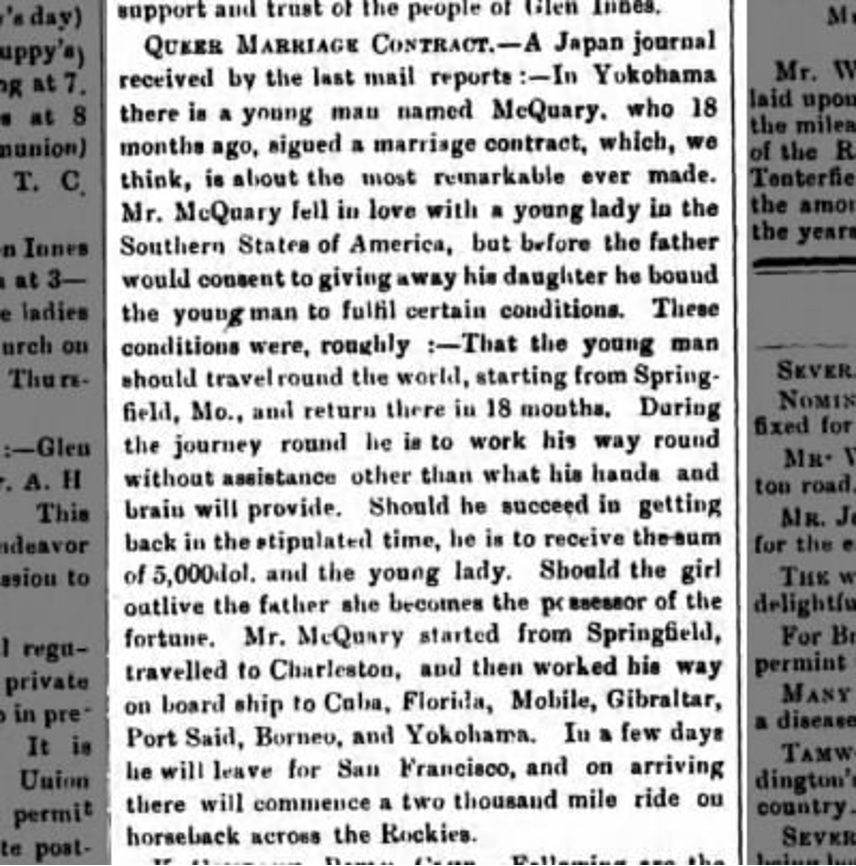
Glenn Innes Examiner, New South Wales, Australia, Tues., August 23, 1898, p. 2.
The fact the paper was Australian, however, proved nothing about McQuary's travels except that he was in Yokohama and even that wasn't certain. Otis wondered if the article had been written by Glenn, sent to Yokohama or perhaps just put out on the wire, and picked up by the Glen Innes Examiner.
In short there wasn't a single reliable article from anywhere in the world that proved McQuary had visited any of the places he claimed he had gone.
It took until August for credible articles about McQuary to begin showing up again. The first report was dated August eighth and said McQuary would be speaking at Willamette Heights Park in Portland, Oregon. Then, some ten days later, a telegraph came in from The Dalles Weekly Chronicle that said McQuary had spoken there on August 19 and was due to speak again that night, which was the 20th. Then, after those stories from The Dalles, nothing. Not a peep, until the early days of September when the Neosho Miner and Mechanic published this letter from Mack:
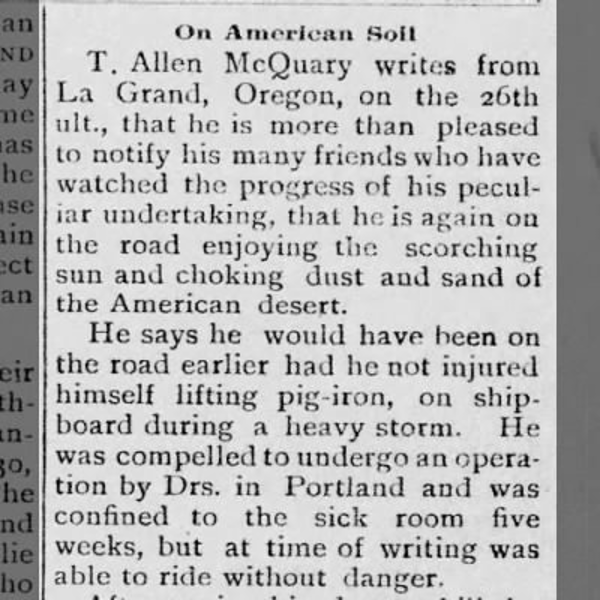
The Neosho Miner-Mechanic, Sat., Sept. 3, 1898, p. 5.
Otis consulted his map and saw that La Grande lay some two hundred and fifty miles southeast of Portland. Then he traced the Columbia River to the Snake River, and the Snake River to the Grand Ronde River, and he supposed that McQuary might have made his way from Portland to La Grande by the three rivers. Otis took out his pad and pencil and calculated time and distance, and yet again, the math didn't work.
So, if McQuary was in Portland on August the eighth and in The Dalles on August the twentieth, then he couldn't have lain abed for five weeks in Portland. Maybe five days. But why would he lie about having an operation and being laid up?
Well, he is a liar.
On the other hand, who's to say McQuary even wrote the article? Perhaps Glenn wrote it, and sent it to the Miner-Mechanic.
(Otis's speculation concerning the telegraph was almost correct. More precisely, the goofballs in the Mountain Grove Western Union station replaced the code for Mountain Grove with the code for La Grande, Oregon, whereupon the telegraph was picked up as a legitimate by several papers in the Northwest and finally by the Miner-Mechanic to printed in Neosho, so that the fraudulent telegraph spanned some seven states and 1700 miles of telegraph wire to end up on the desk of Otis Bulfinch at the offices of the Springfield Leader.)
Every day for the last eight months, Otis had rummaged through papers and asked telegraph operators if anything had come in concerning McQuary, but there was nothing until September 30th, when Otis read this short piece in the Enterprise of Curtis, Nebraska:
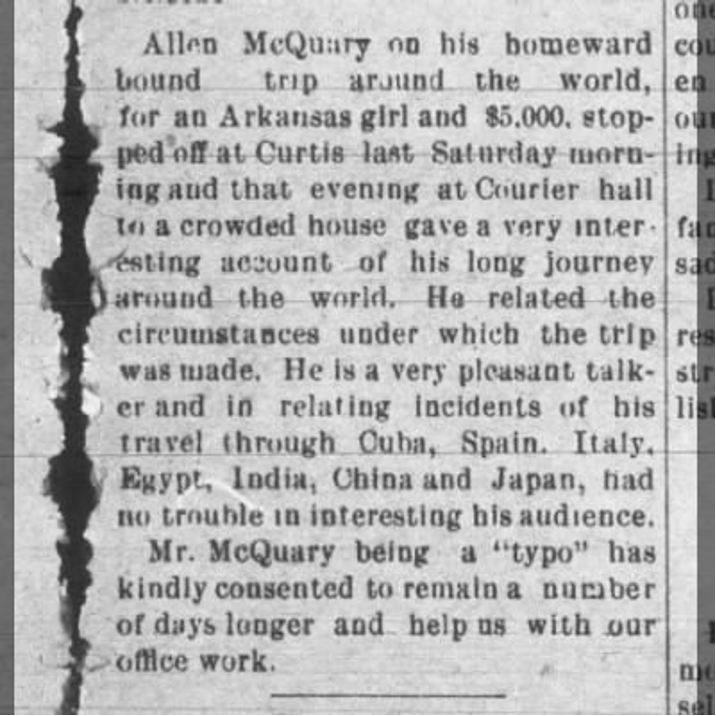
The Curtis Enterprise, Curtis, Nebraska, Fri., Sept. 30, 1898, p. 3.
Another consultation of the map with the ruler and another calculation.
Good God! It's over a thousand miles from La Grande to Curtis, Nebraska! If he traveled by horse every day of the week, it would take well over thirty days to ride that distance. So he has to be traveling by train.
This surmise was confirmed a month later by an article in The Joplin Herald.
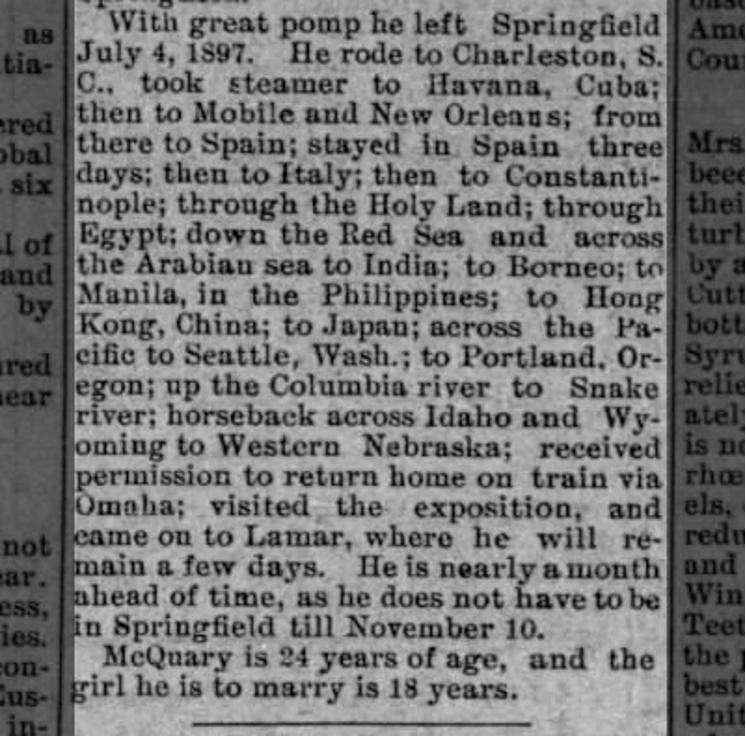
The Joplin Herald, Thurs., Oct. 27, 1898, p. 3.
He "received permission to return home on train via Omaha…" Huh. From whom did he receive permission, I wonder? I suppose the fictitious father gave fictitious permission to the fictitious knight.
In his perfect hand of precise penmanship, Otis made another note in his record of McQuary's travels, set the notebook on his desk, and opened the newspaper to the next page. What he saw there caused him to sit up straight and take notice, for in a sixteen-point font in capital letters and with exclamation points galore was the opportunity for which Otis had sold his soul:
You've read about him in the newspapers!
You've talked about him in the barber shop!
Now T. Allen McQuary, the Purple Knight of the Ozarks, has returned to Missouri and will speak at the German Turnverein Hall right here in Joplin on November 1st! Don't miss your chance to hear the first-hand account of his travels. Don't miss his inspiring and entertaining lecture on the customs of continental Europe, the fantastic foibles of the fakirs in India, and the amours of the amiable aborigines of Borneo!
Strengthen your faith!
Increase your knowledge!
One night only, November 1, at 7 o'clock.
He rides hence to Mountain Grove to complete his quest and thence to Arkansas to claim his bride and prize money! Don't miss the romantic adventure of the century!
Otis grabbed his valise, tossed in a pencil and pad, and rushed from the offices of the Springfield Leader. Clapping his derby to his head with one hand and clinging to the valise in the other, the reporter bounded up Boonville and darted to the depot where he purchased a 1:40 ticket on the Missouri Pacific for Joplin. Then he sat on a bench in the waiting room and jounced his leg up and down as he waited for the train to arrive.
At last! At last, he would confront McQuary and rip off his mask!
After all these months, the stage was set for a dramatic encounter, but this time Otis Bulfinch would play the starring role.
And speaking of stages, please permit me a few short words concerning the location of the impending confrontation. In the mid to late 1800s, German immigrants established Turnverein Germania Halls in many towns across America. In paneled rooms redolent of pilsner and ambergris, German men and boys gathered to sing rousing German songs about the Vaderland and eat spaetzle and schnitzel and drink and wrestle in tight, bulging trunks. The Joplin Turnverein Germania Hall was particularly Teutonic, modeled (albeit loosely) on a Bavarian castle designed and constructed according to the architectural whimsy of Otto Wittenberg of Nuremberg.
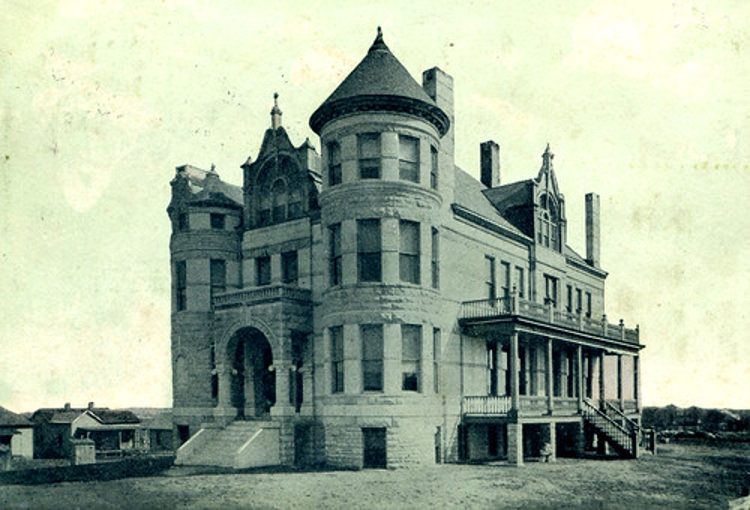
When Mack rode up to the Turnverein Germania Hall, he gazed up at the mighty turret and thought, "This place looks like the castle in the painting way back in the Admiral Bimbo. Guess I've come full circle."
Mack tied Rozinante to the hitching rail, dismounted, tugged his doublet to his belt, and pursed his lips.
Well. Here we go again, old girl.
He walked up the steps and pushed open the heavy oaken doors, and light fell onto the bottom steps of a stairway that ascended into darkness. When he closed the doors behind him, he waited until his eyes adjusted to the gloom. Then he climbed the stairs until he reached a wide landing; directly before him was another set of heavy doors, and he opened these to find a hallway paneled in walnut but glowing dimly with gaslit globes mounted on sconces. At the end of the hall was an arched entryway, and through the arch he could see light streaming down onto the gleaming wood floors of a huge open room. Everything smelled of buffing wax.
Mack strode down the hallway and entered the room, and there he saw a little man with a large mustache and brass spectacles setting up chairs. The man turned to see Mack and exclaimed, "Ach, mein Gott! You started me! Who er you?"
"I'm the Purple Knight of the Ozarks. I'm supposed to speak here tonight."
The little man slapped himself on the forehead. "Naturlich! Sie haben ein lila Kostume! Ich bin ja so ein Dummkopf! Of course, you er! Er you hungry?"
"Yessir, I sure am."
"Vell, we go to die Küche."
The little man led Mack to the front of the gymnasium where a door on the left opened into the kitchen, and he spoke to the cook who fixed Mack a meal of cabbage and wurst and beer. And even as Mack ate, and the little man returned to the room to set up more chairs, and the cook sprinkled marjoram in a large pot of Eintopf, Otis Bulfinch was on the Frisco barreling over the rolling hills between Springfield and Joplin. Things were coming to a head.
6:58 PM. The Purple Knight was standing beside a makeshift dais at the front of the hall, and beside him fidgeted the Meister of the Turnverein, Herr Brautigam, freshly returned from the Black Forest. As you might expect, Herr Brautigam was dressed in lederhosen and sported a green hat with a feather in the band. He lacked only an accordion. The gymnasium was full to the back wall, and the chatter and laughter felt warm and friendly. Then Herr Brautigam said to Mack, "Kommst du hier," and they stepped up onto the dais. The room fell quiet, and in a pidgin mix of Deutsch and English, Herr Brautigam introduced Mack as the Purple Knight of the Ozarks, who had recently returned from a "Reise around die Welt, a man who, uh, you know, gesegelt on das Boot mit Admiral Dewey and discovered the Missing Link of Borneo, a man who risked life and everything for his hübsches Mädchen, das Ubermensch, T. Allen McQuary," and the Germans erupted into applause and shouts.
Mack raised his hands and the room quieted down.
"Good evening, Meine Herren! I'm not sure who Herr Brautigam was talking about, but I guess I'll have to do my best to live up to it!" And with that Mack sailed heavenward on wings of words. He told the Germans how he floated aloft in a dirigible over Rome and wafted into Vatican City, where he befriended one of the Swiss Guards who shared a pizza with Mack whereupon he, that is, Mack saved the Pope from a bout of malaria with a dose of quinine. Mack told the Germans that he descended in a diving bell to the floor of the Aegean Sea where he gazed on the ruins of Atlantis. Among the broken columns and fallen walls, he saw beautiful Thetis, mother of Achilles; she was cavorting with her Nereids while old Triton sat atop his throne and shook his trident.

Then he told them about a triangular craft that rose from the Pacific Ocean and took him aboard where he dined with alien creatures who took him to a magic window and showed him the heart of the universe. He told them about saving the young daughter of Nicholas I from a gang of masked bandits and was rewarded by her father with the Star of Montenegro, the highest honor of that fair country.
When he reached the apogee of the narrative arc, Mack exclaimed, "Reality surpasses fiction every time, my Germanic brethren! The most vivid imagination given full rein cannot compete with the truth. As Hamlet said to his dear friend, 'There are stranger things in heaven and on earth about which your philosophy knows nothing, Horatio!' True, so true!"
And McQuary was just getting started.
After his encomium to reality, Mack told them story after story, laughing with his audience at various humorous happenings in which he had played the fool and sharing their outrage at villains who mocked his mission and tried to impede his quest. He concluded, of course, with the old, old story of the Arkansas girl whom he would soon claim as his bride and the five thousand dollars he would pocket and the immense satisfaction he would feel at proving his mettle to her father. Then, after the standing applause and guttural cries of "Sehr Gut! Wunderbar! Ja!" Mack asked, "Are there any questions?"
At that very moment, Otis Bulfinch strode into the hall from the back of the gymnasium, and without hesitation, he pointed a stubby forefinger at the Purple Knight and asked, "Mr. McQuary, you are from Neosho, Missouri, are you not?"
Mack was composed and answered in a friendly manner, "Yes, I am. My father is a minister of the Gospel there. For several years he and I published the Neosho Rustler." But behind his mask, Mack was thinking, That little fella looks familiar, though he couldn't put his finger on where he had seen him.
Bulfinch then asked, "Can you tell me why the owners of the Neosho Miner-Mechanic claim time and again that you are a fraud? In fact," and here he pulled out a newspaper clipping, "they say you proposed your scheme—the purple outfit, the Arkansas girl, the whole nine yards—two years ago to a Mr. E. B. Tricket. How do you respond to that?"
"Have you ever talked with E. B. Tricket?" Mack asked the question with the clear indication that a conversation with Tricket would tell you all you needed to know about his veracity.
Bulfinch stood up straight and said, "I have. In fact, I visited Mr. Tricket in Hazelton, Kansas, and he confirmed every word printed in the Miner-Mechanic. He said that two years ago you proposed the same story to him down to the greyhounds."
Mack had been interrogated many times by many skeptical reporters, but this one seemed different, more personal. Mack wondered, Did I do something to this guy? I feel like I've seen him before. This is driving me crazy.
But Mack suppressed his feelings of uneasiness, puffed out his chest, stood as tall as he could, and laid his hand on the hilt of his sword. With stentorian dignity he said, "You should know that E. B. Tricket has ever been an envious man. He challenged my father as a rival in the newspaper business. In the end, Tricket skedaddled for Kansas, and Father remained in Neosho. Does that indicate to you who prevailed?"
Laughter from the audience and some appreciative nods, so Mack felt better. He continued, "I assure you, Mr., Mr.—I'm sorry, I didn't catch your name."
"Bulfinch, Otis Bulfinch. I'm a reporter for the Springfield Leader."
"You are welcome here, Mr. Bulfinch. I have the profoundest respect for journalism, though not always for the journalists. If you are an honest journalist, we will get on splendidly. If not, well—" Mack shrugged and lifted his hands as if to say, "Who knows what could happen?"
Laughter from the audience.
Then in a more thoughtful vein, "Have we met before, Mr. Bulfinch? You look strangely familiar to me."
A voice hollered from behind the kitchen door, which stood to the right of the dais. "'Strangely familiar'?" The door swung open. "How can somebody be 'strangely' and 'familiar' at the same time? That's what the Oxturd perfessers call a 'ox-ee-moron,' but who's the moron, who's the ox, and who's the turd is what I wanna know!"
Of course, the voice belonged to the Yellow Kid. He floated into the hall and turned to Mack. "Don't worry, McQuacky! I see a empty chair. I'll be fine," whereupon he proceeded to fumble his way over and around the legs of the men who were in his way.
Mack stood frozen on the dais. The boy was clearly making a nuisance of himself as he stepped on the men's feet and steadied himself by planting his hands on their shoulders and said things like, "Scoozy, Herr Dingus! Oof. Pardonne à moi, Monsieur My Sewer. Entschuldigen, Duke Verruckt." But the men didn't react; they didn't acknowledge the boy when he spoke or flinch when he stumbled, and Mack suspected they couldn't see him at all. When the Yellow Kid reached the empty chair, he sat cross legged in full lotus and levitated some six inches above the webbed seat, but no one to the Kid's left or right acknowledged he was there.
Otis Bulfinch, on the other hand, smiled to himself when the Yellow Kid made his entrance. The climax was at hand, the curtain was about to lift and fall, once and for all, show over.
Okay, McQuary, let's see what you've got.
For Otis knew that Mack could see the Yellow Kid because that was the deal. That was the purpose of the signed contract and the Yellow Kid's visitations to Mack in his travels. Remember? The Yellow Kid appeared to Mack at the séance in Charleston and at Mack's crowning in Tchoupitoulas Street in New Orleans, and finally, at the captain's table on the Indrani when Mack arose in distress after hearing the Terrible Story.
But those weren't his only appearances, oh, no.
With a shudder, Mack recognized the boy with the rictus smile who had unsettled him at a cafe in Athens and a samosas stand in Mozambique and a koshary cart in Cairo; floating before him in the Turnverein Germania Hall of Joplin, Missouri, was the same bald demon who had mocked him on a street in Bombay, interrupted a tete-a-tete with a grass-skirted girl in Samoa, and followed him on a carabao in the Philippines.
Mack was nonplussed.
Billy Simpkins? Is that you?
Or are you the ghost of the half-buried skull of Panias?
How is it that no one else sees him, floating over his chair and intoning, "Om"?
And that's when the pieces fell into place for Mack.
He finally recognized Bulfinch as the silent reporter in Charleston and the harlequin in New Orleans. He remembered seeing Bulfinch on the Indrani: Bulfinch had taken Baxter's chair at the table; indeed, he had become Baxter. Or Baxter had become him.
But why do Bulfinch and that weird kid always show up together? What could it possibly mean? Wait a minute; what about the guy in the fedora with the peppermint stick? He should be here, too.
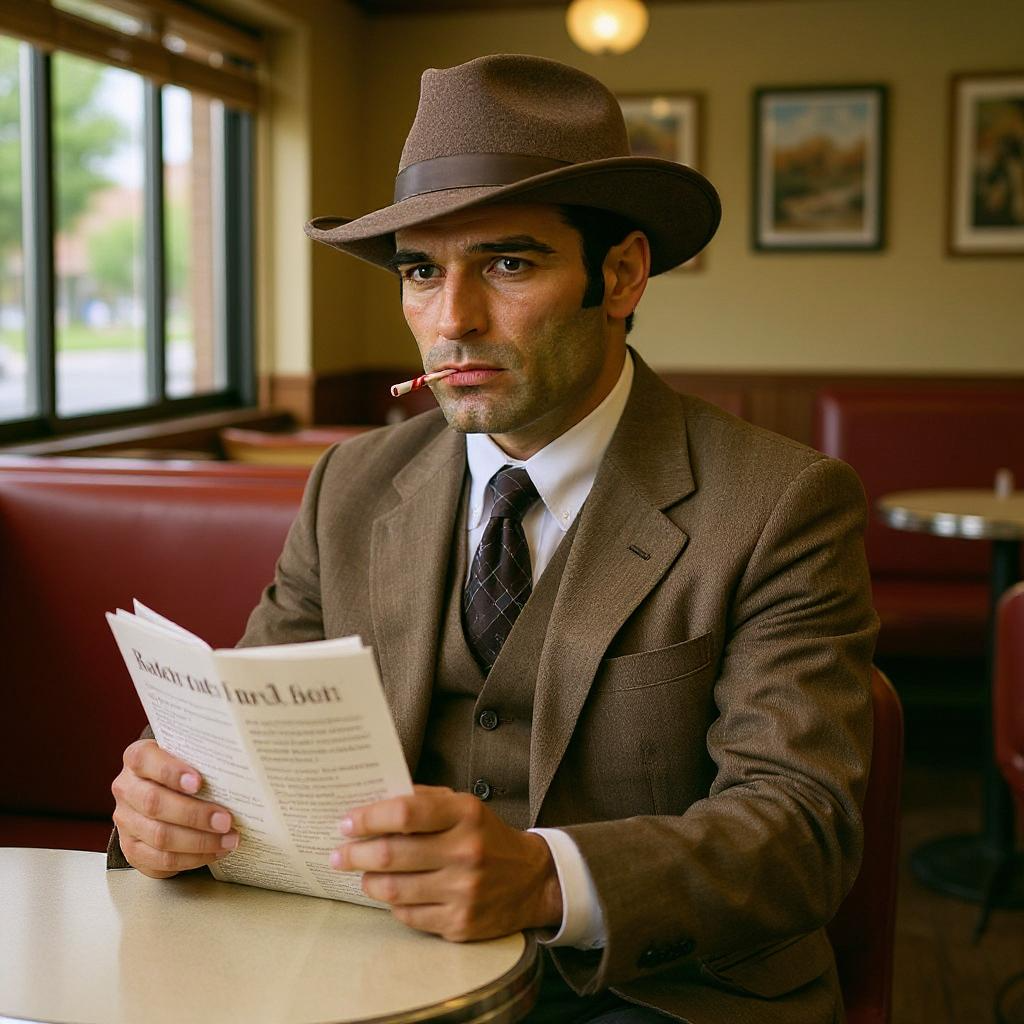
Mack surveyed the audience, and there, sitting toward the back of the room, was the third man of the triumvirate, wearing a gray suit with his fedora balanced on his knee. He was sucking a peppermint stick. It was Van Hennessey.
Mack saw that his three nemeses were gathered in the room—the only real threats to his ongoing deception—and he saw them watching him, judging him, and preparing to unmask him. He felt his self-control slipping away, as if he were struggling in quicksand or whirling into a vortex. His heart was pounding, and he looked about the room to find something or someone familiar and palpable.
But he recognized no one; all were strangers.
Except his enemies.
His hands and scalp were tingling. His breaths were short and shallow.
Easy, now. Breathe.
In this strange state of unreality, Mack held his tongue lest he betray his confusion, but he finally said, "Well?"
The Yellow Kid said, "That's a deep subject, McQuacky. Deep enough to hold you and me and these here krauts and the rest of die Welt!"
Otis said, "I suppose you could say we've met, after a fashion. I was at the Zoo Fairgrounds and the Baldwin in Springfield when you supposedly set off on your trip, but perhaps you didn't notice me. No, you and I have never formally met. Still, we feel a connection to each other. Don't we?" Bulfinch kept his eyes fixed on McQuary.
Then the Yellow Kid shouted to Mack, "Hey, McQuacky! You rekkernize me, too, don't you? I'm the Kid in the funny papers! Mickey Dugan is m'name and cartoonin' is my game!"
The men in the audience did not react to any of this. The Germans were full of tasty Eintopf and helle bier. Alles war gut, and they were happy to be there to watch the show. They didn't care.
Mack was becoming overwhelmed by the likelihood he was descending into madness, and he had to sort things out, but how with an audience and two reporters in the room?
Steady as it goes, old man, he told himself.
Just breathe.
So, Mack contrived a little test. He said, "You, sir," and he pointed to a big blond fellow sitting next to the chair where the Yellow Kid was floating. "Do you sense anything odd about any of this? Anything at all?"
"Wer? Who? Me?"
"Yes, you, sir."
"Nein. Aber I zink maybe zee reporter has some courage to stand up and make questions like he does. But, no."
"Nothing else seems strange?"
"Nichts."
"What about the chair next to you?"
"Was? The chair iz empty." The blond man scowled and whispered something to the fellow on his left. The room became utterly silent.
Mack thought, Okay, so it's true: None of them can see or hear the weird kid. That means all I have to do is ignore him, regardless of what he says. Okay. I can do this.
In fact, Bulfinch and Mack were locked in the strangest of struggles.
The truth no longer depended on evidence and facts because the truth had regressed into a silly hallucination, a cartoon boy with big ears and a yellow nightshirt. The winner in this contest of wills would be the man who ignored the truth of the hallucination, the man who kept his mouth shut and his shit together. The man who acknowledged the kid would be deemed a lunatic, a mad man, unreliable and given to visions.
So, it was that Mack and Otis stared with a malice born of generations of struggle between liars and truth-seekers. Their contempt for each other was tangible and stretched between them like a beam of palpable light over the blond heads of the assembled Germans. The hall and the men and the cartoon boy and the conflict felt thick with symbolism and significance, namely, the meaning of unreality and all that unmeaning means.
Choosing his words, Mack said, "Let me assure you, Mr. Bulfinch, we have never met. I neither know nor care about you or the Springfield Leader. Nor the Neosho Minor or whatever the rag is called. But also let me also assure you, my Father is a man of the highest principles. He is a minister of the Gospel, a newspaperman, a doctor of the eyes, and an honest businessman."
Mack thought, Why did I say that? Why did I mention my father at all?
"You hear that, Deutscher männer?" asked the Yellow Kid. "His fadder is like one of them chameleon lizards; he's a real this and a real that dependin' on the money. Just like his own true son, who's a real buffalo chip off the old blockhead!"
Bulfinch was also perplexed. "Why are you talking about your father? What does he have to do with this?"
Mack recovered. "What I mean to say is, the character of Mr. E. B. Tricket is precisely opposite that of my father, as anyone in Neosho will tell you if you had taken the time to ask them. Tricket is a liar and a fraud!"
"But I am not interested in your father, Mr. McQuary. I am interested in you."
"Here is my defense, Mr. Bulfinch: Can you really imagine that anyone would merely pretend to do what I have done? Do you think I or anyone could lie so persuasively that newspapers across this country—from South Carolina to Oregon—would believe and print my story? Could I have circumnavigated the whole, round world if I was just a fake? Did you even take the time to look through my book of souvenirs in the foyer? Please, go ahead: Look, and then tell me I am false. I stand before everyone here, purple in attire but purest white in my soul, and ask for judgment. Does anyone really believe a fraud would subject himself to this kind of scrutiny?"
Scattered applause, but the Yellow Kid was laughing and bobbing up and down on his toes. "Lissen to that liar lie! 'Purest white!' he says. 'Like a nymphomaniacal in a white weddin' dress' is what I says. Write that down, Otiose: 'The Purple Knight of the Ozarks is like a nymphomaniacal in a white weddin' dress.' Hey, Mr. Fadder of Lies, tell us another lie!"
Mack ignored the taunting demon in the yellow nightshirt and suppressed his mockery beneath high dudgeon: "No, Mr. Bulfinch, Jesus said that a prophet is never honored in his home, and the same might be said for all young men of ambition and imagination, the sort of young men who risked their lives by crossing the wild Atlantic—I know of its wildness for I, too, have braved its towering waves—to make America their new home." Mack turned to his audience. "You men know all too well how it feels to be turned out by your own towns! You know what drives a man to seek a better life, a life of adventure and derring-do, do you not?"
"Ja! Wir kennen! Ja, unser Freund!" "Yes! We know! Yes, our friend!"
Then turning back to Bulfinch, McQuary said, "Sir, you should know that Missouri is my home, but you yourself prove the Master's point that a prophet is not welcome in his own home! I stand for judgment, but not by you, no, by these men!"
With that the men began applauding and shouting again, and Otis swallowed hard and tried to quell a swelling panic.
The Yellow Kid leapt up, maneuvered around knees and shins and feet, and stamped down the aisle, tapping men on the shoulders and yelling in their faces, but they couldn't hear him. "Don't let that liar get away with that, usin' the Good Book to make hisself look like a profit! Lissen to Mr. Bulfinch! He's about lost his mind tryin' to show you the truth! The least you can do is lissen!" But the Germans could not see the Yellow Kid, and they clapped all the louder for the Purple Knight of the Ozarks, and one fellow threw a wadded newspaper at Bulfinch. And then another. Wads of newsprint flew from every direction.
But Bulfinch stood resolute; he wasn't finished, not yet. He said, "Mr. McQuary, your business associate, M.S. Glenn is notorious in Mountain Grove and, in fact, in that whole region for proposing several outlandish schemes for his own profits. I have in my possession articles of indictment, that is, newspaper stories that declare with absolute certainty the malfeasance and trickery of Mr. Glenn. For example, he talked his fellow citizens into investing in orchards, pocketed their money, and then said, 'Sorry, boys, it just didn't pan out.'"
"Oh, and that's not all, my Teutonic brethren," said Bulfinch. "Mr. Glenn promoted a reunion of veterans under the auspices of the city of Mountain Grove and was denounced by that same city as a fraud."
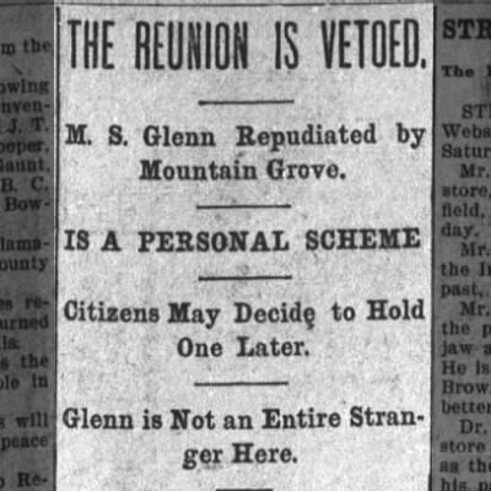
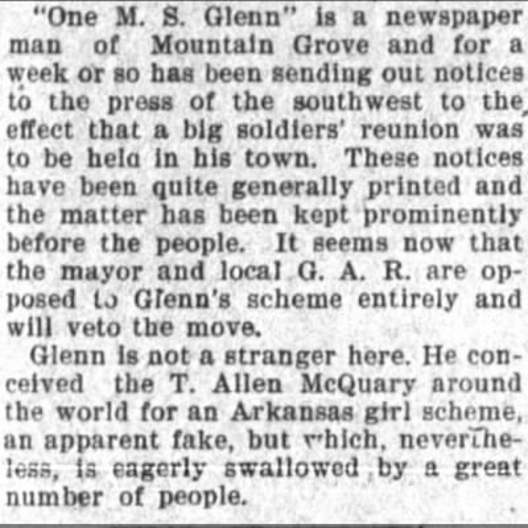
"How, I ask you, can anyone take seriously a man who would promote a veteran's reunion to line his own pockets? Such a man can only be regarded as despicable and worthy of repudiation and public humiliation. But let me call attention to the final line of the repudiating article: 'Glenn is not a stranger here. He conceived the T. Allen McQuary around the world for an Arkansas girl scheme, an apparent fake . . .'. 'An apparent fake?' Perhaps our reporter was overly cautious in his censure of Glenn's improprieties. Our next reporter is not so delicate. After reporting that Glenn had been convicted and sentenced for mail fraud—a felony, mind you!—the article denounced Glenn and his stooge, McQuary! Gentlemen, I offer this as positive proof that the man before you is nothing but a charlatan!" whereupon Bulfinch began reading the following article:
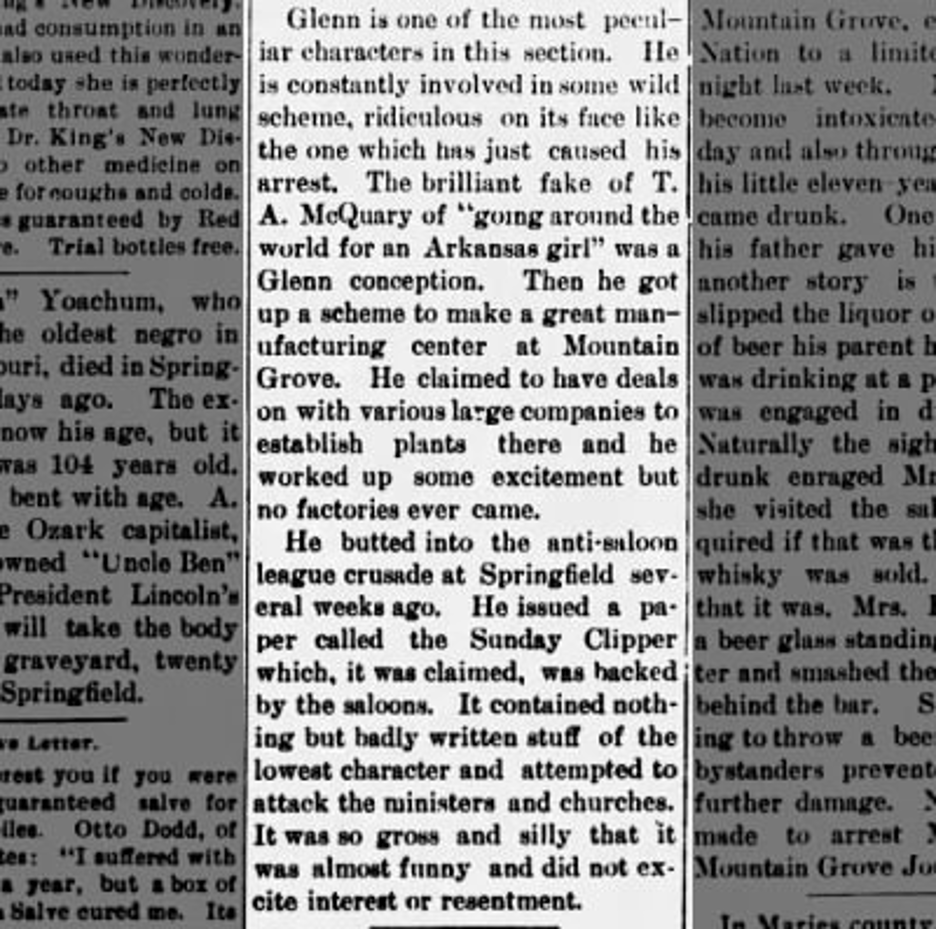
The Journal-Gazette, West Plains, MO, Thurs., Oct. 8, 1903, p. 3.
"I assert that Glenn is as bad a scoundrel and fraud as ever published a paper. And it's this same Glenn who not only wrote letters as if he were you," and here Bulfinch pointed his quivering accusatory finger at McQuary, "but he has also promoted a book about your travels, a book, incidentally, that has yet to see the light of day. I have in my possession a copy of the advertisement. Look!"
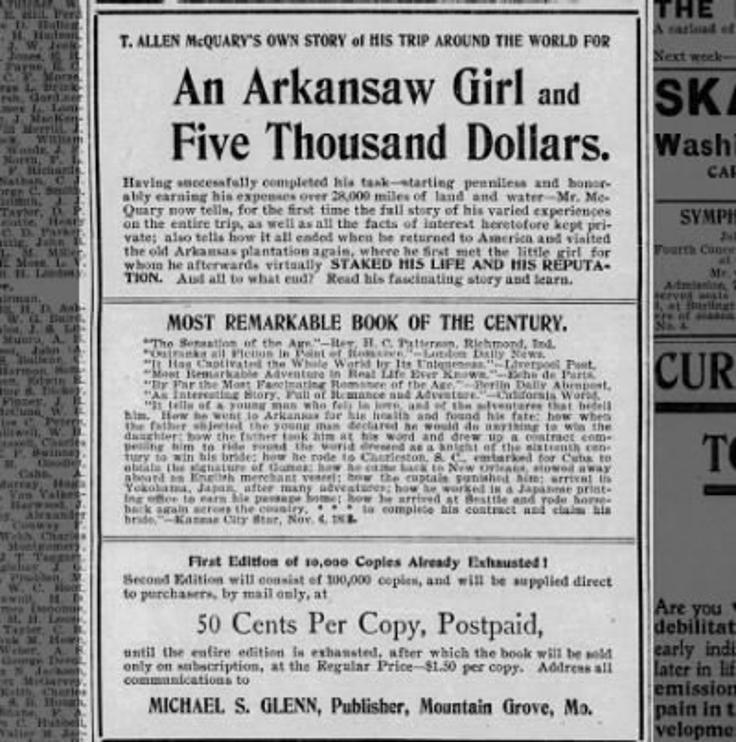
The Kansas City Times, Sat., Feb. 4, 1899, p. 8.
"Finally, I know for a fact that Glenn also sold fraudulent insurance policies because he sold one such policy to my own mother, whose farm and home burned to the ground, yet she never received a red cent. Mother is afflicted with senility, a condition that left her vulnerable. Did that stop M.S. Glenn? No, it did not! Mother's illness was to him just another opportunity for exploitation! Again, I ask you, men of the jury, how could anyone defend such a man as M.S. Glenn and by extension, his stooge and puppet, T. Allen McQuary? Defend your association with Glenn, if you can!"
By now the Yellow Kid had floated up and over the audience and was hovering close to Otis. When he heard Otis accuse McQuary with such bold and condemnatory language, he clenched his fists and punched the air and danced about. He shouted out to McQuary, "Yeah, take that, you Liar of Lies! If your partner's bad, then you're bad! Ha, ha! Otiose has got you now!"
Mack rubbed his eyes beneath his mask and took a deep breath. Then he said, "Mr. Bulfinch, those are indeed damning accusations. But tell me, sir, what is the date of that first article, the one about the apple orchards?"
"Uh, 1900."
"I see. And what was the year of the advertisement?"
Reluctantly. "1899."
"And what year is it now?"
In a low voice, "1898."
"Right. The year, this year, is 1898. In fact, today is November the first, 1898. Aren't you defaming Mr. Glenn's character for crimes he hasn't committed yet. Is that right?"
Silence.
"Tell me, Bulfinch, in what year was Glenn convicted of mail fraud?"
In a whisper, "Uh. 1903."
"I'm sorry, I can't hear you. What was that date?"
"1903."
"Right. 1903. Five years in the future! How can I be expected to know things that haven't occurred yet?"
"But it's in the newspaper."
"In a newspaper yet to be published! You can't use it! I mean, literally, you can't refer to articles from papers that haven't yet been printed."
And the Yellow Kid yelled back, "You're a liar, liar pants on fire, and Glenn is a crooked stick! And you know it! Look at me, McQuacky, when I speak to you! Look at me!" The Yellow Kid began floating toward Mack, and his nightshirt swirled around his feet, and the child made a terrifying face. But Mack ignored the approaching demon and focused on Bulfinch. "You're worse than a liar, Bulfinch, by quoting papers that haven't been published! You can't do that! Any fool knows you can't do that!"
Something in Otis broke and he blurted, "You know you see him! He's coming toward you!" and with that, Mack knew he had won.
"See whom, Mr. Bulfinch? Who is it that you think I see? Perhaps you see someone the rest of us can't. Tell us what you see. Perhaps someone who hasn't even been born yet? A ghost of the future?"
Bulfinch folded his pad and put it in his jacket pocket and stuck his pencil in his hatband. Then he looked Mack in the mask and said, "Well, at least I'm finally shut of you. I do wish I'd won, but I've learned something. I'm not sure what I've learned yet. But it's something."
Meanwhile, Herr Brautigam had motioned to two men dressed in military garb and shiny shoes, and they began walking toward Bulfinch. When they took him by the elbows, Otis Bulfinch said, "Hold up a minute!" The guards hesitated, whereupon Bulfinch raised his hands and prophesied, "All of you listen to me! You think I'm a troublemaker. A rabble-rouser. Well, maybe I am. But sooner or later you will find out the truth. And when you do, I want you to remember this moment—I want you to remember him—" and again Bulfinch pointed at Mack—"and think twice before someone else, someone more sinister and stupid, makes you look like a gathering of fools! Good night!" A general hissing followed, and Bulfinch was escorted from the hall.
Mack waved his hand in farewell. "Auf Wiedersehen, mein Freund!" and the Germans roared with laughter. The applause in the Turnverein Germanic Hall rattled the windowpanes in their casements, and the men rose to their feet. As the crowd whooped and cheered, the two guards tossed Bulfinch into the street. As Mack stepped down from the dais, the Yellow Kid floated beside him. With the same air of feigned nonchalance, Mack ignored him, but he heard a vicious whisper, "I will haunt you till you die, McQuary. And in the end, you will be just as I am."
NOTE:
During the imbroglio Van Hennessey slipped into the kitchen for another bowl of Eintopf and a beer. He knew he could sell the hell out of a stew like that, it was that damned good. Van Hennessey could sell anything because he was the handsomest guy in Springfield, Missouri.