Chapter Thirty-Three: Homeward Bound
July 8, 1898
If the final curtain was falling on the old merchant sailing ships, the Kinghu Maru was a curtain call with the house lights on and the actors bowing while roses were thrown at their feet. She was a splendid schooner! When the Kinghu Maru sailed from the Yokohama harbor, her sails were swollen with the west wind, her prow dipped and rose like the beak of a magnificent bird, and her sleek hull split the water. She was swift, even swifter than many of the modern steamships. In April of 1897—three months before T. Allen McQuary set out from Neosho to pursue his Quest—the Kinghu Maru sailed from Yokohama to Seattle, Washington, in twenty-two days, besting the previous record of a steamer, the Queen of England, by three days. Once, the Kinghu Maru sailed over three hundred miles in a single day. When Mack saw her harboring proud and majestic with masts that towered into the sky, he thought, That is a fitting vessel to bear me home.
This time he had enough money in his wallet to purchase a ticket: no stowing away (or making up stories about stowing away) was required for his passage. He had a berth with a portal that looked out onto the ocean and space beneath his bunk to stash his belongings: a duffel bag held his costume and accouterments and a suitcase contained his souvenir book, a few small gifts for his family, and a couple of the Japanese books he had bound. His tutor, Mistress Linjin, had given him the books, so he could demonstrate his skill to potential customers. She told him, "You are silly boy with strange mind. You will find it hard to be true to wife or to belong to village. Do what I taught, and maybe you can be happy. Maybe not. Who knows?" Mack bowed to her, took the books, and wrapped them in dish towels before packing them in a duffel bag.
Now the Kinghu Maru was slicing the wine dark sea and skimming before the wind over the barren acres. Mack knew that he would never sail again, never breathe the salt air of the open sea or feel the spray flying from the hull, so he spent as much time on the deck as he could. He observed that the planks were so snugly fitted together that sand couldn't collect in the grooves. Once, he even climbed the mast, running his hand along the rigging as he did, and he joined the boy in the crow's nest where they smoked a cigarette and gazed over the boundless leagues of water.
He thought, I will never again be who I am now.
On those rare days when the skies grew dark and the rains fell, Mack explored every interior inch and niche of the ship. He ran his hand over the tar caked walls of the hold and examined the wooden pegs that connected thwarts to ribs. He marveled at the ship's construction. It was perfect! Mack examined the hammocks in the fo'c'sle, and he fingered the clew knots and the woof and warp of the netting. Mack absorbed the ship into his being, so it wouldn't leave him when he was landlocked once again.
For days on end, the Kinghu Maru ran before the west wind until one day far away in the distance, a gray-green stripe appeared between the dark ocean and unbounded blue. Mack leaned against the gunwales of the fore deck and stared at the approaching land as if he were afraid it might sink into the waves. The blazing sun and the wind on his face reddened his cheeks, and tears pooled in the corners of his squinting eyes, but still he clutched the rail and stared. Misty shapes clarified into mountains, and the gray-green strip resolved into forests of firs, and on and on, the approaching land grew more distinct as the hull clove the waters. On the fourth morning after the sighting of land, Mack awoke to the cries of gulls, and when he emerged onto the deck, the air smelled sweeter, and he heard distant thumps and the cries of men. Soon, the sails were struck, the ship hove to, and the Kinghu Maru dropped anchor in the frenzied harbor of Astoria.
Mack released his grip on the gunwale and thought, I can't believe I'm back in America! It's still a damn long way to Neosho, though.
He went below and passed through the galley on the way to his berth; the calendar on the galley wall showed the date as July 30. He had a little over three months to complete his journey and win his prize. Then Mack caught himself.
Who am I kidding? There is no prize. What am I gonna say to the newspapers? What in God's name will I do?
Going home would be complicated, but in the meantime…
In the meantime, Mack's first order of business, of course, was to find the Western Union station and telegraph Glenn. So, after the packet bore Mack and his luggage ashore, he hoisted his duffel on one shoulder, grabbed the suitcase with his left hand, and staggered on unsteady legs down Portway to the depot. Within the hour, the following telegram was delivered to Glenn at his office:
PLAIN DEALER
MOUNTAIN GROVE, MISSOURI
BACK IN US. ASTORIA. PORTLAND NEXT THEN THE DALLES. TRAIN TO KC. NO HORSE.
MACK
Then, as if he had an afterthought, Mack sent another telegram:
FIRST CHRISTIAN CHURCH
NEOSHO, MISSOURI
ARRIVED ASTORIA FROM JAPAN, SAFE AND HEALTHY. NEXT PORTLAND AND THEN THE DALLES. HOME SOON.
MISS & LOVE YOU & MOM.
MACK
Mack imagined the boy delivering the message to his father's study at the church and his father taking the telegraph, fearful perhaps that it bore bad news. He saw his father put on his spectacles and read the reassuring words, and Mack wondered what his father would think. He supposed his father would be relieved to know that Mack was back in America and in good health, but the Quest stood as an unbreachable barrier between them. The danger of discovery was perhaps greater for the father than it was for the son. Reverend McQuary was a "preacher of the truth," the Gospel of Christ, and a man of science, an optical doctor; he was by turns businessman and newspaper publisher: His livelihood depended on his integrity. If the truth came out that he, the Reverend A. L. McQuary, had known the truth about his son's deception, who would believe the reverend anymore? Who would buy his spectacles or attend his church? Would his parents be forced to lie about what they knew, forced to say that they were as deceived as everyone else?
O, what a tangled web we weave!
When first we practice—
Perhaps the truth would never come out. Perhaps Glenn would think of some new and outrageous way to allegorize the Quest—to make it a fable or cautionary tale and thereby open it to the kind of interpretation that redeems a story even as it negates it—thereby salvaging Mack's reputation and even elevating him as a hero. But Mack couldn't see how, couldn't see the way forward, because he only wanted to fuck girls and see the world, and lying was the easiest way to get what he wanted.
Redeem that if you can!
Mack left the Western Union station and went to the train platform and sat on a bench to watch the people. He had seen so many people in his travels, perhaps too many people, and he recognized the same urgent stride everywhere, the serious eyes, the uncertainty with regard to timetables and delays, and the obsession with a "better future" that keeps people in motion. A new century was at hand, and people were moving as they had never moved before—ships, locomotives, wagons—who knew what might come next? People were thirsty for motion. Now he was thirsty for home.
But is home ready for me?
Mack returned to the street. He checked into the Bowline Hotel and slept the rest of the day. The night would bring its own distractions and pleasures. Like every harbor city, Astoria was a gate flung open to the Devil's Highway.
On August 5th, a Thursday, Mack boarded the T. J. Potter, a side-wheeler steamship that bore him down the Columbia River and docked in Portland where he disembarked and walked along the Willamette River. He crossed over the Morrison Bridge, made his way down Milwaukee Avenue to Brooklyn Street, and checked into a hostel where he changed into his purple costume. He tied on the mask, adjusted it so he could see through the holes, and sighed. He also strapped on the sword and the poniard.
He looked at his image in the mirror and thought, Time to gin up the old act again. Uhh. He unwrapped the scrapbook.
Better take this in case.
Back up Milwaukee to Morrison and First where he entered the newspaper offices of The Oregonian. A girl with a pencil behind her ear sat at a desk reading an article.
Here we go again.
She glanced up, pursed her lips, and said, "May I help . . . wait a minute . . . are you . . . ?"
"Am I who?" Mack asked with a smile playing on his lips.
Disbelief and astonishment mingled in her pretty face, and her mouth made a perfect O.

Lyla Philips, July 3, 1898, Portland, Oregon
She managed to say, "I can't believe it! But the last article I read said you were in Japan."
"Well, I'm not in Japan anymore. Because here I am!"
In a voice hushed with admiration, she said, "So, you are the Purple Knight! Your story is so romantic! When did you get back?"
"A week or so ago. My ship dropped anchor in Astoria, and I took a steamboat here to Portland."
"I'm sorry; I'm not being very polite. My name's Lyla," and she put out her hand.
"I'm Mack, short for McQuary. It's nice to meet you," and he kissed her hand. No one had ever kissed her hand before, and she blushed.
"My goodness, you are like a knight of old. I still can't believe it's you!"
"Okay, I'll prove it. I brought my book of souvenirs. Just in case I ran into a doubting Thomas." Mack handed her the scrapbook, and the girl began leafing through it.
"Wow! You really have been around the world. Who's that?"
"He is the councilor to the Japanese Emperor."
"Did you meet the Emperor, too?"
"Not really. Besides, there's a law in Japan that he must never have his photograph taken, so what was the point?"
"How come he couldn't have his picture taken?"
"Who knows? Some silly superstition."
"And whose signatures are these?"
"Most of them belong to postmasters in the different port cities, but there's a couple of mayors and governors in there, too."
"Wow! Well, you are definitely who you say you are! What would you like me to do for you?"
Mack studied her face through his mask. Lyla's eyes were clear with an untainted innocence, and he could discern no real invitation in her question.
Still . . . you never know. A question like that can mean different things.
"Well, I guess, I mean . . . do you, do you think the people here in Portland would be interested in hearing me speak?"
"I'm sure they would! I know I would! How long are you in town?"
"Not long. I have to get home before the deadline."
"Of course." She tapped the pencil on her desk. "I have an idea. There's a concert at Willamette Heights this Tuesday evening. Maybe we could add you to the program. Would that work with your schedule?"
"Yes, that should work just fine. Where is Willamette Heights?"
"I'll draw you a map. We're here at the corner." She drew the map with the tip of her tongue sticking out, just like Abby so long ago in the Mount Neosho Schoolhouse.
"Perfect. Let me take a few notes, and I'll run the announcement by my editor."
This is Lyla's short article as it appeared in the Oregonian.
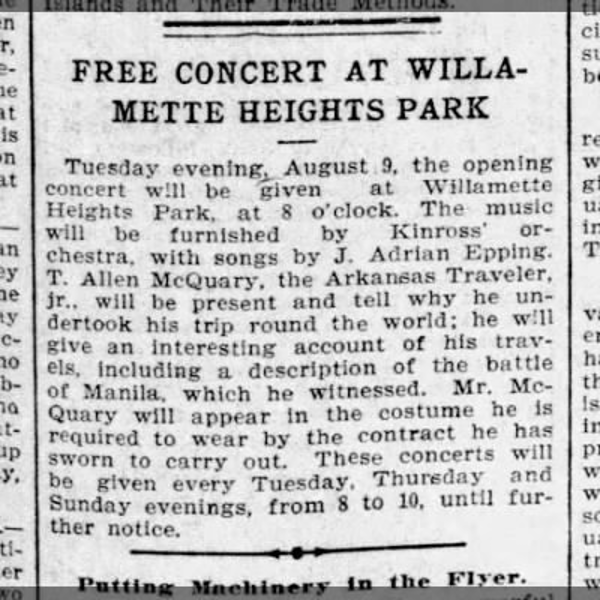
The Oregonian, Portland, Oregon, Mon., Aug. 8, 1898, p. 5.
"Thanks. Say, you seem like a nice girl. What are you doing tomorrow night? Maybe you could show me around town? I need a guide. How does that sound?"
Lyla and her fiancé, Roger, had made plans, but when would an opportunity like this come again? Never, that's when. So Lyla said, "That sounds like fun."
"Do you have a favorite restaurant?"
"I like the Mariner's Wharf on Burnside."
"Great!" Mack was sick of seafood but not affection, so he said, "Six o'clock?"
"Sure."
"Where should I meet you?"
"Let's just meet at the restaurant. Everybody knows where it is, and it's easier to find than my house."
"It's a date." And Mack kissed Lyla's hand again.
Saturday evenings in summer are gravid with desire. Blame the heat that makes young people languid, moist with perspiration, and more apt to remove their clothes. The same kiss bestowed in April is deeper and wetter in August, and hands more readily fumble with buttons. Throw in a good meal, a little wine, and a hand-in-hand walk in the all-embracing darkness, and sticky intimacies are inevitable.

Picture Mack and Lyla in a snug restaurant with candles on the tables, aperitifs, and dinner. Flashing eyes and gentle laughter. Sorbet.
Licked lips.
Hmm. Maybe I do have a chance for some good fun.
Now they're walking along the pier. A quick kiss beneath a lamp. Then a longer kiss. Then fumbling hands and hot breath.
"Where shall we go?"
"Not to my house; I live with my parents. And my fiancé lives across the street."
"We could try the hostel, but there's always a man at the desk."
"No, that won't work. He might recognize me."
"What about behind those bushes?"
"I guess. Okay."
Well, well, you just never know.
On Tuesday afternoon, Mack was killing time before his lecture at the park, and that's when he wandered to the Portland stock yards where he chanced to meet the Reverend Isaac Brown, farrier, preacher, and former slave who fled to freedom almost forty years ago. Reverend Brown invited Mack to speak at the African Methodist Episcopal Zion church on Wednesday night, and that's when he made up the story about the Charleston Golf Club. After the service, Mack stuffed his pockets with loose change and six one dollar bills from the collection plate, gathered his bags from the hostel, and hurried down to the docks where he boarded the Sarah Dixon for The Dalles.
As it turned out, Mack's three days on the Sarah Dixon were his last trip on a steam boat. After he went ashore at The Dalles, he never boarded anything larger than a john boat for fishing trips on the James River. He went to the Western Union station where a telegram was waiting for him.
THE DALLES, OREGON
GLAD YOU'RE SAFE. WEDNESDAY AT FOUR, SECOND AND LAUGHLIN. LOOK FOR AD IN WEEKLY CHRONICLE.
HOW'S THE BOOK COMING?
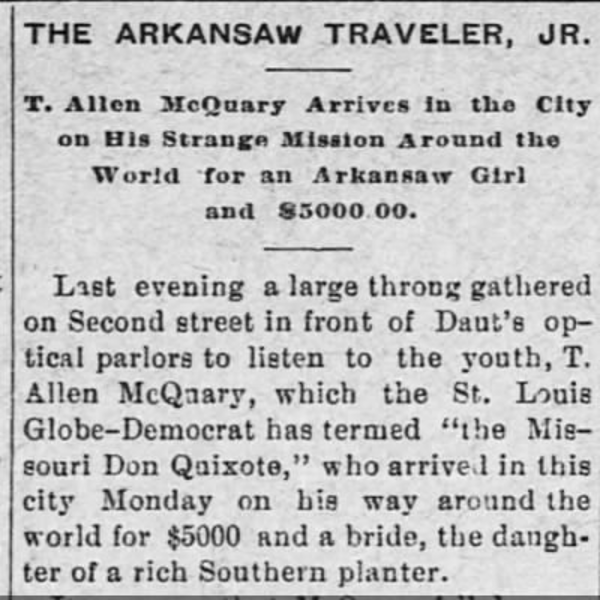
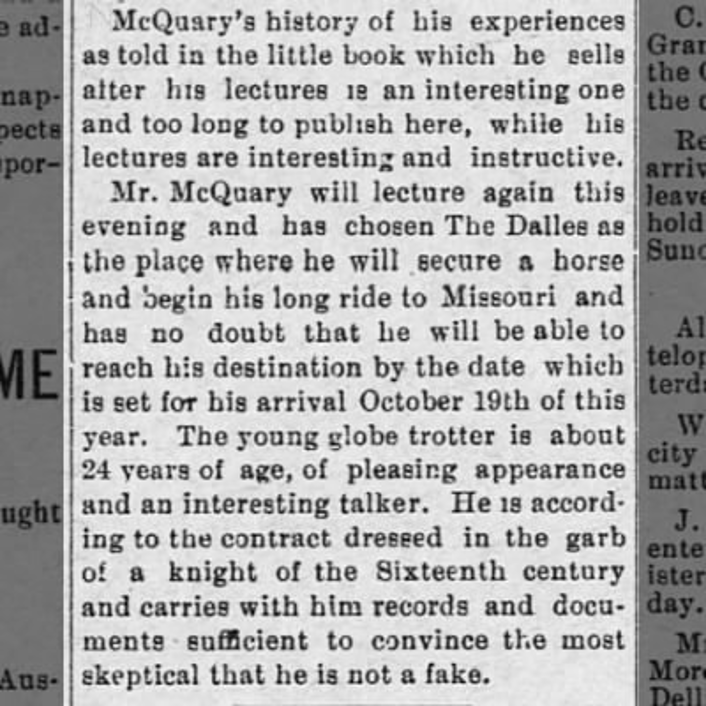
The Dalles Weekly Chronicle, The Dalles, Oregon, Sat., Aug. 20, 1898, p. 4
Ah, yes, Glenn and his goddamned book. I'll cross that bridge when I cross it.
In the meantime…