Historical Notes: The End of an Era
The Philadelphia Inquirer and the Hand of M.S. Glenn
The Philadelphia Inquirer, December 11, 1898
Among the many newspapers that covered McQuary’s Quest, the Philadelphia Inquirer of December 11, 1898 stands in a class by itself. The feature, which ran on page 34, was one of the most visually elaborate newspaper treatments of the entire Quest—an unusually large, heavily illustrated spread for a story that had already been running for well over a year. By that point in the autumn of 1898, McQuary was back in Missouri and the adventure was effectively over, yet here was a major Eastern paper devoting considerable column inches and engraving work to his story as if the excitement were freshly minted.
What is striking is not merely the size of the feature but the consistency of its details with coverage appearing in papers across the country during the same period. The same anecdotes, the same turns of phrase, even the same minor embellishments surface again and again in publications that had no obvious reason to coordinate. That consistency strongly suggests a single authored source—a press release, or series of press releases, composed by one hand and distributed broadly. That hand was almost certainly M.S. Glenn’s. Glenn had a well-documented practice of writing promotional copy and dispatching it to papers far and wide; it was, in his own estimation, the engine of the entire enterprise. The Philadelphia Inquirer feature looks very much like his work at full throttle.
Illustrations from the Philadelphia Inquirer, December 11, 1898, p. 34
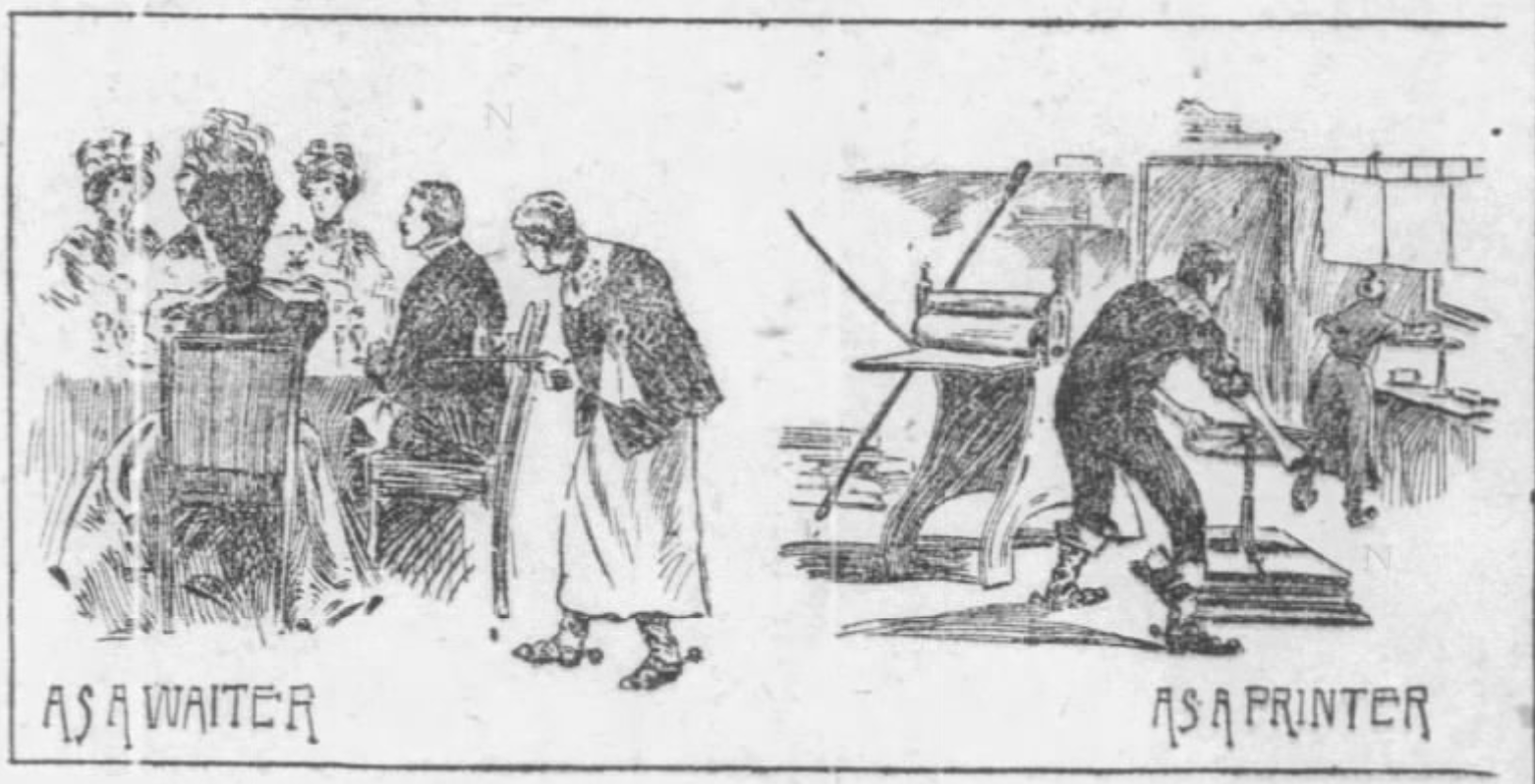
Philadelphia Inquirer, Dec. 11, 1898, p. 34 — McQuary earning his passage as a waiter, one of the many odd jobs that sustained him during the Quest.
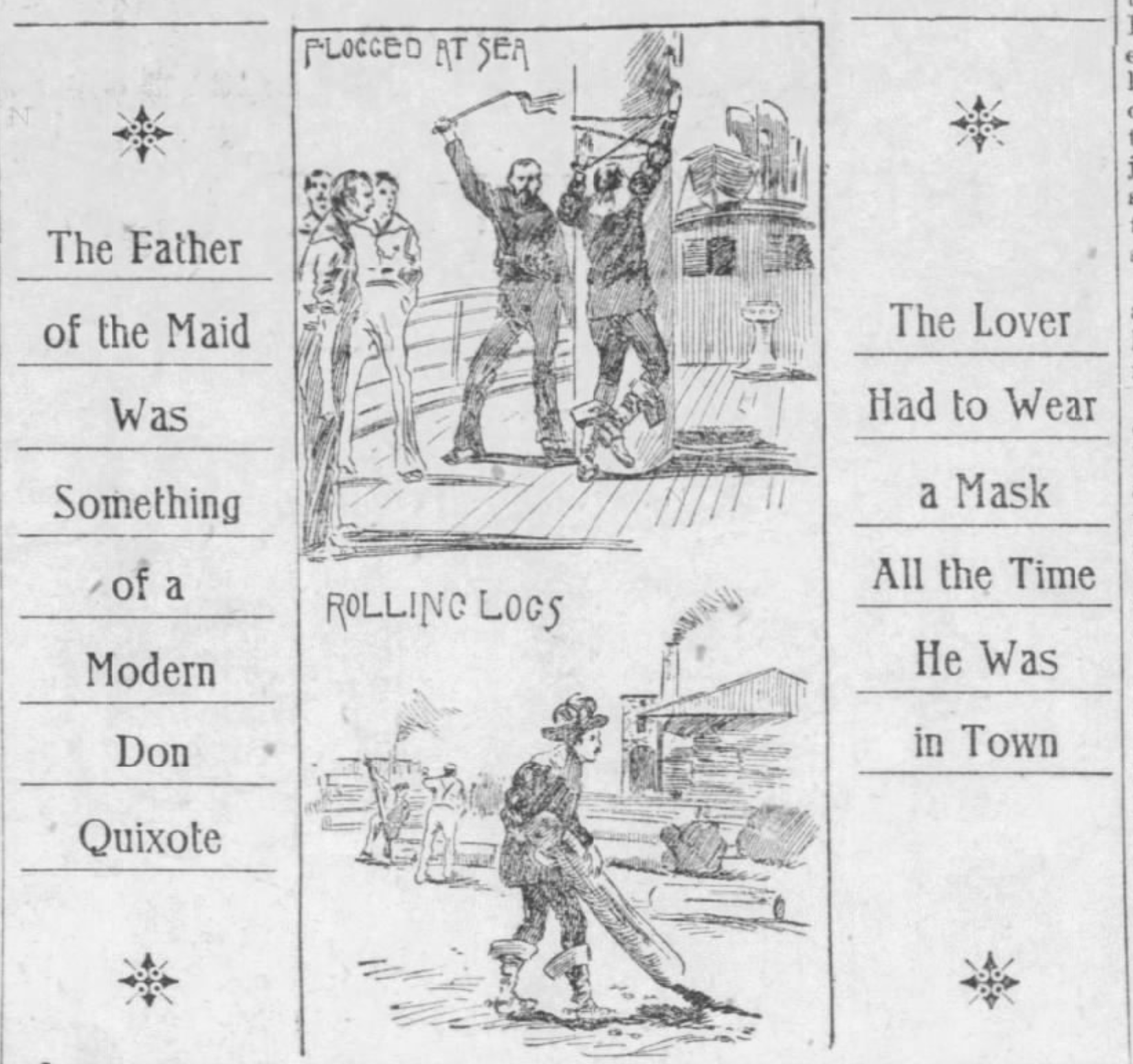
Philadelphia Inquirer, Dec. 11, 1898, p. 34 — The cat-o’-nine-tails incident aboard ship, one of the most widely reprinted episodes in the Quest narrative and almost certainly a Glenn embellishment.
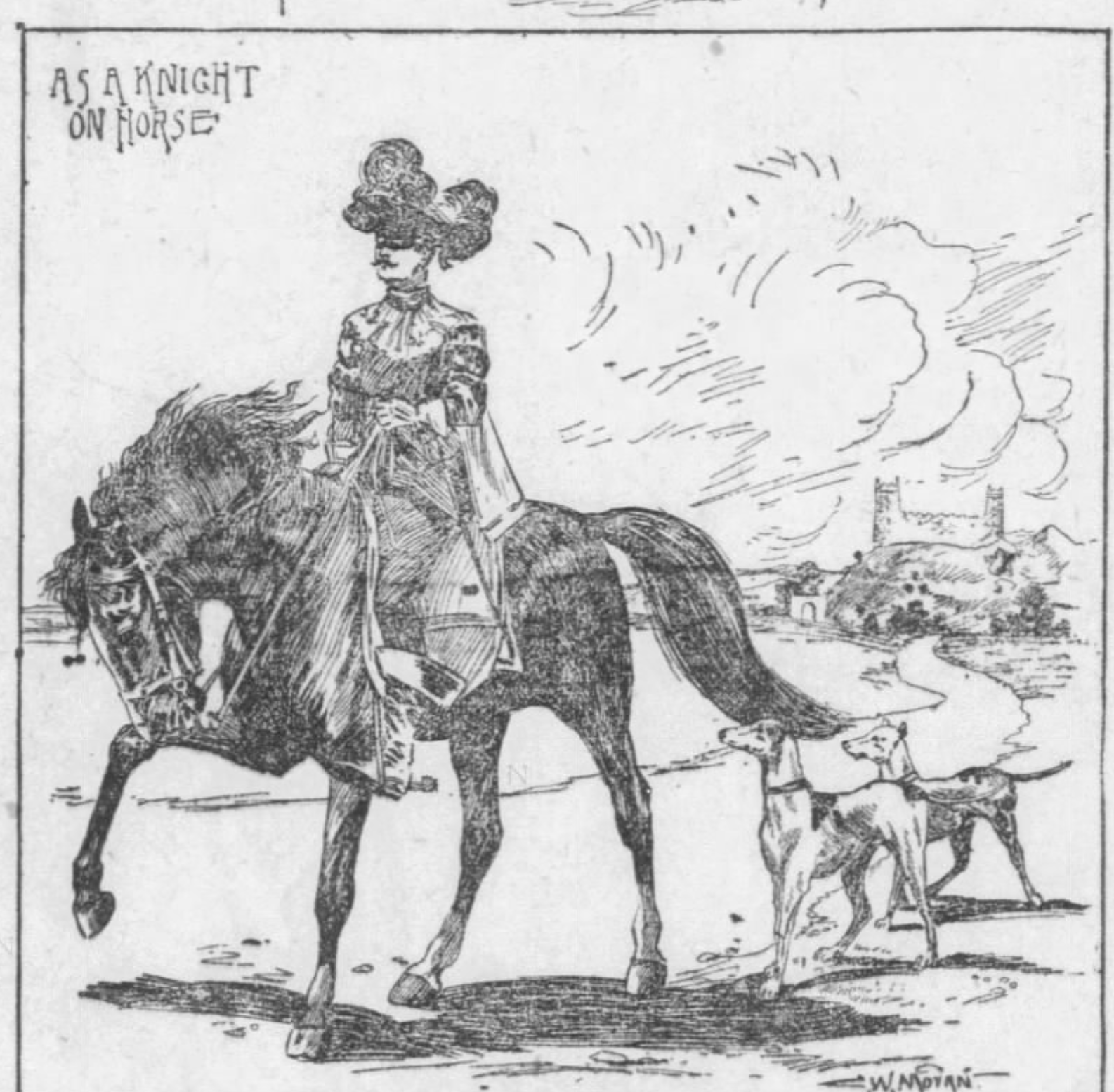
Philadelphia Inquirer, Dec. 11, 1898, p. 34 — McQuary in his Purple Knight costume, mounted and attended by greyhounds — the image Glenn himself described in the mock homecoming article he composed for the Plain Dealer.
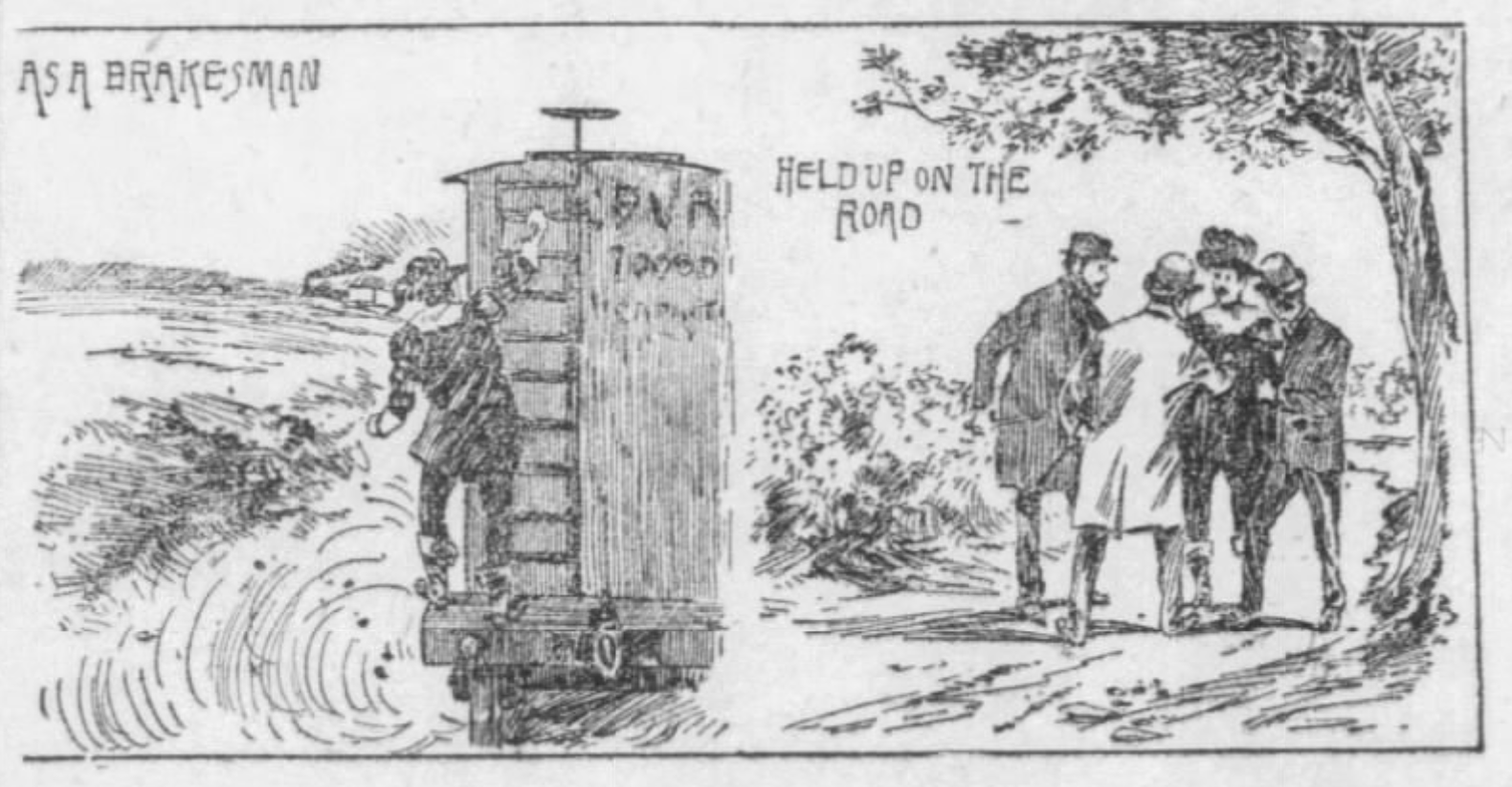
Philadelphia Inquirer, Dec. 11, 1898, p. 34 — McQuary working as a railroad brakeman, one of the documented occupations he held during his travels.
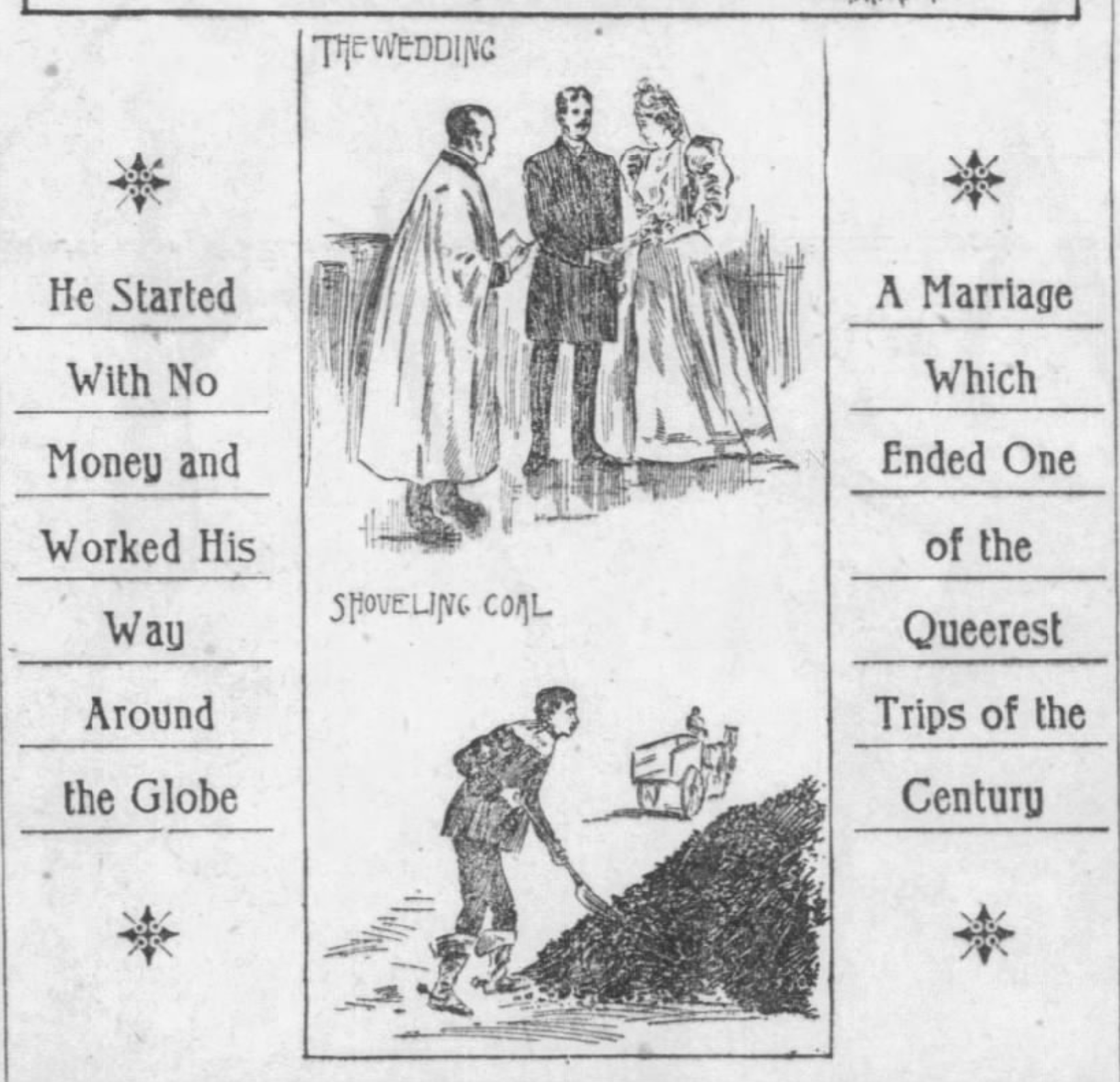
Philadelphia Inquirer, Dec. 11, 1898, p. 34 — The wedding of the Purple Knight to his Arkansas bride — the fiction at the heart of the Quest, and the lie that outlasted everything else.
McQuary’s Later Life: Bookbinder
Historical records show that in the years following the Quest, T. Allen McQuary worked as a bookbinder—an occupation that turns out to be one of the few verifiable threads connecting the narrative to his actual documented life. It is worth noting that bookbinding was among the traditional crafts McQuary would have encountered during his time in Japan, where the art had deep roots and was still practiced with considerable refinement in the late nineteenth century. Whether he acquired the skill there, or was simply drawn to it by temperament, the occupation fits the man: precise, solitary, and concerned with giving durable form to other people’s words.
The novel deliberately de-emphasizes the work McQuary did along the way—the waiting tables, the brakeman stints, the odd jobs that kept him fed—in favor of the larger thematic arc: a young man who circumnavigated the globe on the strength of a lie and came home to find that the lie had outgrown him. The labor was real; the legend was Glenn’s. That tension, between the ordinary man and the extraordinary story told about him, is what the Purple Knight Chronicles is finally about.