Chapter Thirty-Seven: Maggie Swan
May 25, 1900 — Emporia, Kansas
How Mack found himself in Emporia, Kansas, is anyone’s guess. Perhaps he followed Horace Greeley’s advice—with the footprint of Glenn on his derriere to speed him on his way—to “Go West, young man,” but those are pretty broad instructions and could have taken him anywhere. In fact, they could have taken him all the way west to Oregon and over the Pacific to Yokohama or Borneo, back all the way around the world to end up right where he started in the Ozarks. A fellow could go so far West that he never went anywhere at all. But that’s true of any direction, isn’t it? Well, except up or down, the directions that death will take us, or so we’ve been taught.
The truth is that Mack landed in Emporia as a matter of pure happenchance. His return to Missouri had been a manifest failure in every regard. His parents had disowned and disavowed him, the partnership with Glenn had fallen apart, he had no job and his only experience was in a profession he hated, he had no credentials except for a cockamamie story that became less tenable as the days wore on, and he had no prospects. Eventually, he would have to admit the Arkansas Girl was a fabrication cut from whole cloth, but that time had not yet come. In 1900, two years after his return, a lack of money was his chief concern. If anything led him to Emporia, Kansas, it was penury.
This is what happened. In February of 1900, Mack had taken a job as a printer for a Mr. White at the Republican newspaper (Mack’s resolve never to do any more printing weakened and died under the insistent pangs of hunger) on Merchants Street in Emporia, Kansas. Across the street from the shop was the Kansas State Normal School. Every morning, Mack would come downstairs and watch as the children arrived in wagons, on horseback, in the trolley and, occasionally, in carriages. Mack paid special attention to the nicer carriages because nicer carriages signified money. One bright March morning, Mack was opening the windows to let in the spring air and relieve the shop of its shut-shutter fustiness, when a particularly fine carriage caught his eye. Covered with a taut, black canopy, drawn by two fine dappled mares, and driven by a Black man with a jaunty cap and riding crop, the carriage came to a stop in momentary splendor before the school. Mack guessed that someone had climbed down on the other side, and his supposal was confirmed by the driver’s cheery, “Have a good day, Miss Swan.”
A small voice called out, “Thank you, Mr. Dobbs. You have a good day, too!”
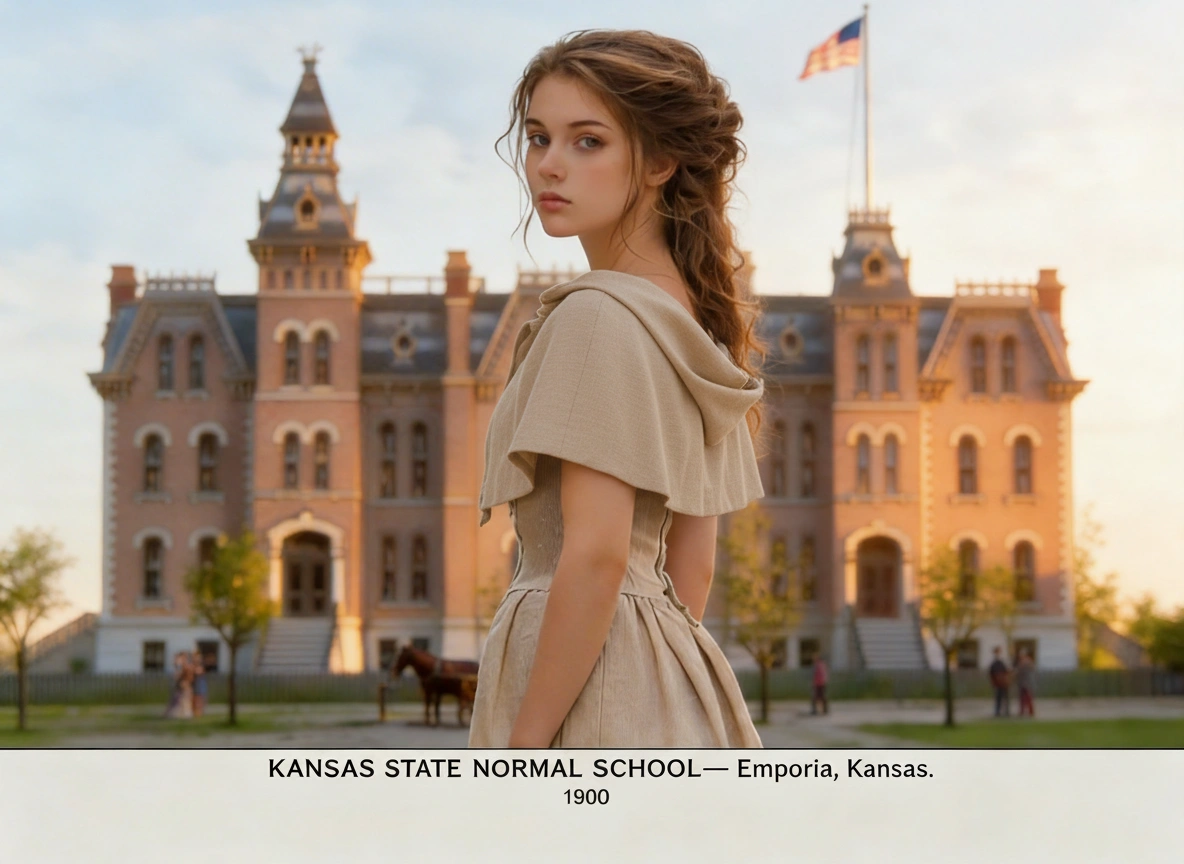
When the carriage pulled away, Mack saw a pretty, winsome wisp of a girl standing on the sidewalk. She was thin with brown hair curling to her shoulders, and she wore a cream cape over a beige dress that fell to the tops of her shoes. It’s impossible to imagine now, but in those days, such a dress was considered “short” and indicated that the wearer was ineligible for courting because of her age. The girl waved at the departing carriage and turned to walk into the school. Mack continued to watch her and thought, Well, well, what have we here? When she disappeared into the school, Mack pursed his lips and began tightening the screws on the quoin.
The next morning, Mr. White happened to be with Mack when the same carriage pulled up, and with a practiced air of nonchalance, Mack said, “Now, that’s a fine rig, isn’t it? How much do you suppose a carriage like that costs?”
Mr. White said, “Oh, that’s Mr. Thompson’s buggy. He’s rich as old Midas, but he’s got a heart of gold. He and his missus took in their granddaughter Maggie after their son passed, and the girl’s mother lost her mind to grief. She’s a beautiful child. Sweet, too.”
Mack said, “That poor girl. Where is her mother now?”
“Little Rock from what I hear.”
“So I guess the girl is on her own?”
“Except for her grandparents. Their house is big enough for half of Emporia to live in.” Mr. White paused. “I hear they’re taking in boarders. You might want to talk to Mr. Thompson about a room yourself, Allen. It’s a nice place.”
At the time, Mack was living in an apartment above the press until he could get “his legs under him.” He had struck the deal with Mr. White back in January, and here it was the middle of March, and Mack was still camped out upstairs, apparently, with little inclination to move. Mr. White had begun to regret his hospitality and was understandably anxious to rent the apartment to someone who would actually pay him. So, Mr. White said, “If you want me to, I’ll talk to O.C. and see what he would charge.”
“Well, that’s kind of you, Mr. White. I would appreciate that. How far is the Thompson home from here?”
“Only three blocks. Their place backs up to Washington Park and is around the corner from the streetcar line. You wouldn’t have to walk at all, unless you wanted to.”
“That sounds perfect!”
“I’ll talk to O.C. and see what he says.”
Mack moved into his new room in the Thompson house on April 1st, 1900, and he had not enjoyed such comfortable lodgings in a long, long time. The pleasurable accommodations of pastors and mayors and civic dignitaries were far behind him, and for the last year or so, he had pined for a soft bed and clean sheets; in fact, for the first time, he understood the old proverb about cleanliness and godliness, and though Mack wasn’t particularly interested in God, his desire for cleanliness had become an obsession.
You’ll recall that he had stayed only one night with his parents in Lebanon and that he had stayed with M.S. Glenn not at all. A.L. had given Mack enough money to stay at cheap hotels and travel camps and to buy tinned beef, but Mack had grown sick of chamber pots and stinking privies and fleas, or even worse, the canvas tarp and dirty bedroll he pitched beside a creek or under an oak tree.
His apartment in Emporia wasn’t much better than a tent. It was a shell of a room: single plank, wooden walls and a cold wooden floor, a corn shuck mattress on a rope-woven bedstead, and a metal bucket for the slops. A Franklin stove stood in the corner, and in the dark depths of winter, Mack fetched in an armload of firewood to heat the room, that is, until he nearly burned the place down. When he moved into the apartment, Mack had noticed the charred boards around the flue pipe but given them little thought until one night after he stoked the fire, snuffed the lantern, and climbed into bed, he saw the black boards glowing orange. He leapt from the bed, grabbed the slops bucket, ran thumping down the stairs and into the street, filled the bucket, ran up the stairs, and dowsed the burning wood. A sharp hiss followed, and from that time on, Mack slept in a frigid room, curled up beneath two thin quilts.
The Thompson home, by contrast, was a palace of warmth and efficiency. When Mack opened the window in the morning, the spring breeze lifted the curtains gently from a pristine sill. A small water closet opened off the bedroom, and Mack rejoiced in the down-swirling water; across the hall was a bathing room with a great clawed tub and ample hot water. The sheets and coverlet on his bed were washed and line-dried every Monday, so they smelled of April and felt as soft as the pretty girl who slept on the other side of the wall and whose proximity nearly drove Mack mad with desire.
Of course, the girl was Maggie Swan, and she incarnated her name—supple, downy, dark eyed, quiet, delicate to the touch. She was the reason Mack rented a room at the Thompsons. True, he loved the comforts he found there, but ever since the morning he saw her standing on the sidewalk in her beige dress and waving good-bye to the colored man, he had been infatuated with her. She was, as Mr. White said, “a beautiful child,” but equally (more?) important, she was associated with money, with Mr. Thompson’s money, and like all young men, Mack also wanted to be close to money. The girl reminded Mack of Shakespeare’s Portia, who was not only fair but “in Belmont richly left.”
Maggie, what a sweet, humble, bucolic name! Mack would awaken at night, speaking her name aloud into the darkness. Her young form stirred his dreams into a delirium of desire, and the transparent curtains that lifted on the breeze from the sill became her gauzy shift through which he could see her supple, naked body; a warm bath in the clawed tub became her naked embrace. The tedium of printing failed to distract him from imaginary and passionate liaisons so that his fever burned with an ever increasing avidity. Wealth and carriage and Mr. Thompson all trailed behind Miss Marguerite Swan, pretty Maggie, the orphan girl who in her vulnerability had conquered Mack and reduced him to a sweating, secreting young man who may have circumnavigated the globe but could not find his way around the child.
For make no mistake, Maggie Swan was still a child, only fourteen, and Mack knew better. He knew that his wild, lying lectures might someday be forgiven as the folly of youth, but a twenty-six year old man wooing a child would never be tolerated. But what could he do? When she used a spoon to crush a soft-boiled egg on buttered toast, the slight resistance of the albumen brought to mind her small breasts yielding to his caresses. He would watch her eating—albeit with careful, sidelong glances—and when a creamy bit of egg clung to her lower lip, he would seize the apron of the table in a spasm of lust. In those moments, he would twist about and pretend that he was admiring the lightly greening trees in the park and say banal things like “I love the spring, don’t you, Miss Swan?” but all the while he was waiting for her little pink tongue to lick the milky egg white off her lips. Her face was angelic! Mack was hostage to a wrenching desire that originated in his loins but possessed him entirely.

On the morning of May the first, May Day, he knew what he had to do, resolved to do it, and began to flesh out the contours of a desperate plan. He gobbled his breakfast and said, “Sorry to leave so abruptly, Miss Swan, but I’m off to work.” He bowed to her in an awkward arc and hurried down the street to the Republican. And as he hurried he planned.
He sat before the window, setting type and tightening the quoins when the carriage pulled up to the school. When the carriage pulled away, she stood on the sidewalk like a child bride in a tawny pinafore. He watched her walk into the school with the merest suggestion of swinging hips, and for a moment he sat in profoundest contemplation. He held the type-frame loosely in his lap and ink smudged his trousers. He was planning a desperate maneuver.
That afternoon, Mack was again watching as Maggie waited on the sidewalk for Mr. Dobbs. He fancied that she caught him staring at her and gave him a faint smile before glancing away, but he couldn’t be sure. Then up the street rattled the carriage with Mr. Dobbs sitting upright and driving the horses; for a moment, the girl was blocked from view, and when the carriage pulled away, naught was left but a vacancy. Mack thought, My heart was made for thee, O, Maggie, and is restless until it rests in thee. He scrubbed his hands with pumice and lye, hung his printer’s apron by the door, and began walking briskly up the street to the house on Washington Square.
When he arrived, he dashed up the stairs to the bathroom where he rinsed his mouth and combed his hair. He changed into clean pants. Then he walked down the hall to her room. Pausing outside her door, he took a deep breath and lightly knocked. “Miss Swan?” he asked.
“Yes?”
“It’s Allen. Are you there?”
What a stupid question!
“Yes?”
“May I come in?”
“Yes.”
Mack cracked the door and peeked in. Maggie was sitting before a mirror and combing her hair. She set the comb on the vanity and turned to look at him. Her eyes were a dark, mysterious brown and revealed nothing of her thoughts but a mild curiosity.
“What is it, Mr. McQuary?”
“Please, uh, call me Allen. Would you do that?”
“I suppose so. What do you want, Allen?”
For a moment, Mack’s determination wavered, but then he thought of his previous exploits, and the memories gave him courage. “Do you mind if I sit on your bed?”
“I guess not.”
“Miss Swan, Maggie, I have something to confess.”
“What? What could you possibly have to confess to me?”
Looking down at his hands, Mack breathed deeply and said, “I confess that I am madly in love with you. That I can think of nothing but you night and day. And I must have you as my wife.” He suddenly lifted his head and with dramatic confidence, looked into the girl’s eyes. “And I must have you as my wife now. You may think I’m proud because I’ve seen the whole world and been written up in all the papers as a modern Don Quixote, but I know I’m not good enough for you. You are so far beyond my reach that you are…you are more like a star in the firmament than a girl who lives next door.” Mack fell silent and watched her closely for some sign of encouragement. “Maggie, I love you with all my heart.”
She frowned and asked, “But, Mr. McQuary, what about the girl in Arkansas to whom you pledged your heart and soul? I read about her in the papers, too! How can you propose to me when you are engaged to another, a girl you have so publicly proclaimed to love! How can this be?” Maggie’s eyes filled with tears, and one slipped down her cheek. “Are you a rogue, Mr. McQuary?”
Mack stood and approached the girl, a gesture both desperate and threatening, though he was stupidly unaware of how it might affect her. “No, I swear to you that I’m no fickle lover! Yes, I did love her, it’s true, and that love gave me the strength to travel around the world. But you are more beautiful than—”
Maggie interrupted him. “Beauty is within the heart, Mr. McQuary, and manifests itself in loyalty and compassion.” Mack looked down at the girl and imagined her draped in the lacy curtains lifting in the breeze. He was seized again in a vice of violent desire.
“But the heart is a compass, Miss Swan, and will ultimately point true north! And that’s what you are to me! You have drawn me to you as certainly as the lodestone draws iron! All my love belongs entirely to you and no one else! I no longer care what the girl in Arkansas or her father or the newspapers or anyone anywhere says! I want you and no one else!”
“In one article, you said she threatened to kill herself if your love should falter. Can you be so hard of heart now?”
“Ha! Is that all you’re worried about? I have the dagger in my room! I can show it to you.”
“Was that the only knife in her father’s house?”
Mack was struggling in the web of lies he had spun for so long, and he searched for the right words to cut the strands. He took another step toward her, and she shrank back from him, so he knelt instead and reached out to take her hands. “Please, my pretty Maggie, think no more of her. She’ll be fine. She has more suitors than her father has acres. She, she was always given to exaggeration and theatrical gestures, but inside, she was as calculating as a captain in wartime. And, besides, she is rich, and money shields her from suffering and heartache. But what do you and I have as a bulwark against the vagaries of Fate? Nothing but ourselves and our desire and our future together. Marry me, Maggie, and I’ll be true to you, I promise.”
“As you were true to her? You frighten me, Mr. McQuary. You frighten me very much. Besides, I am too young. You would need my grandfather’s permission, and he would never consent to that.”
“Come with me now! I’ll take care of everything. Listen. I’ve already contacted my sister in Carthage. Yes, it’s true! I telephoned her, and she agreed. We can elope and go to her house. It’s all arranged! Just say, yes!”
But Maggie held her hands over her face and began to weep. “No, Allen. It’s too sudden, and it’s all wrong! It’s wrong, I tell you! What kind of sister would encourage her brother to pursue such a desperate and immoral plan?”
The dreary interview went on for some time until the front door opened and closed downstairs. Mack took the girl’s tear-dabbled hands in his and kissed them; then he whispered hot words, “I’ll never give up, Maggie! Never! I love you madly!” He rose and kissed her forehead. Then walking from the room, he shut the door quietly behind him and went to lie in his own bed. It was just a matter of time.
Having declared his love to Maggie, Mack was emboldened to watch her with open admiration: He watched her lift her glass of milk to lips, he watched her spread jam on her toast, and he watched her rise from the table. He accompanied her to the door and assisted her into the carriage. Mrs. Thompson was also watching Mack, and she mentioned to O.C. that she was concerned about Mr. McQuary’s behavior. “He seems to be altogether too interested in our granddaughter.”
“I don’t doubt it, Mary. She is a fetching girl—”
“But altogether too young for courting!”
“What would you have me do?”
“Talk to him! Tell him she is not of age to be the object of his attentions.”
“Does she return his advances?”
“Don’t you see anything at all, Mr. Thompson? She permits him to hold her waist when he helps her into the carriage. When he opens the door for her, she brushes against him.” Then with a look both serious and certain, she said, “She laughs at his jokes! I even fear that he may be going to her room at night!”
“No! I will not have my grandchild debauched in my own home!”
“Good! The sooner you act the better lest things get altogether out of hand.”
“I will tell Mr. McQuary to pack his bags and leave tonight!”
Much of Mack’s success lay in his intuition regarding the emotional reactions of those around him. He could, as they say, “read the room,” and this clairvoyance gave him the notion that he was the star of the show. He often recalled Glenn’s “first principle of business”: “Anticipate, deliberate, and actuate!” though Mack wasn’t sure that “actuate” was the right word.
Shortly after nine o’clock on May 25, 1900, Mack scrubbed his hands, hung up his apron, told Mr. White that he would be back soon, and took the trolley to the courthouse. At half past nine, he returned to the Thompson house with a marriage license in his jacket pocket. Meanwhile, Maggie was pretending to focus on her lessons—she even had the presence of mind to recite from memory “Annibelle Lee” in front of the class—and her algebraic sums were perfect. Then, at eleven o’clock Maggie went to the Headmistress and told her she wasn’t feeling well and needed to go home. Through various discrete intimations, Maggie communicated that she had just “become a woman,” and so while her situation wasn’t dire, it was nevertheless urgent. She said she would take the streetcar home, but in fact, she disembarked from the trolley at the corner of Merchants and First.
Mack was hard-pressed to actuate his plan. When he returned home, he urged Mr. Dobbs to meet him behind the carriage house for some earnest conversation. Mack told Mr. Dobbs about his experience at the Charlotte Golf Club: the fierce prejudice of its members and their vicious acts of injustice, and then he asked Mr. Dobbs, “What can be done? What can anyone do about such cruelty?” Mr. Dobbs told Mack what it was like growing up in Alabama—before, during, and after the War—and he said that justice “ain’t nothing more than an excuse for white people to beat up on colored people.” Then Mr. Dobbs rolled a cigarette with one hand—a talent Mack genuinely admired—and then Mack said, “Mr. Dobbs, may I ask you a favor?”
“What’s that, Mr. Allen?”
“Could you teach me to drive the carriage?” Of course, Mack already knew how to drive a carriage, but feigned ignorance is the surest way into a man’s confidence.
Mr. Dobbs said, “Why, I’d be happy to, Mr. Allen,” and soon Mr. Dobbs and Mack were circling Washington Park, with Mack holding the reins while Mr. Dobbs encouraged him. “That’s right. Jess pull the left rein easy like. Uh-huh.” Finally, and with confidence, Mack said, “I think I’ve got it!”
Mr. Dobbs said, “You’re a natural driver, for sure. Let’s go home.” When they returned to the Thompson house, Mack yelled, “Whoa!” and pulled back on the reins.
Then, casually, almost as an afterthought, Mack asked, “Hey, Mr. Dobbs, how about letting me drive this old buggy by myself?”
Mr. Dobbs sensed something was amiss, and he hesitated. So, Mack said, “All right. I’ll tell you why I want to do it. The school lets out for lunch at half-past eleven, and I would like for Miss Swan to see me driving the carriage past the schoolyard. To speak truly, Mr. Dobbs, I am smitten with her. You understand.”
Mr. Dobbs smiled and shook his head and said, “That I do. All right. One pass around the schoolyard, and you come right back. If you get caught, Mr. Thompson’ll give me hell.”
“Don’t you worry, Mr. Dobbs. I’ll come right back. Honest Injun.”
Mr. Dobbs climbed down and watched Mack flick the reins whereupon the carriage rattled off down the street. Mr. Dobbs thought, Maybe that wasn’t such a good idea.
And for Mr. Dobbs, it wasn’t. When Mack turned onto First Street, Maggie was standing on the corner with her schoolbag in her hand, which instead of books held sleeping clothes, a dress, a shift, and a change of knickers. Mack tugged on the reins, and Maggie climbed into the carriage behind him. When she was settled, Mack snapped the reins with a violent crack, and the horses galloped northward up Merchants Street and toward the railroad tracks. The carriage rattled as if it would shake to pieces, but Maggie looked straight ahead with serene eyes. Mack reined the horses left onto the road that ran beside the tracks and drove them onto Americus, a village northwest of Emporia.
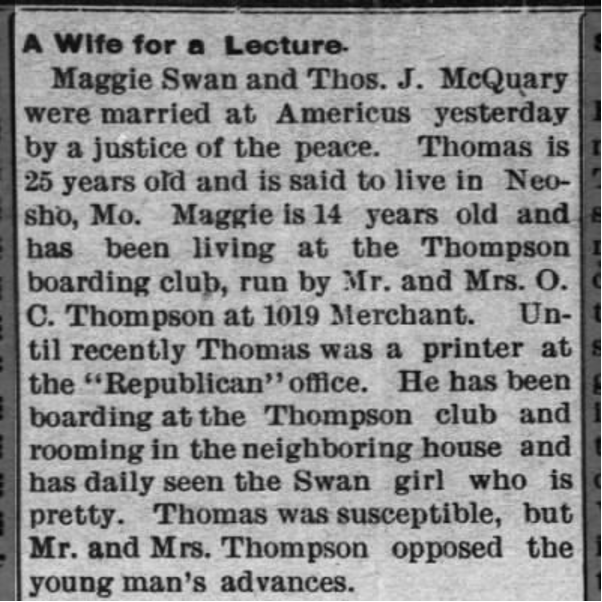
When they reached the courthouse in Americus an hour later, the horses were sweating and snorting, and Mack was excited, frantic, verging on mania. He said, “Here now! You hold the reins while I find the justice of the peace.” So, Maggie climbed onto the wagon bench and tugged the bill of her bonnet as low as she could. Mack saw her skirt didn’t reach her shoes, so he said, “If the judge sees your dress, he’ll never marry us. Get back on the carriage seat and hold the reins there.” She had to lean forward to hold the reins, and Mack said, “Good. I’ll be right back.” Then, he ran up the long steps and into the foyer of the courthouse, looked around, and saw a door with a frosted glass panel and the name “Judge J.P. Mason, J.P.” stenciled in black.
That’s kinda funny. JP JP.
Mack opened the door and said to the fellow behind the counter, “Is Judge Mason available? Me and my gal want to get hitched. See? I have the marriage license.”
“Whoa there, pardner. You seem mighty anxious to tie the knot.”
“Gotta do this and catch the three-thirty for Amarillo.”
“Okay, okay, I’ll see if he’s available.”
“Thankee, sir. By the way, who all has to sign the license?”
“Just you and her and the judge. How old’s your bride?”
“What difference does it make?”
“She has to be at least eighteen years to sign, or you’re gonna have to get her father or a legal guardian to do it. She’s eighteen, ain’t she?”
“Yessir. She turned eighteen a week ago; that’s what we were waiting for.”
“Good. Wait just a minute.”
The fellow knocked softly on a door to his left and waited to be admitted. He closed the door behind him. Mack could hear muffled voices, and he was becoming anxious when the fellow came back out.
“The judge says he can see you now.”
“Great! Can he meet us outside at the buggy?”
“What?”
“We ain’t got much time. This morning, my Maggie received word that her mother is dying, and if we miss the train to Amarillo, we might not make it before she passes. Oh, please, sir! I have the license right here. See?”
“Well, I reckon you do. Go on to your rig, and I’ll talk to the judge.”
So, Mack hurried back to the carriage and climbed up beside Maggie. “It looks like the judge will marry us right here! I said you were eighteen.”
“How much does a judge charge?”
“I don’t know. We’ll be okay.”
It wasn’t long, and the fellow behind the desk came out followed by a tall, thin man whose head looked like an upright watermelon but the color of a cantaloupe. He wore silver rimmed spectacles and the crown of his head was shiny. He wasn’t wearing robes.
Mack said, “Judge Mason? Hello, I’m T. Allen McQuary and this here’s my bride-to-be, Miss Maggie Swan, and, well, thank you so much for agreeing to marry us. We are set on marriage as you can see, and—”
“What in God’s name is so all fired urgent that you want to be married in a carriage?”
“As I told this fine fellow, we got to catch the train to Amarillo because Maggie’s ma ain’t doing too good, and we’re afeared she might die before we get there.”
“You don’t have to be married to travel together.”
“Nossir, but it has always been her mother’s fondest wish to see her daughter married.”
The judge looked at Maggie. “Can you speak for yourself, darling? How old are you anyways?”
“I’m eighteen years of age, your honor. And what he said is the truth, pure and simple. My poor ma is ailin’, and she only wants to see I’m taken care of before death closes her eyes.”
The church bell chimed four times, one long, three short, and Mack said, “Oh, Lord, it’s a quarter to three. Please, your honor!”
“This is highly unusual.”
And Maggie said, “We didn’t plan to be married like this, sir, but what can we do? We were going to have a nice little wedding at St. Peter’s, but then we got the telegram about my ma—”
“What? Are you a Roman Catholic?”
She wasn’t.
“Yessir. Does that make a difference?”
“No, but why didn’t you seek out a priest?”
And Maggie said, “We did, your honor, earlier this morning. But he wouldn’t budge. You know how they are.”
“Ah, yes. Beholden to the traditions of men. Young man—what did you say your name was?”
“T. Allen McQuary, your honor.”
“Come on, Allen. We’ll show your little lady how Christians are supposed to behave. Hand me that license.” Mack passed the license to Judge Mason and gave Maggie a sidelong glance. With a flourish, Judge Mason signed it and handed it to Mack who put the license in his jacket pocket and said, “Thank you so much, your Honor.”
“Now, climb up on the wagon bench, Allen,” said the preacher. “I’ve at least got to put you two lovebirds in proximity to one another.” So, while Mack and Maggie held hands, and the chickadees chirped among the zinnias, and the gray misty May morning enveloped them in her mild embrace, Judge Mason read from Paul’s Letter to the Ephesians and asked the couple to repeat after him, and raising his right hand, he blessed them, saying, “Go in peace and live happily ever after.”
“Thankee, Judge Mason,” said Mack. “And God bless you, too.” And with that, Mack flicked the reins, and drove the carriage to the Americus train depot.
Mack and Maggie didn’t know it, but they were only one step ahead of the law. Mr. Dobbs realized soon enough that Mack had made off with the carriage, so he called the operator who connected him to the police, who by that time had been contacted by the headmistress of the Kansas State Normal School, who had reported that one of her pupils had not returned to her classroom after lunch, and putting these anomalies together, the police conjectured what had probably happened and so sent a small posse to the depot but found no couple. The police went back to the Normal School, and one of Maggie’s classmates said she had seen the carriage headed north and in a hurry, too. But, of course, the posse didn’t know where to the north they might be headed, but figured it must be Americus because there are no other towns even close to Emporia.
The posse rode to the Americus depot and found the carriage tied to the hitching rail. The train, however, had left some twenty minutes earlier, and the only thing the sheriff could do was telegraph ahead to Amarillo, which is where Judge Mason said that the couple was bound. (Judge Mason was so chagrined at his role in the fiasco that he shortly thereafter resigned his judgeship and moved with his family to Omaha where he went into the furniture business.)
But Mack had only planted Amarillo as a diversion. He and Maggie switched trains at Wichita and took the Atchison, Topeka, and Santa Fe east to Fort Scott where they switched again, this time to board the Missouri and North Arkansas, and traveled south to Carthage, Missouri, where Mack’s sister, Vertrude, and her husband, Smith, lived with their two children. When they arrived at the depot in Carthage, Mack hired a hansom cab that carried them west down El Dorado Street, south on MacGregor, and west again on Sycamore to Vertrude and Smith’s bungalow. Mack knocked on the door, and when Vertrude opened it to see her brother and his child-bride standing on her porch, she put her hands on her hips and said, “Christ-amighty, Mack. What have you gone and done this time?”