Chapter Thirty-Eight: Farewells
The Purple Knight Chronicles
Mack’s unlawful elopement with Maggie Swan cause much speculation regarding his motives. Most people believed he wanted a wife who would pretend to be the girl from Arkansas, and who better than Maggie, the poor, little orphan girl? If that speculation was true (and it may have been), it was a ruse destined to fail. Too many people knew the truth—decent, honest people who would never countenance such a lie, people like O.C. Thompson and Mrs. Thompson and Mr. White, the editor. They denounced McQuary in the press, calling him an opportunist and no better than a rapist. They defended Maggie as naïve and trusting and thereby betrayed their complete lack of knowledge of the girl, who was, in fact, desperate to escape their demanding and unrelenting embrace.
Mack himself may have found it difficult to unpack his motives in running off with Maggie. He had departed Missouri as the Purple Knight of the Ozarks, a romantic dreamer, a spinner of tales, and a playful cynic who believed that the world was so stupid that he could fool everyone. He returned to the Ozarks with a severed consciousness: one hemisphere believed the ultimate reality was the abyss, the blank hole at the center of human experience that found its consummation in the grave. This hemisphere descended often into a glowing red cave to bow before a little, half-buried skull.
The other hemisphere believed Mack had the freedom to choose another story if he so desired, a better story. This hopeful half argued that if one story really is better than another, then nihilism must be false, for if nothing is the greatest reality, there are no grounds for comparison. The hopeful half continued to scrape about in fusty novels and erotic misadventures in search of meager meanings.
Then further back, somewhere above and behind the cloven hemispheres loomed a holistic Mack, a Mack detached from nihilism and anti-nihilism, a Mack who watched his two hemispheres and cheered on their competition. Call him “The Greater Mack.” The Greater Mack perceived himself and Maggie and the Thompsons and M.S. Glenn, in fact, everyone with whom he had ever interacted, as pieces he could move about on a chessboard for his own amusement and distraction. And behind the Greater Mack was another Mack who watched the Greater Mack, and another and another, each of whom watched a mirrored version of himself moving chess pieces, an infinite regress of Macks reflected forever in a parabola of purple-plumed images.
If such is true for Mack, then how true might it be for you? And for me? And for Claude? Aristotle writes that reason despises an infinite regress, but what if, in spite of our contempt, the regress is the ultimate reality? What meaning do our choices have in such a world?
Well, that’s enough dime-store philosophizing. People much brighter than I have cudgeled their brains on similar questions and come up with much better answers than I ever shall.
So, to continue our history.
A.L. McQuary left the ministry for a final entrepreneurial venture, a tourist resort called Camp Clark outside of Galena. The resort was a tidy place with white cabins and timber pavilions on the banks of the James River. Vertrude and her husband moved to Galena and lived at the camp. You can find ads for Camp Clark in the old Stone County News-Oracle, and I found this postcard from the resort:
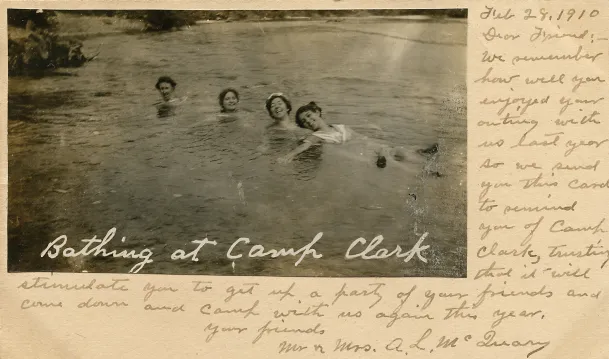
A postcard from Camp Clark, A.L. McQuary’s resort on the James River near Galena, Missouri.
Otis Bulfinch continued his persecution of M.S. Glenn. He was like a dog digging in a fresh grave: He wasn’t going to stop until he turned up something. That something came to him in a letter from Butler Price of Marshfield, Missouri. Price was the editor of the Marshfield Gazette; he and Otis had met a couple of times, and the two men were on friendly terms. Price wrote that Glenn had sent letters to several Missouri newspapers advertising half-priced envelopes, so he, that is, Price, sent Glenn a check for twenty-four dollars but never received any envelopes. In an effort either to acquire the envelopes or recover his money, Price needled and threatened Glenn until Glenn replied to Price that he didn’t have the envelopes, that the person for whom he was acting as a “go-between” failed to deliver the envelopes, and he, that is M.S. Glenn, was lucky to get out of the deal with the shirt on his back. Price concluded, “I thought you might find this interesting.”
Price was right, and Otis deliberated thus: “Huh. Glenn advertised the envelopes through the mail, and that constitutes mail fraud. And mail fraud is a federal offense. If what Price says is true, I may finally nail that slippery son of a bitch.” So, Otis went to the post office where he got the names of two postal inspectors, Stofford and Bunson, to whom he forwarded the letter from Price. As it turns out, Stofford and Bunson had been watching Glenn for a long time, but until they read about the envelope scam, they didn’t have any solid evidence against him. Glenn was arraigned and brought before a judge, to whom he eventually confessed the scheme. The judge sentenced Glenn to eighteen months in the penitentiary, coincidentally, the same amount of time allotted to McQuary to go around the world.
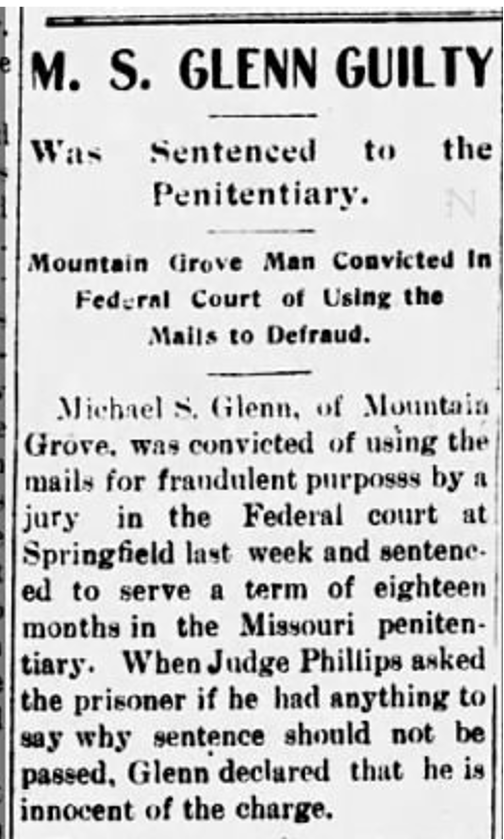
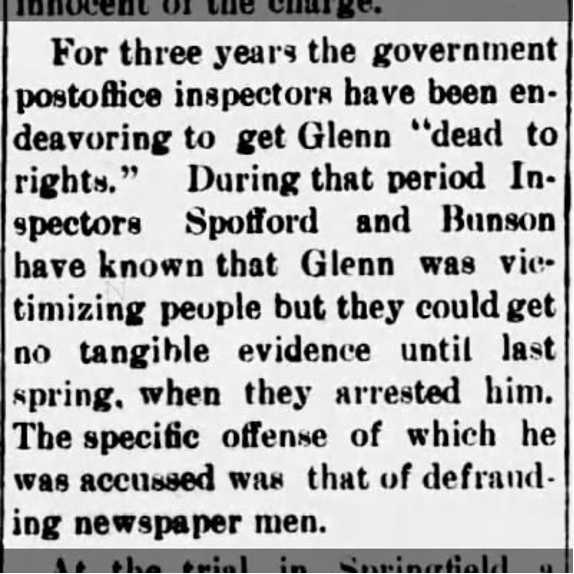
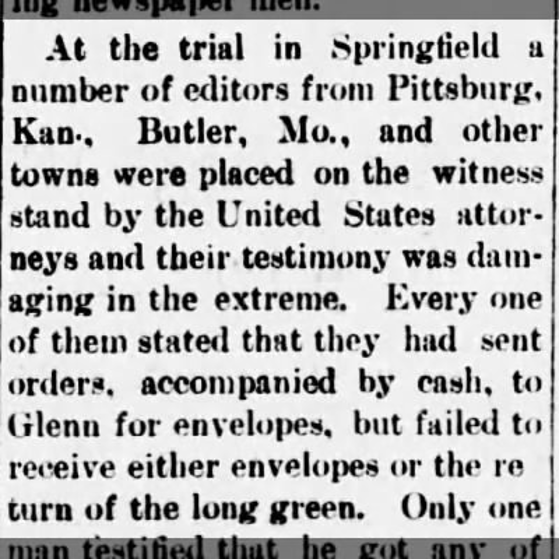
You may wonder about the fraudulent insurance policies that initially entangled Otis Bulfinch in the whole McQuary/Glenn hoax. Well, truth be told, Glenn never sold phony policies. Bulfinch made that story up, but not even he could tell you why. Maybe he wanted to make Glenn sound worse than he really was. Maybe he thought it was a better story. But the reason that Dobbins ordered a retraction of the story was because it just wasn’t true.
What happened to Otis Bulfinch you ask? After his embarrassment at the Turnverein Germania Hall, Otis gave up on historical truth as attainable. Oh, he still believed there was a “real truth,” a sequence of events that actually happened in the past and involved real people who remain “real” even after they’re dead. What he gave up on is his capacity to know the truth. After all, events are recorded by people who get it wrong all the time. Otis found several mistakes in the articles he included in The Purple Knight Chronicles. For example, in one article, the Neosho Rustler was called the Hustler. In a couple of articles “McQuary” was spelled “McQueary.” Sometimes McQuary was said to be nineteen years old at the beginning of his quest; in others, he was twenty-three. Similarly, Maggie Swan was sometimes said to be fourteen and at other times sixteen. And the list goes on and on. People, even reporters, make lots of mistakes.
Paradoxically, the most consistent details in the articles were the out and out lies created by M.S. Glenn. For example, in every article about the journey, Theophilus Trotter has Mack flogged with a cat-o-nine tails. That never happened. In every article and in precisely the same words, Mack remarks that only the memory of his beloved’s face kept his hand to the task of shoveling coal. Another lie. It’s worth remembering that often the most consistent and persistent details in a story are likely to be false.
Finally, there’s the problem of knowing the motives behind people’s actions. Even if a would-be historian knows who did what when, he or she still cannot know why. People’s motives are always complex. A man may take a bullet in defending his wife, and we praise him (rightly) for his love and devotion in the face of danger. But the husband may also harbor a fear of the shame that attends cowardice. Or maybe he wants to appear in the papers as a hero, and he thinks it’s worth it even if the bullet kills him. Perhaps his wife has just told him she is filing for a divorce, and he hopes to die in a manner that will cause her lifelong guilt and remorse. Or the husband may be terminally ill, and getting shot to death is a hell of a lot quicker than dying of cancer. The point is that no one has access to the range of possible motives that result in the acts that are recorded as history.
All of these caveats are not to say that we can’t know something of the truth—people have done horrible things to other people, and there is no excusing their crimes. When people say that we should study history to prevent history from repeating itself, they are making an implicitly moral claim. No one is worried that forgetting the number of tomato canneries in the Ozarks in the 1930s will result in an inexplicable proliferation of tomato canneries in the present. But we may be worried that forgetting the causes and horrors of the Civil War may lead to a false sense that civil war is not really that bad. Well, it is that bad and ought to be avoided at all costs. So, rather than toss out history because of an “epistemological crisis,” we should hold history lightly, recognizing that history may be fuzzy but is nonetheless true within its limitations. With regard to the Purple Knight of the Ozarks, Otis concluded that even though something happened (i.e., there was a T. Allen McQuary who pretended to be a knight errant), and we can be fairly certain that Mack traveled from Mountain Grove to Charleston, South Carolina, and from Portland, Oregon, back to Mountain Grove (it is, after all, hard to imagine that all those regional newspapers along the way were mistaken or lying), it was nevertheless best to hold McQuary’s history lightly, to let the lies and mistakes sift through his fingers, and even to mistrust the residue that was left in his hands.
What Otis didn’t expect is that “holding history lightly” would play a role in his redemption. The date was April 7th, 1901, Easter Sunday, and Otis was walking in the cool, mid-morning sunshine down Campbell Avenue. These days, Campbell is a busy, bustling thoroughfare flanked by car dealerships, strip malls, and Chinese restaurants, but in the days of Otis, Campbell was a serene, tree-lined street with brick sidewalks and forsythia blooming by the homes. Otis was “clearing his head,” as his job often required him to do. He had been reporting on the murder of a young girl in Galloway; the attack was brutal—rape, head trauma, and dismemberment, a reckless orgy of blood that betrayed a sadistic insouciance on the part of the killer. No assailant had been arrested, indeed, there were no suspects in the case, and whoever did it was probably long gone west on the Frisco. Otis was understandably distressed, and he was walking with downcast eyes when he passed by the open doors of The Church of the Immaculate Conception. Otis sneered at the singing of the Hallelujah and thought, What a silly doctrine! As if Mary had to be born sinless so Christ could be born sinless so he could somehow save a sinful world. According to that logic, why couldn’t Mary have died for humanity and saved Jesus the trouble? Otis didn’t really believe in salvation, so his questions were entirely rhetorical. I don’t see that humanity is worth saving anyhow. It would’ve been better had Adam and Eve been struck down at the East Gate. But for a bunch of old men in red hats to multiply doctrines in the hopes that somehow the whole thing might work is folly and maybe a sinister attempt to control their people.
Otis stood before the open doors as Father Claude raised the Bible and carried it to the ambo. In his sonorous and dramatic voice, the priest read the Easter story; he told how Jesus rose from the dead, and Mary Magdelene thought he was a gardener, and when she realized it was Jesus she wanted to touch him, but he said, “No,” for he had yet to go to the Father. Then, she told the disciples that Jesus was risen, but they didn’t believe her and had to see for themselves, and then Jesus appeared to them, too, before ascending into heaven.
Verbum Dei.
Laus tibi, Christe.
and the people sat down.
Otis thought, Men have been milking that story for a long damn time.
Father Claude paused before walking behind the altar, whereupon he pointed upward at the crucifix, and proclaimed in a loud voice, “My brothers and sisters, that,” and he shook his finger, “that never should have happened. Never! We kneel every Sunday before an outrageous murder: the unjust killing of an innocent man, a man who healed the sick and fed the poor, taught the love of God to lepers and gave hope to a desperate people. And crucifixion is what he got for his trouble! Behold, brothers and sisters, the good man tortured to death; gaze upon the faithful Son who cried out because his Father had abandoned him: Eloi, eloi, lama sabachthani!
“That,” and again Father Claude stabbed his forefinger toward the crucifix, “never should have happened! But it did. And why? Because God wants to reveal something to us, the deepest truth about who we are. We fret about our petty sins, and so we should because all sin comes between us and God. We fret and pray and the Church gives us absolution, but all too often, we ignore the bloody foundation of that sin. And what is that foundation? Violence! Yes, violence! Even the meekest of us harbors a worm in our hearts. Heed the words of the poet Blake:
O, rose, thou art sick!
The invisible worm that flies
In the night in the howling storm
Hast found out thy bed of crimson joy
And his dark secret love
Does thy life destroy!
The cross shows us that the invisible worm we harbor and caress and nourish is our secret love of violence! We envy our neighbors who have a cup of cream and a pound of sugar more than we do, and in our secret hearts, we pray for their humiliation. In our pride, we remember slights and insults and repudiations, and our dark hearts want vengeance! Yes, in our hearts we rise up in anger like ancient Cain who slew his brother, Abel.
“But, my brothers and sisters, Easter has come! Gaze upward at our Savior on the cross and now at the altar, the alter of the sacrifice of wheat and wine. When we take in our mouths the body of Christ, when we drink His blood, we take in not the bloody sacrifice of Abel but the bloodless sacrifice of Cain, a sacrifice made acceptable by the sacrifice of Christ! Think on this miracle! Soon I will pray to the Father to receive our sacrifice, to make it holy, and in a miracle of transformation, God will approve the sacrifice of the murderer, of the envious man, of us all!
“You remember the old story: Abel sacrificed a lamb to the Lord and Cain the fruit of the field, and the Lord approved Abel’s sacrifice and rejected Cain’s. For Cain, that rejection was a lance to the heart and into the wound crept the worm with its dark secret love. Cain envied, he raged, and he killed innocent Abel. But today, as we do at every Holy Mass, God accepts the sacrifice of Cain because of Christ! Think on it! What can that mean except that Cain has been forgiven and accepted and approved? What can our sacrifice mean except that Cain has been saved! For that reason was he marked that no man might harm him. What does it mean for us that Cain has been redeemed?
“For God so loved all the world that he sent his Son who let himself be nailed to a cross, so you and I can know who and what we are. We look at Jesus on the cross, and we discover what we have ever loved: Violence and vengeance and the clenching of our fists! How bitter would that knowledge be without resurrection! How terrible our self-awareness without forgiveness! How cursed would we be to find we are Cain with no hope of redemption.
“And that’s why Easter is the most joyous day of the year! Because of Easter, we look at the cross and walk through the door of self-knowledge into a new light, the holy light of resurrection, the resurrection of Christ, of course, but also of Abel! Thanks be to the Father: Love awaits us beyond the cross! Thanks be to the Son: Faith awaits us beyond the cross! Thanks be to the Holy Ghost: Hope awaits us beyond the cross! Cain is redeemed, his sin is forgiven, and violence is overcome, not with domination, not with greater violence, but with love because of the Outrage That Never Should Have Happened!
“Is this a mere story? Fah! You feel it in your hearts, do you not? You feel it in the very marrow of your bones. This is no mere story, this is the story beyond history, the story beyond all stories, the story that transforms human violence into divine love and peace. The rose blooms, not because the worm is crushed but because it becomes a butterfly. This is the Good News that God awaits us all beyond the cross! We bend the knee to the sign of our outrageous failure, so we can rejoice in God’s even more outrageous love! Hallelujah. Hallelujah. Amen.” The people rose for the prayers of the faithful while Otis stood awestruck beneath the oaks.
A story beyond stories, a history held so lightly it could buoy all humanity. Otis felt the power of the story, and even as he mourned the butchered girl, Molly Joiner, robbed of her innocence by unbridled lust and of her life by unprovoked violence, he prayed for the redemption of her killer.
That was the last prayer Otis ever prayed. He never made a profession of faith. He didn’t join the Catholic Church or any other church as far as that goes. But he didn’t kill himself either. When he looked into the abyss, he still saw darkness, but whether it was through the straining of his eyes or some function of his brain, he fancied he saw a dim light in the depths. Otis Bulfinch died at the age of 86 after a lifetime of doing his best to tell the truth. Requiescat in pacem.
And now for Mack’s sad story. After he eloped with Maggie, Mack confessed to all his falsehoods.
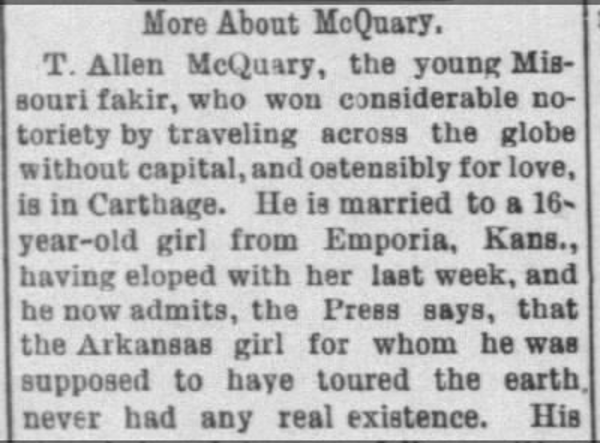
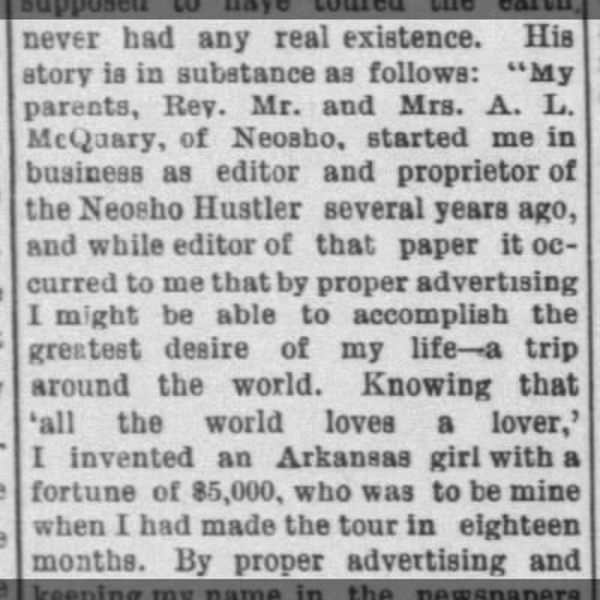
What else is there to say? There was no girl in Arkansas, no eccentric father, no contract, and no reward. The whole thing was a lie. Otis Bulfinch felt much satisfaction when the scam was revealed as such, and he hoped that the Germans of Joplin suffered a humiliation equal to his own.
After Mack’s confession, the Yellow Kid returned to the funny pages and soon thereafter passed into virtual obscurity. Cartoons should know their place lest they exercise undue influence on societies grown stupid and lazy. Otherwise, they will become our heroes, and what could be stupider than a cartoon hero? Of course, Mack became a cartoon in all the articles written about his adventures and remains so, in spite of AI’s rendering the illustrations as photorealistic images.
Maggie filed for a divorce from Mack in 1907. She said, “There’s not room in this marriage for two of us. You might as well be married to yourself.” She died childless three years later. She was not yet thirty.
Mack remarried and spent the remainder of his life binding books. And not adventure books, either. He bound books of county records and genealogies and town plats and other drab documents. Indeed, his life after the Quest was unimaginably mundane. When he returned to Galena in the 1920s, he continued his bookbinding business, though he was eventually appointed postmaster there. He did burst forth occasionally with grand designs. In 1930, he said he would erect a business building in Galena:
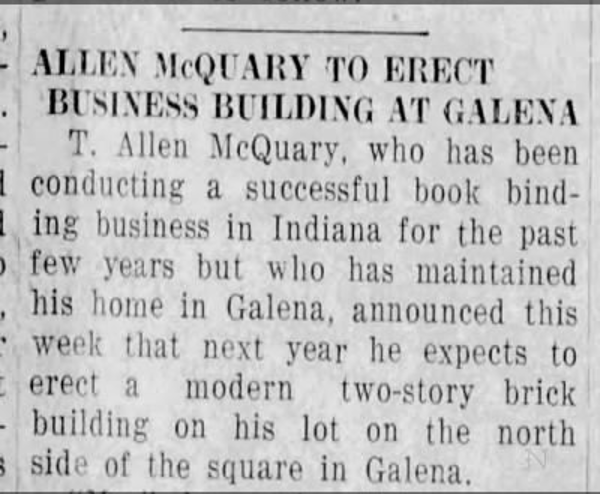
But Mack never erected the building.
Nor did he start a patriotic newspaper, though he thought the “time was ripe” for such an undertaking:
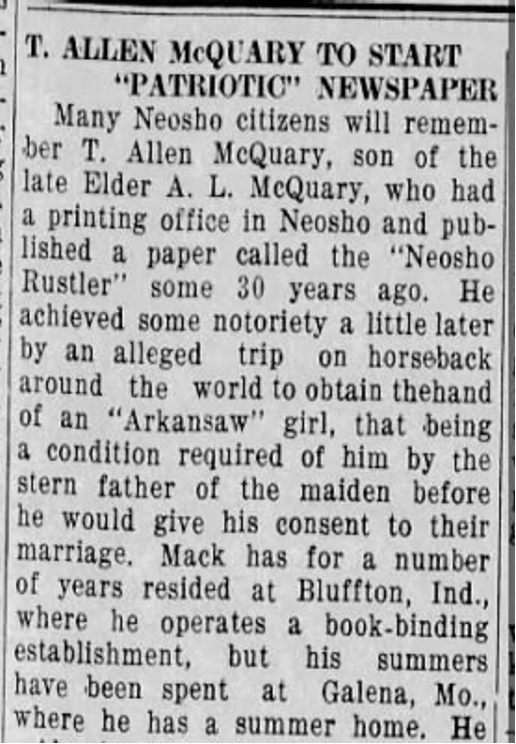
In his years as Galena postmaster, McQuary taught Sunday School at the Christian Church where his father had preached from time to time.
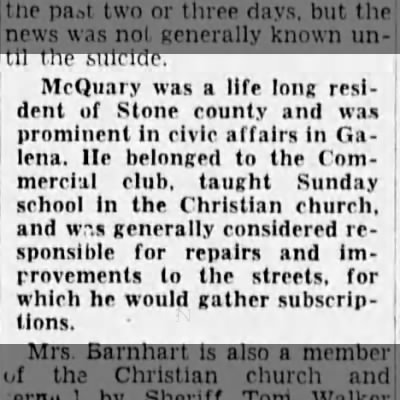
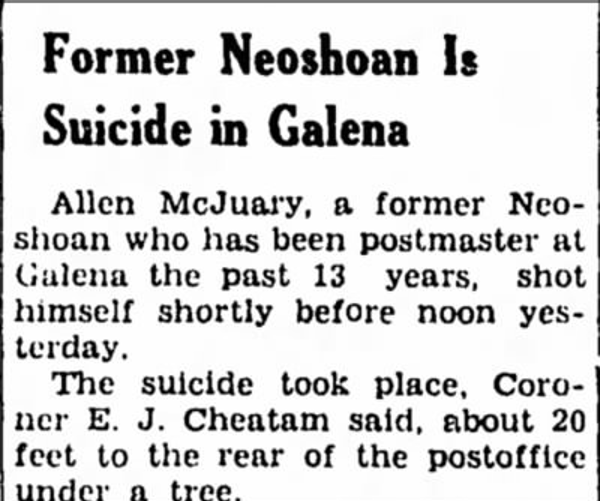
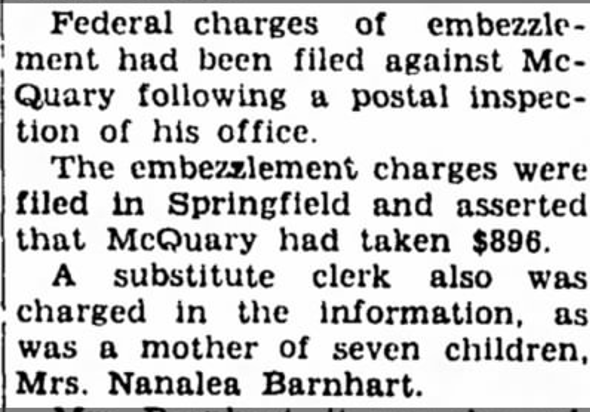
He and Naomi played bridge and attended teas and appeared at church functions. And then he was caught pilfering from the till at the post office. According to the newspapers, he reported his employees’ wages as higher than the amount he paid them, and he pocketed the difference. Nanalea Barnes, the assistant postmaster, may have been in on the scheme, but her conviction was overturned. Rather than face trial, on July 27, 1948, T. Allen McQuary shot himself under an oak tree behind the Galena post office.
THE END