The Seventh Interlude
From the Desk of T. Allen McQuary
I suppose you have already guessed that things didn't really happen as I told you. But, surely you understand that different circumstances require different stories, different ethics, different ways of interacting with the world. I was in New Orleans at Mardi Gras, but there was no Green Girl; no Mahogany Hall; no throne of Comus. I did have Oysters Rockefeller at Antoine's, but I paid for my meal.
The meal was as good as I said.
But, you might ask, what sort of circumstances would prompt a man to say he spent a night in a whorehouse? Well, circumstances aboard a ship with sailors who had seen the world and whose reputations depended on their "sexual conquests". In fact, I concocted the whole Mahogany Hall scenario as I was waiting on the wharf to board the Indrani.
So, what really happened, you ask?
I was still in Pensacola, Florida, when I made up my mind to go to New Orleans, and I telegraphed this decision to M.S. Glenn. He began combing through every Louisiana paper he could get his hands on and eventually found the following article:
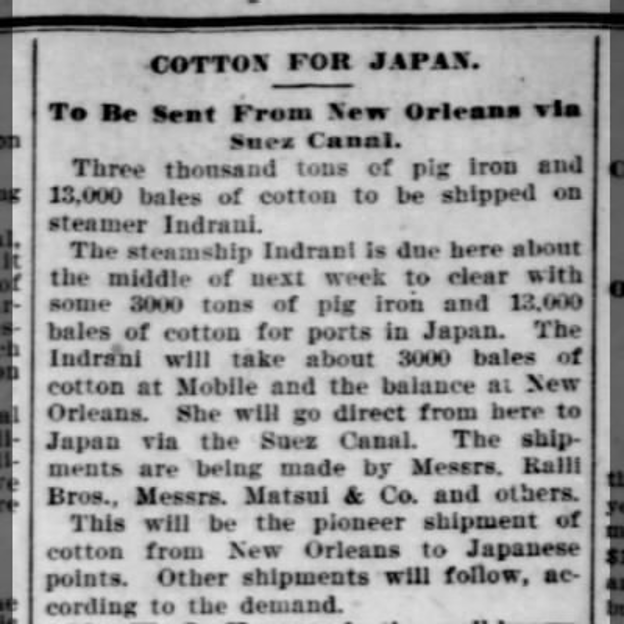
The Times-Democrat, New Orleans, Louisiana, Thursday, February 10, 1898, page 3. View on Newspapers.com
After making a few calls, Glenn was able to contact a Mr. Hammonds in New Orleans, and he was the agent who sold Glenn a ticket in my name. Everything was settled before the Iroquois (or the Orange Blossom, take your pick) anchored in Pensacola. Shipping aboard the Indrani required little more than showing up and saying, "Howdy, Cap'n." Glenn also sent a telegram to Captain Trotter blah-blahing about my quest, and that's why, presumably, the captain showed special deference to me: He and I dined in his cabin most every night as the Indrani traversed "the seven seas."
Of course, the rest of the crew hated me because I didn't work, but I ask you, what is the point of buying a ticket if you are not exempt from working? On the warmer days of our crossing, I sunned myself on the deck and drank from the captain's store of wine and made up tales of adventure for my "lecture circuit" back in America. And of course, I was reading all the time aboard the ship. You can peruse my reading list by going to Chapter One and looking in the Historical Notes.
Anyhow, one of the most popular stories I told on the circuit was about stowing away below the deck where I was tended by a Dutch sailor who shared food with me from his own "wack"–that's what sailors call lunch. I said the English sailors despised and persecuted me. I even said that one of the sailors betrayed me to the Captain, and he commanded that I be whipped with a cat-o-nine-tails.
Well, read it for yourselves. It was all in the papers.
My audience would gasp out loud at the cruel treatment I suffered at the hands of Captain Trotter, and then I really spread it on thick. I said that heat and thirst and the misery of shoveling coal into the fiery maw of the ship's engines nearly drove me to suicide. I said that only the face of my beloved kept me going over the endless miles.
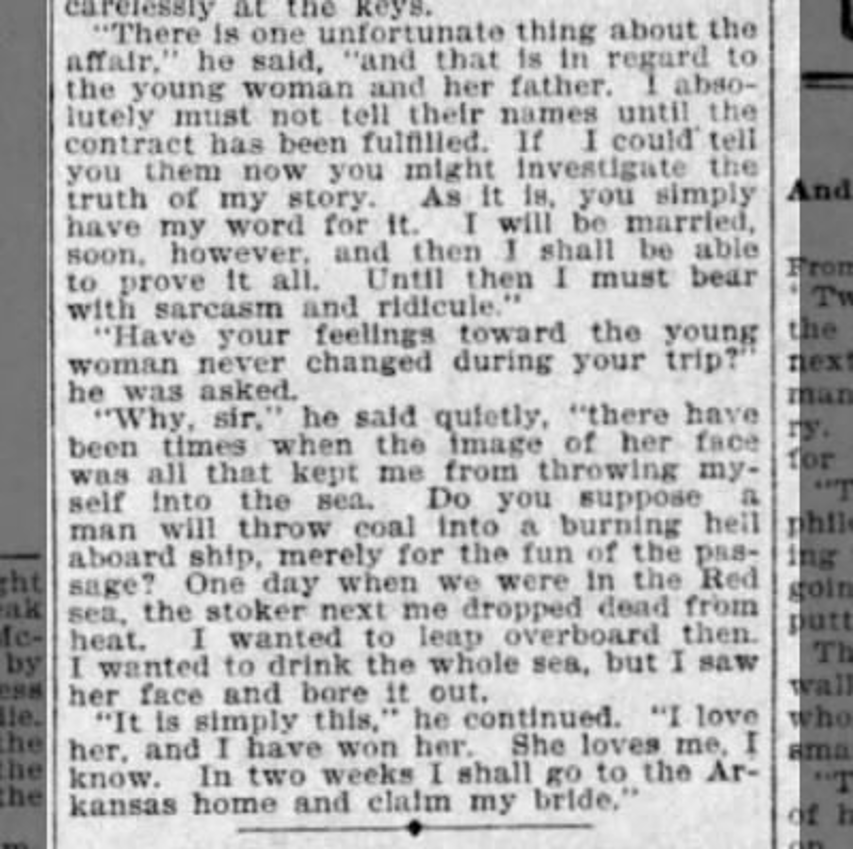
The Kansas City Star, Sunday, November 6, 1898, page 20. View on Newspapers.com
But now you know the truth. The whole truth.
I didn't do a goddamned thing.