It was sometime during the interim of the years of 1886-1890 that great lumber camps were established throughout the wooded Ozark hills. One particularly large camp was founded along the Niangua River. Here a whole army of men, tie hacks, teamsters, and lumbermen of all sorts made an assault on the virgin forests of pine, oak, sweet gum, maple, and other large trees that had thrived on these hills for hundreds of years. During the winter months the great trees were felled and the logs prepared for skidding down the steep mountain sides. In the early spring, before the ground became soft and before the spring floods came, these logs were skidded down the mountain sides in chutes or runways. Those farthest away from the mills were loaded on the crest of the spring floods and floated down to the mills.
Along with the army of workers came another army of human riffraff. Back up on the hillside a saloon sprang up with its roulette wheels and other gambling devices. Strong liquor for strong men was hauled in every Saturday in barrels by ox-teams from the nearest railway.
Back from the river, up each gulch or valley, sprang up log cabins or rough cabins with slab sides. Living in these was another type of camp follower, women who had no special attachment to any one individual of the camp. These women were known among the tie hacks and loggers by only their first names. In time the gulch or ravine bore the name of the particular woman who inhabited it. Even to this day some ravines are known by the names of Grace's Valley, Irene Gulch or Bessie Gulch. A stranger, not knowing the background of such names, might wonder at so many little valleys bearing the names of women.
Some of those who labored in this camp were men of rough character and little was known of their past. From whence they came little could be learned. Their co-workers knew them only by their first names or some alias or probably a nickname. No one tried to pry into the past of anyone else. It was simply not the thing to do unless one were courting trouble. Generally, at the termination of such a camp, this conglomerate mass of humanity, with the exception of a few local hillbillies, simply melted away; no one knew where they went.
Among the loggers was a husky, robust man whom everybody called Jim. Jim was strong and could swing an ax all day with the best of them. He was short of stature, red faced, with large watery eyes. Jim liked to drink liquor and stayed at the saloon and drank as long as his money lasted. In spite of his fondness for liquor, he never missed a day's work. In addition to these traits, Jim loved to fight and was the bully of the camp.
Jim had a disagreeable habit of boasting of his superior strength. His big booming voice could be heard almost any time of day echoing through the woods, boasting, boasting, boasting.
One day there came to camp a lean, lank lad from down the valley who asked for work. He was assigned to the same crew where Jim was working. Things went well until near the middle of the afternoon. The new worker went about his tasks paying no attention to anyone. In fact, he seemed a little shy. This quietness and unconcern of the stranger irked Jim beyond endurance. Jim walked slowly over to the stranger, dragging his ax behind him. He looked disgustedly at the lad and said:
"Who tole you, you wuz a logger?"
The boy paid no attention to the taunt, but went on trimming up the tree he had just felled.
This was more than Jim could stand. Again he bellowed,
"Who tole you, you wuz a logger, I ast you?"
The boy looked up, spat on his mittened hand, and swung his ax again at the limb he was chopping.
The other men began to gather around expecting to see Jim make short work of giving the impudent lad a thrashing.
Various remarks came from the crew, some of encouragement to the boy not to be afraid of him, others to Jim urging him to fly in and clean him up.
With this encouragement Jim threw his ax on the ground and began to boast of what he could do to such a skinny boy.
" 'Y, I can whop him an' not 'alf try. 'Y, I cud whop him in no time, the little runt."
"Jes' you try," said the boy smiling. He stuck his ax in the stump of the tree on which he was working and laid his heavy buckskin mittens by the side of his ax.
By this time all the workers nearby had gathered to see the fun.
Jim's big voice could be heard down the valley. He grew purple with rage at such insolence.
" 'Y, I can whop you in three minutes," he boasted, "er —, er — I'll —," glancing toward the sky he saw a flock of crows flying over, "— er — I'll eat a crow," he said finally.
Everyone roared at this wit.
Jim approached the lad menacingly.
He had no sooner come within reach of the strange, silent, hill boy until a hard fist shot out from somewhere so quickly that Jim did not know from whence it came. He found himself lying on the ground flat on his back. He looked around at the crowd laughing at him, then slowly his consciousness seemed to come back to him as his eyes fastened on the slim lad standing a few feet away from him.
His big watery eyes seemed filled with fire as he slowly arose and charged like a mad bull, bellowing with rage. The sight of this charging man would have frightened many with less courage. But the cool hill boy stood his ground and met the furious charge with an iron fist. Jim took some time before he arose again. When he did, it seemed that his knees were weak. But he was not licked. He charged the third time with the intention of crushing his foe.
Again that steel-like fist shot out from somewhere and cut a slit in one of Jim's red cheeks. This time he did not get up but lay there groaning. The hill boy walked up to Jim and kicked him gently in the side and said,
"Will yer eat crow?"
"Go on away from me," groaned the unhappy Jim.
"But will yer eat crow?" insisted the lad.
"No, I won't," said Jim with an oath.
The boy took Jim gently by the throat and shook him and repeated,
"Will you eat ther crow?"
"Yes, I'll eat hit," said Jim, weakly.
Everyone roared with laughter and slowly went back to work.
The next morning before daylight the hill boy was seen to depart from the camp with his squirrel rifle over his shoulder. It was not long before he returned to camp with a crow in one hand and his rifle in the other. With a grin he took the crow to the camp cook.
There was much speculation among the workers as to what would happen that day at dinner. Some felt sure that there would be another fight if the boy attempted to make Jim keep his promise.
When dinner time came, the men gathered around the pine board tables in the mess hall and fell to eating ravenously as only hungry men can do.
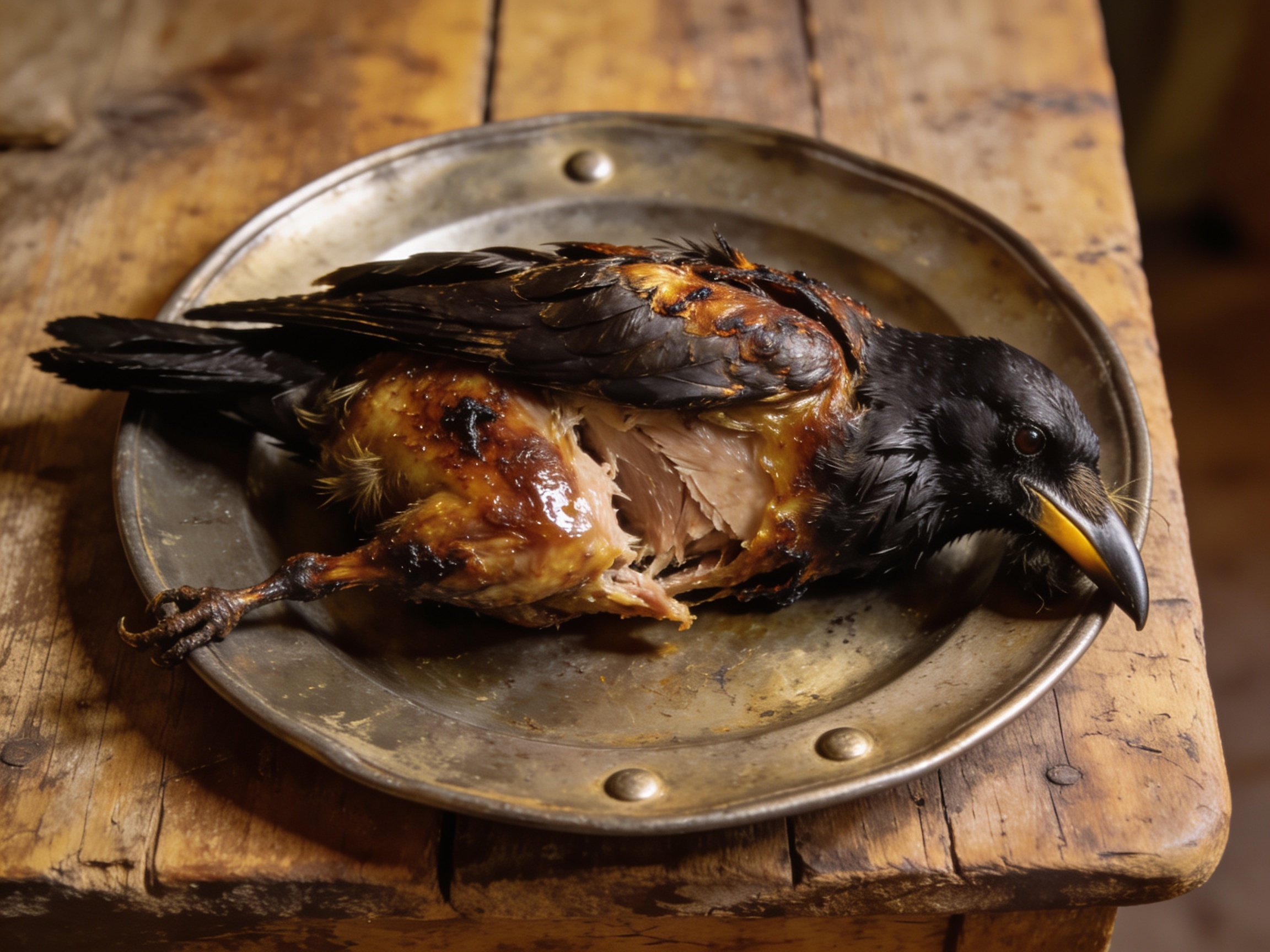
Then all eyes were fastened on the cook. He brought out a tin plate on which was a nicely roasted bird. Loud yells of approval met this sight. The cook took the roasted bird and set it down before Jim. Jim looked up like a whipped child and pushed the plate away from him. He had no sooner done this than the hillbilly was standing over him talking to him in a low voice.
Jim's eyes looked up and down the line of laughing men as though appealing for help. His lower eyelids seemed to hang down lower than ever. He looked up at the boy, gave a sort of sheepish grin and reached out and took hold of one of the bird's legs with a big hairy hand and broke off the leg. Then with a wry face he bit into the leg of the crow and took a bite. He started to spit it out but a firm hand on his shoulder made him think better of it. With a gulp he swallowed the bite without chewing and looked appealingly at the boy.
"Take another bite," said the boy.
Jim took one long look at the bird in front of him and set his yellow teeth into the meat again. The hill man made him swallow this and then walked away.
The roar of laughter around the table fairly shook the building.
Jim's red face almost showed purple through his stubby beard. He seized his hat, stepped over the wooden bench at the table and dashed for the saloon to get a drink to take the taste out of his mouth.
Jim did not stay at the camp very long after this humiliating event. He soon disappeared. He could not take the jibes his fellow workers gave him.
The expression "Made him eat crow" became famous. Always after that when anyone made boasts of what he could do, someone was sure to say:
"Be careful, or you'll have to eat crow."
The expression spread throughout the hill section and into neighboring states. It still carries with it the meaning it was given at the beginning. One who has to eat crow has to back down from his original boast. There is no chance for one to save face but he must carry out his original agreement. "To have to eat crow" is as common among Missourians as "to save face" is among the Chinese.