Fred was born in 1878 and died in 1962, and lived his whole life in High, Arkansas. In spite of Fred's isolation, he became a favorite of folklorists from Vance Randolph to Mary Celestia Parler to Max Hunter. If you poke around in the Max Hunter Collection at Lyons College or the Mary Parler Collection at the University of Arkansas, you will find recordings of Fred singing the old songs. There is even a video of Fred High singing an "atonal song" on The Search, a 1950s show hosted by Charles Romine and featuring Mary Parler, who is searching for a particular traditional ballad, The Two Sisters. Just click on the image of Fred to view the video.
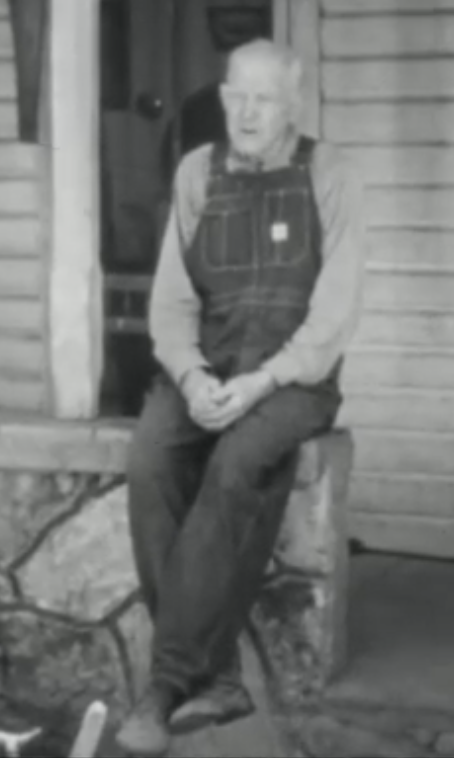
Click Fred's picture to watch him sing.
The following stories are taken verbatim from the beginning of Fred's book:
JOHN HOKE SETTLES IN ARKANSAS
In the beginning God created Heaven and Earth: When my grandfather first came to the United States of America, in the year of about 1756, he was 18 years old.
His name was John Hoke (in Dutch). Hoke in Dutch, is High in English, so hereafter we are called High.
When John Hoke came to the United States he brought with him a dog he thought lots of. One day he went out hunting, and found a porcupine. The beast hit the dog with his tail which was filled with sticky quills. They stuck so deep in the dog that the beast could not pull them out, so the man was obliged to kill them both. Then he was badly discouraged and out of heart, not knowing what to do. But he would not give up. He later married in the State of Ohio.
In 1832 he moved to Indiana, Warren County, Mound T. W. In 1838 he moved to Arkansas in Benton County, a few miles east of where Rogers now stands. He located on Prairie Creek, one-half mile from White River, and built a mill that run by water, to grind corn.
He was six weeks on the road to Arkansas.
They had three wagons pulled by oxen, and they drove a bunch of milk cows, which they would milk as they went along. After they had milked they would put the milk in a churn and by noon there would be a ball of butter instead of cream. It was in the summer and the stock would graze on the grass as they moved along. They came by way of St. Louis, Mo., and the city at that time was one mile wide and five miles up along the river. Now it is much larger.
This John High, as it is called in English, was a full-blooded Dutch, and he lived until 1845.
He and his wife came to Carroll County on Indian Creek, with four girls and eight boys. He bought out a claim, as in those days just a claim on land was all you got.
Later on Uncle Sam passed a law where one man or woman could homestead land, one hundred and sixty acres for their own use, if they would stay on it and improve it.
The government would give the man a deed to the said land if he would pay the small fee.
This John High's children, I will give you all of their names but will try to make it as short and interesting as I can.
The oldest son's name was Dow High, and he was the smartest one of them all. At one time he paid more taxes than anyone in Carroll County. Before Boone County was taken off, he lived one mile North of Urbanette, or where it is now. He ran a store there until the Civil War came up. Then he just stopped selling goods, leaving the door open for the people to help themselves. And about the middle of the war he was killed for his money. But they did not get all of his money for part of it was in gold and was buried. They only got about $40 in silver. The gold was hunted by many for fifty years, and was found by a party too smart to tell.
Gold was discovered in 1848, in San Francisco, California. Thousands rushed there to get rich by digging gold.
At that time there were no railroads or highways, only trails, and one was called the Santa Fe Trail.
Dow thought he would make some money by driving a bunch of cattle over this trail to Frisco, as it was called. He did go with five hundred head. The difficulty was who to go with him, on a long trip like that. So he called a meeting at Antioch, to get volunteers to go with him and he had to have two or three meetings to get enough cowboys to go.
And there has been many a tear shed in that old house. When a young man would go up to the stage and say he would go, three others would be by his side and say: "You can't go." This would be his mother and daddy and sweetheart.
Next would be a young married man come to go and at once five would be at his side crying and dragging him back. This would be his wife, and dad and mother on both sides.
After two or three meetings of this the boys were chosen. Two of them were Standlees and one of them was Dow's youngest brother. All were single but Dow.
They started as soon as the grass was high enough to graze on, in the spring of 1851. It took six months to go through, and they met with many difficulties on the way. Though it don't take that long to go through now, although I've never gone.
I saw a man in Berryville who said he walked back here from California in the winter. He was 18 and he walked over snow eighteen feet deep. He said it was crusted over and it held him up. Here is what the two Standlees did who went with Dow High to California.
One fell in love with an Indian maid as they went out, and he came back by to get her for his wife but was too late, she had married another man. So he came back here on his horse and soon went crazy and died.
The other stayed in California and never married and lived to be old, and was exceedingly rich at death.
So Dow and his younger brother got on a ship that sailed around the Cape of South America and to New Orleans, La. At that time there was no Panama Canal.
From there they went to St. Louis by boat. They bought two black mares and rode home with his gold in buck-skin belts around their body. And the skin on their hips was cut through from the weight. Dow's younger brother never married.
Dow had another brother whose name was George High. He went to the Mexican War and was deafened by the canons and sent home on foot, but never got there. His fate lies unknown until yet.
While the two Highs were in California a song was made. When my dad heard it he said the hair raised on his head. Here is a part of it:
The gold of California has begun to lose its youth,
While soul and body is a partying what good can money do?
Whilest we were moving onward and plains did seem severe,
And many was the danger that met with by the way.
There was a cholera plague and fever and madness all combined,
So death was a mowing down,
They are falling on the mountains high and in the valleys too,
And sinking in the briny deep, no more to rise in view.
The gold of California is passed away and gone,
And many a poor miner, no more will see his home.