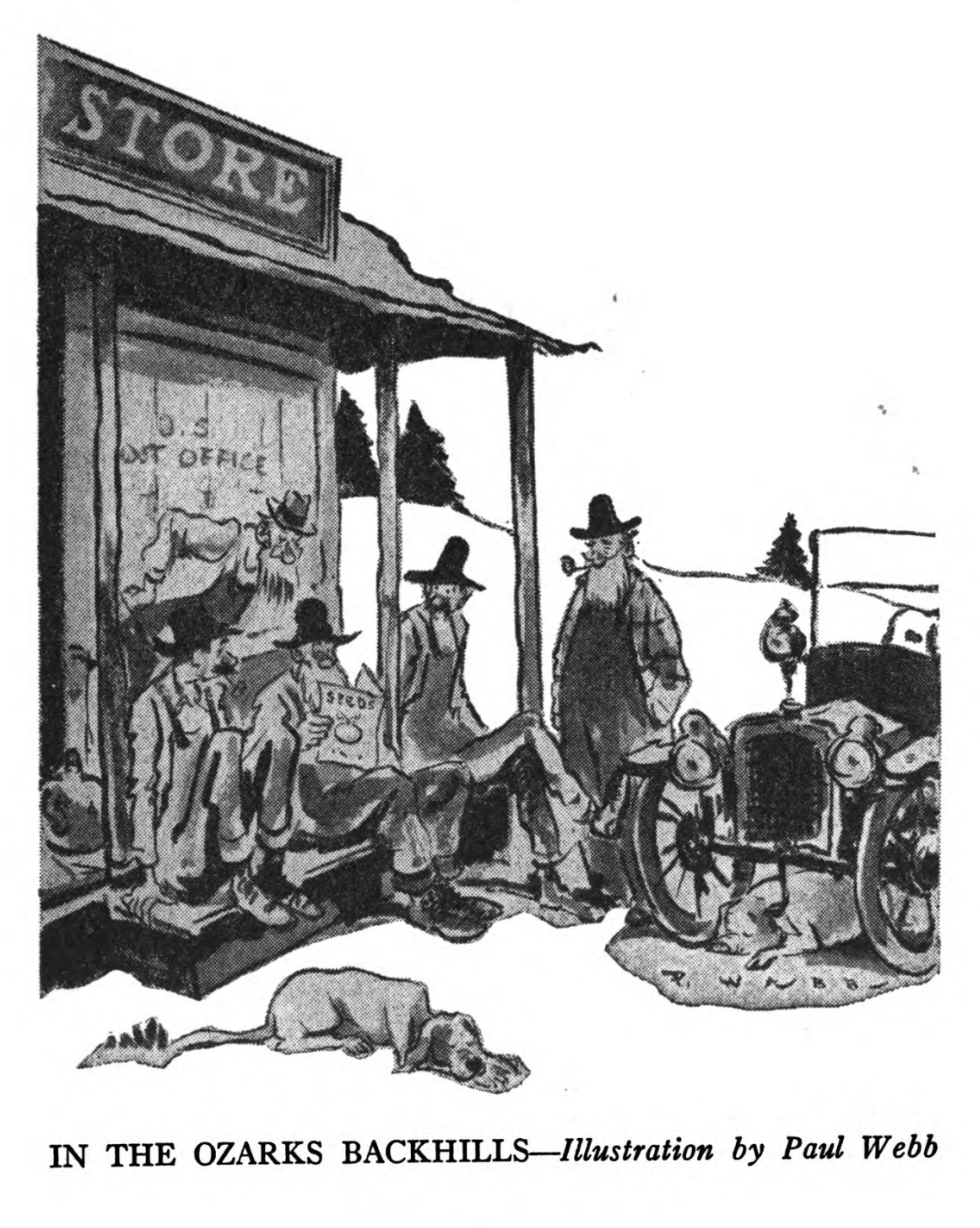
Next day, at Avoca, we came upon a still warmer trail. Our Uncle Greene had been through only one day before. He was still collecting cats—all kinds, toms, tabbies, strays, house, barn, porch, and wild, but recruiting on a very high ethical level. Yessir, it was for shore our Uncle Greene was no common cat thief. He was getting hold of the cats square and honest. He would hobble to a cabin door, knock, and ask in his courtly manner if the folks happened to have any cats they chose to get rid of. As a rule, they did. Reportedly one family contributed sixteen surplus cats to the roundup. Several had surpluses of half a dozen or more.
The storekeeper at Avoca reported that by then our aged uncle had three chicken crates, all smackdab full of cats. “Ever’ kind of fool cat you ever see,” the man of commerce affirmed. “Tiger stripers, yellers, whites, blacks, grays, blues. . . . Big cats and li’l cats and quite a lot of fat cats.”
Having refreshed himself from a grayish clay jug, the storekeeper allowed the cats were all getting fatter on account of Uncle Greene had been feeding them real good. “I give the old man a mighty good dicker on some canned sal-mon that had got rusty on me. . . . Onderstand, now, it was good sal-mon fish . . . only the tins had got a mite rusty.”
My father promptly identified that the dicker had been a good one for the storekeeper. Our uncle had swapped a pound of dry ginseng roots worth at least six dollars for four dozen cans of pink salmon. At least nobody could doubt that the confined cats were being properly fed.
“Your old tetched uncle man done a funny thing while here,” the storekeeper related. “In his fiddle case he carried one of them round handglasses that make things look lots bigger’n they really is. So, after we’d finished swappin’ the old man asked me could he take a look at what gold coins I keep in the cash box. So I let him do it. . . . One after the next, he stood there peerin’ at them gold pieces through that there magnifyin’ glass like a child peerin’ at a brand new playpurty. After he’d finished lookin’, I see him count the coin back into the cash drawer, fair and square. Then the old man commenced to play his fiddle and sing. And man, I’m tellin’ you that even iffen your old uncle does look to be a hundert years old, the old sawbuck can still sing like a martingale.”
My father began seeking out the motive for Uncle Greene’s cat collecting. The storekeeper staggered to the doorway and favored the rising breeze with a tremendous charge of tobacco spit. “My notion is this . . . poor old Uncle Greene has met up with mighty hard times since he quit counterfeitin’. He’s a-gettin’ old and as I figger it, turnin’ honest might of tetched him in the haid—proved too much fer his jedgment. Anyway, its seems some mis-chievous durn clodhopper convinced him he could make himself some good money by ketchin’ up a wagonload of cats and peddlin’ ’em in Eureky where the new-come rich folks is fresh out of cats and panicky to buy ’em at a dollar apiece . . . I tried to tell your uncle diffrunt, but didn’t do no good.”
As we shall presently notice in better detail, Eureky, listed on contemporary maps as Eureka Springs, is an ever astonishing mountainside town in what were then backhill Ozarks of Carroll County. At the turn of the century, the discovery of allegedly medicinal waters in the uniquely vertical settlement had drawn a stampede of real or would-be sick people, ranging from the hopelessly stricken or violently insane to the usual majority of comparatively healthy hypochondriacs and their accompanying kin. Thus, almost overnight, the peculiarly inaccessible moonshiners’ outpost had been changed into the biggest as well as the flimsiest town in the Arkansas Ozarks, with a transient and immigrant population of at least 25,000. Most of the influx presently seeped and simmered away, but at the time of our pilgrimage to Uncle Greene’s, Eureky was the wealth-and-wonder capital of the Ozarks.
My father drove hard in hopes of overtaking our tetched uncle before his certain-to-be-unfortunate arrival in Eureka Springs. But overtaking was made completely impossible by the goat trail of a road which even now is probably the steepest, curviest, and most “scenic” main road in all the Ozarks. Once more we arrived only in time to hear about what had “fresh happened.” We learned that Uncle Greene and his cargo of cats had pulled into Eureky around the middle of the previous afternoon. Apparently the loud and boisterous behavior of the cats was aggravated by the rough and bouncy ride and by the fact that Uncle Greene had filled one crate exclusively with adult tomcats.
In any case, the cat-peddling venture was badly snarled long before the vendor got as far as the bandstand which had been built under a limestone ledge near the middle of the town. A horde of boys took in after the cat wagon at the high bend near Streepey’s Wayside. In practically no time the natural caterwauls and miscellaneous uproar was being exceeded by man-made kinds. Uncle Greene was visibly upset. When he undertook to call out his wares—“Cats . . . I got all kinds of cats . . . Who needs a good cat? . . . Good ratters, good mousers . . . for a dollar?”—his rather appealing voice was completely drowned out by the mingled yowling of the cats and the curiosity seekers.
The old man flapped the lines and headed for the fringe of grass which comprised the public green, such as it was. There he hitched his mules, hobbled back to the wagon load of squalling cats and took out his ever shiny fiddle from its beat-up wooden case. He struck up a tune. But this time his music failed to still either the savage humans or the unhappy cats. Indeed, it seemed to make a bad situation worse.
Then Uncle Greene reached his decision. The closer and more attentive onlookers heard him speak gently and resignedly. “So you smart alecs don’t like honest peddlin’! So you’d ruther act stinky and not buy nothin’. So I won’t disaccommodate you for to buy no cats. . . . I’ll give ’em to you, for free . . .”
The old man replaced his fiddle in the battered case which he laid fondly on the front seat of his wagon. Then he hobbled to the rear of the wagon, let down the backboard, and began opening the poultry crates. Cats began pouring out, in feline deluges. They bounded over the fringe of park, leaped and skipped across the dusty road, eagerly resumed their fighting and courting along the board sidewalks and in the storefronts.
A friendly witness told us the story in explicit detail. “Hit was just egg-zactly the right thing that he done.” The witness’s brown cheeks were becoming streaked with tears brought on by laughter. “Ef the old coot was my great-uncle, I’d be the proudest man in Eureky.”
“What’s to become of the cats?” I inquired.
“You needn’t worry your stoopid little haid about that, Sonny,” the informant assured me. “They is plenty of openin’s hereabouts for cats, on account of Eureky is a right big town.” The skinny onlooker concluded thoughtfully, “‘Nother p’int is that cats can take a sight better care of cats than people can take of people.”