Chapter Sixteen: The Purple Knight Upsets the Charleston Country Club
Say what you mean and mean what you say
January 3, 1898 • Charleston, South Carolina
The Country Club of Charleston is an ancient and venerable institution, an impressive sprawl of cathedral ceilings and dark paneled rooms, bristling coats of arms and somber escutcheons, magnificent mirrors and steep stairways of walnut that lead up to verandahs from which one can breathe in the ocean. The Club in her time has hosted old-monied gentry and new-monied speculators and corseted women with feathered hats and gowns that rustled. And, of course, as a matter of necessity, she has long employed obsequious Negroes who wear white gloves and short, black jackets and tailored trousers and who glide from room to room, bearing silver trays with tidbits and carafes of coffee and cigars with the tips already clipped. From a distance, and to the imaginative spectator, the Club resembles an unwieldy but majestic ship riding high on rolling fairways. She evokes an old world image of the good life, not like a public garden where all people are welcome, but more like a massive shrine dedicated to leisure and decorum, wealth and superior status, an institution that safeguards time-honored hierarchies and above all, whiteness.
On this particular morning, January 3rd, 1898, the frost on the fairways sparkled in the rising sun, and the magnolias trembled in the chilly, seaborne breeze. There were no golfers with red sweaters and tan breeches. There were no black caddies. There was no one at all on the links. Inside the Club, however, the Great Hall fairly tinkled with excited chatter. The brittle sun streamed through arched windows and lay gleaming on silver cutlery and broke into little rainbows on water glasses. In an adjoining room and standing before a fire were two men, each holding a glass of port in one hand and a cigar in the other. The elder sported a mustache so outrageous that his face seemed to be an appurtenance to his whiskers. He was Colonel Mincy, and the Colonel was propounding to young Stuart Stalwart that "golf is a gentleman's game! Sherman may have spared Charleston—the son of a bitch deserves some credit for that—but he was no gentleman!"
"And your point, sir?" Young Stalwart was a handsome man: cleft chin, firm jaw, honest eyes of firm conviction, and a nose that was the envy of all Charleston.
Mincy spoke through his mustache, "My point is, the General would have disgraced himself on the course and in the parlor and in an honest poker game! Mark my words, Sherman would have left behind him a trail of divots and marked cards and unused spoons intended for the vichyssoise! That's my point!"
"And what about our guest of honor?"
"I have heard little of our guest and even less concerning his honor!"
"Oh, he's the talk of Charleston! His name is McQuary, but he bills himself as the 'Purple Knight of the Ozarks.' He comes to us by way of Sumter and Monck's Corner."
"But is he a gentleman?"
"From what I've heard, he is gentlemanly enough, though whether or not he is, in fact, a gentleman, I can't say. The papers say that he is traveling the world for the hand of a girl. Seems her father made a wager with young McQuary."
"The father made a wager? For his daughter? No man of honor would wager his own daughter!"
"According to the papers, the father has a substantial cotton plantation not far from Little Rock."
"Acreage in itself will never convert a farmer into a gentleman, and certainly not if he turns his daughter into a chip on a gaming table!"
"The papers say that's the whole point, that the wager is so impractical that McQuary is doomed to fail, and that was the father's intention from the outset."
The old man sipped his port, which left the upper fringe of his mustache tinged with purple. "Papers! Papers! You confer far too much credit on the journalists!" Smoke poured out from beneath the mustache, and the old man growled something about "reporters, editors, and other sons of bitches." A pause and then, "I suppose the hubbub in the Hall has to do with the arrival of this so-called Knight."
"Yes, sir."
"Perhaps we should determine for ourselves whether or not he is a gentleman."
"I suppose we should." With that, the youth and the elder tossed what remained of their cigars into the fire and tipped up their glasses. Thus fortified, they left the quiet dimness of the smoking room and stepped into the glare and gleam of the Great Hall. Banqueting tables draped in white linen extended the full length thereof, and on the tables were vases of deep red roses almost as purple as the carafes of wine. At the far end of the table and standing before a fire was a young man attired entirely in purple. He was smiling and gesturing among a covey of blue-gowned girls whose eyes shone with the light of the sun and the young man's witticisms.
The old man squinted. "Is that our boy?"
"Yes, sir," replied young Stalwart.
The old man squinted again. "And is that your Melinda among the gaggle?" asked the old man.
"Yes," the young man replied. He, too, narrowed his eyes but not with near-sightedness.
The old man harrumphed. "Were I you, I believe I might intervene in their little play-party. It is not seemly for an affianced young lady to be so amused at a stranger's prattle, particularly a stranger attired so . . . strangely."
In truth, Stuart Stalwart shared Colonel Mincy's uneasiness regarding Melinda's apparent infatuation and was thinking how he might disrupt this tete-a-tete most effectively. Were he simply to join his fiancee, he would be forced to feign civility, an attitude that might bestow a regard he did not wish to convey. Outright incivility, on the other hand, would betray his jealousy, which might reveal a deficiency of confidence and even a flaw in his character. So, after a brief consideration of alternatives, Stuart Stalwart strode the length of the hall until he stood outside the circle of girls, whereupon he cleared his throat with a peremptory "ahem." The Purple Knight turned from the tittering girls to the handsome face of Mr. Stalwart. The Knight smiled and stuck out his hand, "Good morning, sir; with whom do I have the pleasure of speaking?"
"Ha-ha! I would think that you as a guest in our city might do me the courtesy of an introduction first." Stalwart was smiling, but he felt his words were too sharp.
"Of course," said the Purple Knight, his eyes glinting behind his mask. "My name is T. Allen McQuary. I hail from the state of Missouri, and I travel to . . ."
But Stalwart interrupted him. "Yes, I've read all about your quest in the papers. Quite extraordinary. Some might even say implausible. But, ha-ha, have we not all in our youthful folly undertaken some mad adventure? My name is Stalwart, Stuart Stalwart the Third. My father sits on the board of the Charleston Golf Establishment. My grandfather was one of her founders."
"Stalwart? Now that is a name you can rely on!" rejoined the Purple Knight, and the girls tittered.
"Are you mocking my name, Mr. McQuary?" Stuart's fine nostrils flared and his chin jutted forward.
"Not at all, Stuart Stalwart. I like saying your name. Stuart Stalwart. And besides, Stalwart is a fine name for a horse. 'Hi, ho, Stalwart, bear me away!" Again, the girls laughed, and Melinda ducked her head in a slight gesture of embarrassment, so subtle as to be almost unnoticeable though seismic in its impact on her fiance. Stuart Stalwart flushed red, and the Purple Knight smiled.
Stuart said, "Sir, you go too far!"
"But not so far as my steed Stalwart will carry me."
"You are no gentleman!"
"May I remind you that it was you who began this little skirmish of words . . . sir. You tried to embarrass me by questioning my manners. You mocked my quest. Perhaps you taste now the bitterness of your own impertinence!"
Stuart stepped closer to the Purple Knight and hissed between clenched teeth, "If I am uncivil it is because you are a fraud! You think that because you put on a costume and tell a ridiculous story that you can waltz into our southern towns and be treated like some sort of hero! For doing nothing!"
The Knight in a loud voice said, "I don't waltz into towns . . . I canter in upon my faithful Stalwart!"
"Enough! I challenge you to a duel, McQuary, here on the venerable grounds of this establishment."
"What?" The Purple Knight was taken aback. "You've got to be kidding."
"I do not 'kid', sir!" Stuart's face flushed into red verging on purple. "I never 'kid'!"
The Knight turned to the ladies and asked, "He is kidding, right? The state of Missouri outlawed dueling over fifty years ago."
A voice from outside the circle proclaimed, "Though the state of South Carolina does indeed forbid the art of honorable recourse, private quarrels may still be settled by pistols—among gentlemen! That's my point." Of course, it was Colonel Mincy, and when he observed the rivals' escalation of anger, he decided to join the "play-party," albeit discreetly, in order to contribute wisdom born of long experience.
"Well, your point is both illegal and stupid," said the Knight. He walked up to the Colonel and tapped his mustache with his forefinger. "Impressive specimen," he said.
"How dare you, insolent boy! Never have I been so insulted! Remove your finger from my mustachio! Good God, are you smelling your finger! What are you inferring, sir? I ask you, what is the inference?"
"I just wondered where that impressive specimen of hirsuteness has been, eh, Colonel?"
The Colonel gasped with rage. In a vicious whisper he said, "I suggest you restrain your tongue lest you find yourself confronting a duo of duelists!" Colonel Mincy grimaced inwardly at the unfortunate expression.
The Purple Knight said, "Alas, must I confront dual duels?" Then to the girls and smiling broadly, "I admit that I, too, once confused those words, but education and experience have larned me the difference." Then to the Colonel. "And, sir, I suggest you larn the laws of the state of South Carolina which explicitly forbid dueling. Or perhaps you persist in your treacherous and failed rebellion against the lawful authority of the Union and so must larn another lesson."
A hole gaped beneath the Colonel's mustache, and his two pink, watery eyes widened. His anger was a felt force, and Stuart Stalwart joined the old man. The girls, fascinated by this cresting wave of masculine indignation, watched in breathless silence. Suddenly, the tinking of a spoon against a glass and a voice ringing out, "Good morning, ladies and gentlemen, or should I say, 'Good afternoon'? I am so glad y'all are here to honor our distinguished guest, Mr. T. Allen McQuary, the Purple Knight of the Ozarks." It was Mayor Smith, and he had entered the Great Hall with a retinue of smiling men in black suits and women in long dresses. With a quick gesture, Stuart Stalwart poked his finger into the chest of the Purple Knight and hissed, "You and I will settle this later." And as one might expect, Colonel Mincy ejaculated, "You are no gentleman!"
In a fierce whisper, Mack replied, "You, Stalwart, are petty, and you, sir, are a windbag!"
Again, from the Mayor, "Please take your seats, and our meal will be served."
There was much pulling back of chairs and seating of ladies and rustling of gowns and chattering and laughter. The occasion was, after all, congenial: No one had died, and no armies were advancing by sea or land. The Great Hall was warm, and the winter sun streamed through the windows. The Purple Knight remained standing at the far end of the table while the girls in blue took the seats closest to him, and he said, "If I may, I would like to say a few words before we dine. I am so grateful for the hospitality I've experienced in your city. Truly, the civility and generosity of the Old South live on in Charleston. How happy I am to have been so warmly and kindly welcomed! Thank you all, and a special thanks to Mayor Smith for inviting me to this wonderful gathering. I am truly unworthy of the honor you have shown me."
To which, Stuart whispered to the Colonel, "At least that much is true," and the Colonel grunted in affirmation.
"Again, I thank you warmly."
After a perfunctory blessing of the meal, Mayor Smith took his seat, which apparently served as a signal to the Black servants who immediately entered the Hall bearing trays of food. They placed before the diners jellied rings of tomato aspic and wheels of shrimp with bowls of horseradish and cocktail sauce and baskets of yeasty, hot rolls. At the same time, white gloves reached over gowned and padded shoulders to pour tall glasses of water and smaller goblets of wine. The chatter increased, and there was much laughter, particularly from the girls closest to the Knight. His eyes gleamed behind the mask, and he smiled as he ate.
More food soon followed: platters of sliced beef and sole with lemon rounds and roasted potatoes and steamed carrots. Black wrists in white gloves continued to replenish plates and goblets, and the hilarity swelled. Then came lemon tarts with cream whipped in peaks and cups of coffee, and finally the Mayor stood again, and raising a glass of wine, he said, "I would like to make a toast to our guest! I think you know, Mr. McQuary, that some of our newspapermen have been less trusting than those of us who have gathered here. The telegraph wires must be throbbing with dots and dashes, for even today a letter from Sturgis and Weisell was published in the Observer questioning the veracity of your quest."
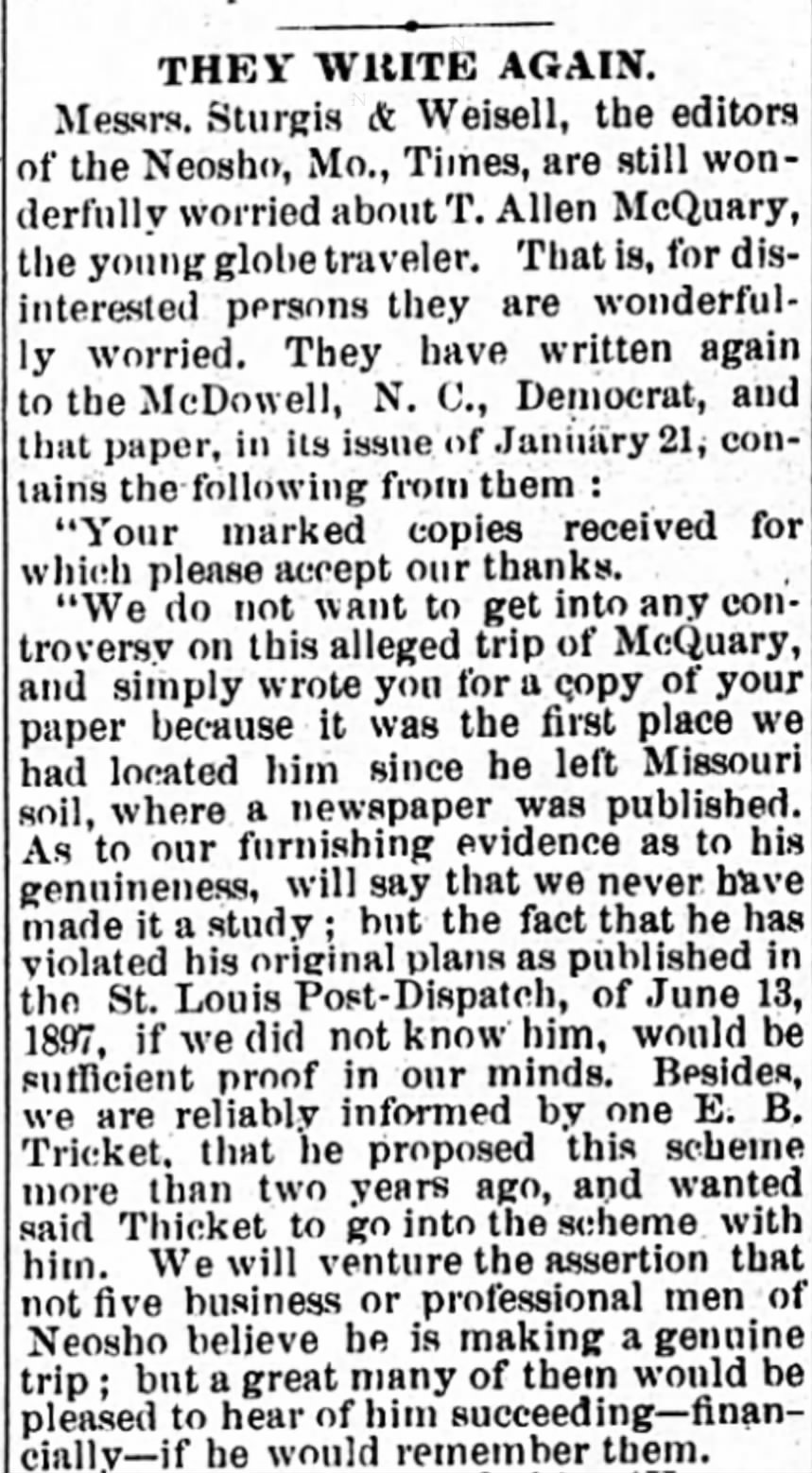
Yorkville Enquirer, York, South Carolina, January 26, 1898
"I even had a telephone call from a Mr. Bulfinch who denounced you in the most outrageous terms. But if you will accept the sincerity of our hospitality, we will return the favor by accepting the sincerity of your quest, the courtesy of your manners, and, of course, the pleasure of your eloquence. Not to mention your fine work as a temporary printer at the Courier. The editor, Mr. Goodwin, has been a friend of mine for many years, and he has nothing but praise for your work and your disposition."
The Colonel whispered to Stuart, "He's more than a printer's devil, he's the devil in a purple costume! The son of a bitch touched my mustache and sniffed his finger!"
The Mayor continued, "And that, I think, is the highest expression of the American character: A job well done! A man may be proud of his lineage and his name, but it's what he does that defines him. I—that is, all of us—trust who you are because of what you do. So, Mr. McQuary, the city of Charleston wishes you all the best in your travels around the world! May you win the hand of the Arkansas girl, and may your future father-in-law fulfill all the terms of the contract! Ladies and gentlemen, I give you T. Allen McQuary, the Purple Knight of the Ozarks!"
Whereupon everyone at the table lifted his or her glass—excepting Mincy and Stalwart, of course—and toasted, "To the Purple Knight!" The girls in blue sipped from their glasses and smiled, and Melinda, who sat at the right hand of the Knight, kicked off her shoe and ran her naked foot along his calf. The Purple Knight, too, drank, and then stood once again to face the banqueters. They fell silent. The Black waiters stood in the doorway to the kitchen and watched, and the room basked in the anticipation of a laudatory speech.
"Thank you again, Mayor Smith. Each word of hospitality is followed by another even more gracious. I'm afraid that I can't compete with your kindness nor your eloquence. You win! I concede to you in every way. But I do so with a full heart and a deep gratitude. I would like to propose a toast to Mayor Smith! May the city of Charleston long prosper under his wise guidance!"
"To Mayor Smith!" responded the people, and everyone drank.
But the Purple Knight continued. "Nevertheless, in spite of Mayor Smith's reassuring words, I confess to a desire to defend myself against the charges of Messieurs Sturgis and Weisell and Bulfinch. Yes, I read their article. They have used telegraphy to create a network of suspicion, and they attempt to poison my reputation before I even enter a town. They say I am a fraud. They say there is no quest. No girl. No planter. And no contract. They say my tale is a total fabrication. But why do they accuse me thus? As you might imagine, I have asked myself that question many times. What axe do they have to grind? What did I do to them that would cause them to besmirch my reputation?
"I have come up with two plausible answers to these questions, though there may be others. The first is that my father's newspaper, The Neosho Rustler, far surpassed their own in terms of integrity, lucidity, and influence. My father, the Reverend A.L. McQuary, is relentlessly honest and stalwart. And he is a fine writer, much more accomplished than either Mr. Sturgis and Mr. Weisell, and certainly more eloquent than that scoundrel, Bulfinch. For ten years and precisely at six o'clock ante meridiem on Tuesdays and Thursdays, the Rustler landed on everyone's doorstep, and by noon, Father's editorials were on everyone's lips. But Father was forced to abandon his newspaper enterprise not because he was losing money—he wasn't—but because my mother fell seriously ill and required his constant attention. At the same time, I suffered from a catarrh and found myself at death's door. Poor Father almost went mad with anxiety, but he never faltered in his duty to his family. Again, 'stalwart' is the word that comes to mind. He sold the paper, gave me a portion of the receipts to travel south for my health, and spent the remaining money on doctors for Mother. I'm happy to say that Mother and I both recovered. But I believe Sturgis and Weissel envied my Father's success and abilities and even his self-sacrificial loyalty to his family, and the 'green eyed monster' so infected Bulfinch that he turned an 'evil eye' on me, the innocent son, and so persecuted me. How sad to think that Father's sacrifice on Mother's behalf and my own poor condition were unable to dispel the resentment of these little men, for it is in the nature of little men to malign their rivals."
At this, the well-bred diners in their finery nodded and spoke to their neighbors in low tones. Had one listened closely to the general murmur, one would have heard the words "yankees" and "abolitionists" and "Abraham Lincoln." The Purple Knight surveyed the diners through his mask and cleared his throat, whereupon the people returned their attention to him.
"So that's reason one. Reason two is perhaps more speculative but, I believe, is also true. In short, Sturgis, Weisell, and Bulfinch have no imagination! They can't imagine that someone like me—a printer's devil from a small town—might undertake such a magnificent quest. And in part, I understand that. After all, just look at me! The mask, the plume, the purple costume, the Sword of the Knights of Pythias . . . do you really believe I am a knight because of these accouterments? Of course not! I don't expect you to believe me. This is, after all, 1897, and a new century is at hand. When was the true age of chivalry? The author Malory wrote in the 1400s, and the mythical age of Arthur was centuries before his own time. So if you said to me, 'You're not a real knight,' I would answer, 'You're right!'
"But does that mean I'm a fraud? With equal conviction, I would answer, 'No!' And so would you also if you gave thought to your own attire, which is, to speak truly, only a different kind of costume. Remember Polonius's famous admonition to Laertes to be careful about what he wears for the 'apparel oft proclaims the man.' When we look around this table, we believe that Polonius is right, that he told the truth to Laertes. But when we read the play, we realize that 'appearance' is a problem that infects the state of Denmark. Appearance drives Hamlet to the precipice of madness. Remember? His uncle Claudius can 'smile and smile and still be a villain.' Gertrude, his mother, appeared to love his father, but betrays her apparent love by her 'o'erhasty marriage.' Rosencrantz and Guildenstern appear to be his friends but are, in fact, in the employ of Claudius. Ophelia, Polonius, everyone in the play—with the exception of Horatio—lies to Hamlet. Is it any wonder he nearly goes mad?
"And then there is the ghost of his father. Hamlet is especially suspicious of the ghost because it might be a lying spirit intent on damning his soul. Hamlet, educated as he was at Wittenberg, knows the words 'apparel' and 'apparition' and 'appearance' all have the same root. And so he tests the 'apparition' of the ghost who 'appears' in the 'apparel' of his father. Everything is at stake but nothing is certain."
"In fact, all of us in this room are like poor Hamlet, trying to judge the character of one another by looking at our external appearances—our smiles, our words, and, yes, our apparel—while at the same time we wear our own carefully crafted masks. Yes, my friends, you are as masked as I; the only difference is that your mask is invisible while mine is apparent."
The diners were silent and introspective as the Knight led them to think about masks and clothes and culture. Some thought, What good does it do to think about things that will never change, and that, by God, ought not to change.
Others thought, Bringing up Shakespeare is in poor taste, as if we were school children, and he's the master. Fah!
And yet others thought, Perhaps that's true, but what can be done? We can't go around naked, can we? My grandmother always said that good manners are to behavior what beautiful clothes are to the body, a covering that preserves modesty and encourages right behavior.
But most of the diners thought, I'm sleepy and ready to go home for a nap.
Those were some of the thoughts behind the eyes that stared down the long table at the young man in purple. Silence settled among the silver and crystal and purple roses. Then with an abrupt gesture, the Purple Knight seized a knife and rapped the table with three sharp thaps. "Servers, come out!" The door to the kitchen was ajar, and Mack had observed three or four of the black waiters loitering at the threshold and listening. When he called to them, their eyes widened in fear, and they shrank back. "Yes, you! I bid you to join us. All of you!" But the black men were sore afraid, for having served the meal, they were not welcome in the Hall until the white folks had departed, and it was time to clear the dishes and wash the linens. But the Purple Knight addressed the servants once again, "Be not afraid! Come forth." He summoned them with a sweeping movement of his arm. "All of you! You are all welcome at the feast!"
With cautious steps, the blacks emerged from the kitchen to walk in front of the windowed wall, and the winter sun cast their moving shadows onto the white draped table. Bringing up the rear was old Joseph, who stepped from the kitchen, still holding his broom. When the black serving staff had entered, they stood as stiff and silent as statues. They dared not look the white people in the eye.
For their part, the banqueters began to shuffle and squirm, and some of them murmured angry words. This McQuary is going too far! Who does he think he is, bringing the nigras out here? A generation ago, less than a generation, they were our property! And now he has the effrontery to parade a bunch of darkies around to make some point about masks and clothes, a point no one cares about!
Most of the servants tried to conceal their mounting fear behind impassive eyes, while a few glanced with longing at the door to the kitchen. The white people who faced the blacks interpreted their Stoic demeanor as insolence and so became angry. The diners whose backs were turned to the servants looked across the table at their angry neighbors and wondered what the blacks were doing to enrage them so. But as if they possessed a single consciousness, the banqueters thought, This will not stand! We will not stand for it!
The Purple Knight smiled at the blacks who stood along the windowed wall on his right. "I won't trouble you for long, and truth be told, I am speaking more to those whom you serve than I am to those of you who did the serving, so I request your patience." He took a deep breath and addressed the banqueters. "Behold, your brothers and sisters who stand in fear before you. You think you have costumed these men and women according to their class and function. And, yes, according to their color. The waiters are dressed in black but if their jackets were longer and they wore cravats instead of bow ties, their apparel would be indistinguishable from your own. You have costumed them in some ideal of your own imagination, perhaps a vestige of the English butler, though you publicly decry the old hierarchies of the English aristocracy as so much blue-blooded bunkum. So it is also with the cooks and dishwashers whom you dress in white, perhaps to emphasize by contrast the color of their skin. In the same way some of you interpret my suit of purple as an eccentric whim or a fraudulent pretense, so you interpret their black skin as a sign of subservience, ignorance, and, dare I say it, inferiority. But I say unto you, beware the interpretation of color, for our scarlet blood is the same and beyond all interpretation!"
By now the black servants were visibly anxious, while the white banqueters were engorged with rage, and their murmuring rose into vicious chatter.
"That son of a bitch! Who does he think he is—?"
"By God, he won't lecture us on how we treat the darkies in our city!"
"To think that we received him with hospitality, and this is how he repays us! We'll show him blood—his own!"
The chatter was swelling into an uproar, and the banqueters were shaking steak knives at the Purple Knight, when the old Colonel leaned forward to grip the table and raise himself on uncertain legs. As he pulled himself up, however, he tugged the tablecloth and so toppled three goblets of wine which spilled purple onto the white linen. The Colonel glared at the black servants, cupped his hand over his quivering mustache, and pivoting toward the Purple Knight, he said, "Scoundrel! Betrayer! Liar! Enough of your balderdash! I speak for everyone—including these fine nigras, well-dressed nigras, I might add—when I say we don't need you or your kind to lecture us about our race relations. We have fine relations between whites and coloreds here in Charleston. That's my point. In fact, the coloreds are treated better in South Carolina than anywhere in the country and that includes Yankee territories up north.
"Furthermore, skin color is not the same thing as apparel, as you call it. Race is not chosen and so cannot be changed like a suit of clothes. People are their skin color. You cannot wedge a dime—nay, not a razor blade nor the thinnest scalpel—between the color of one's skin and the soul of one's being. And so I say, 'The color of a man's skin needs no interpretation; it is self-interpreting, as Calvin said of Scripture. Race is clear and certain and without dispute.' Following Thomas Jefferson, the author of our mighty Declaration, one could even say that race is one of those truths we hold as self-evident, a moral reality—yes, that's right: a moral reality—that long ago took its place among the verities of life, liberty, and the pursuit of happiness. That's my point." The Colonel relaxed his face so that his eyes softened and his mustache drooped and his fury abated into an affected smile. Gazing at the line of black servants, he said, "And I know these good nigras agree with me. Don't you?"
The servants rigid with terror said nothing.
The Colonel's voice was edged with menace. "You good nigras do agree with me, don't you?"
The servants looked at one another and down at the floor. They avoided the faces of the whites at the table, and they dared not look at the Purple Knight, though he was their unexpected and unwanted ally. They glanced at the kitchen door as if it offered a retreat to safety.
With a snarl this time, "Goddammit, do you agree with me or don't you? Nigras?"
Reluctantly and with averted eyes, "Yessuh. Sho nuff. We agrees wid you." Those who didn't speak nodded their agreement.
The Colonel was triumphant, and turning to the Purple Knight once more, he said, "You heard 'em! The darkies agree with me and why? Because they are good. And good folks do not upset the applecart, which is precisely what you are doing!" He pointed his arthritic finger at the Purple Knight. "You are no gentleman, and though we gathered to fete you, to toast you, to honor you, you insulted us. So it is that we now repudiate you! To hell with you, sir!" And with that he sat down stiffly. Raucous applause followed the Colonel's remarks, a ruckus that mounted into hoots and whistles; knife handles were thumped on the table and silver spoons tapped against glasses.
The Purple Knight waited for the hubbub to subside, and then he removed a newspaper clipping from his doublet. He raised his hand and silence followed. Clearing his throat, he began. "Thank you, Colonel, for your passionate defense of the established order. I agree that public order is indispensable to private happiness. Sometimes, however, order is purchased at too high a cost. Consider, for example, this article from The People's Journal in Pickens, South Carolina. It was published six months ago and was written by one Bill Arp. Apparently, Mr. Arp is a Confederate war hero and holds a special place in the hearts of his fellow South Carolinians. In his essay, Mr. Arp defends lynching on the grounds that Negro men perpetrate 'nameless crimes' against Southern white women, and given our refined setting this afternoon, I will join him in refusing to nominate these crimes. Nevertheless, I will say that Mr. Arp not only leaves these crimes unidentified, he also leaves them unsubstantiated. He offers only hearsay and rumors and horrors contrived by his imagination as evidence. Imagine! Mr. Arp defends lynching Negro men for crimes he only imagines they committed. He says, and I quote,
'I cannot help rejoicing at every capture and every execution.'
Then to compound his villainous argument, Mr. Arp defends lynching on the basis of love. Listen to what the heroic Bill Arp writes:
'I heard a preacher say the other day that lynching for this crime or any other was the evidence of a depraved and lawless public sentiment.' He, the preacher, is mistaken. It is rather the evidence of minds charged, or perhaps overcharged, with love and respect for wives and daughters, and no man who has neither is a fit juror to try the case. He is incapable of understanding or appreciating the common peril that, like a shadow, hangs over the farmer's home, be it ever so humble. Parental love is nearly all that these people have to give to their children, and they give that and cherish them and will defend them as a tigress defends her whelps. . . . The law's delay has nothing to do with it. It is the spontaneous outburst of emotions long felt and long smothered, and those emotions are based upon love—love for home and wife and children, love and respect for the wives and daughters of the neighbors. Lynching negroes for this crime is no evidence of lawlessness among our people. How many more outrages there would be if these lynchings should stop, we can only conjecture.
Well, at least that much is true. All the cruelties and injustices of lynch mobs are built upon mere conjecture, groundless speculation, and a fatal and ignorant misapprehension of skin color. But I consider it unforgivable, a blasphemy of the Holy Ghost, that anyone could somehow equate lawlessness and murder with love. That is my point, and Bill Arp be damned!"
With that, the aristocratic diners rose as one, shouting and cursing and shaking their fists. The black servants fled to the kitchen and slammed the door behind them. To the right and left of the Purple Knight, two girls in chiffon gowns fainted. The Purple Knight laughed aloud, and turning to Stuart Stalwart, he shouted, "You have a pretty girl there, Stalwart. Don't be a fool and let her get away." And with that the Knight, too, fled through a door that opened onto the golf course. Vaulting onto Rozinante, he galloped over the fairway, and her hoofs left dark divots in the greens. In the arched windows were furious faces screaming imprecations.