Chapter Thirty-Two: “Blessed Be the Ties That Bind”
June 1, 1898
When Mack stood on the wharf in Yokohama and waved farewell to the Indrani, he was a man marooned between worlds. He had seen St. Peter’s basilica in Rome and the Parthenon in Athens, the Mosque of Hagia Sophia and the pyramids at Giza; he had fondled and made love to anonymous girls and drunk liquor with men whose names he never learned. He had seen the great harbors of Europe and Asia and the South Seas. He had forged letters of introduction to meet dignitaries who refused to admit him, and then forged their signatures to say they had. His photograph had been taken with a duchess in Italy, the mayor of Durres, and young Nicholas I of Montenegro, destined to be king. He had collected signed affidavits from postmasters in every port, pre-printed chits that bore witness to his claims. These souvenirs he collected in a massive book during his stay in Yokohama and carried with him the rest of his life.
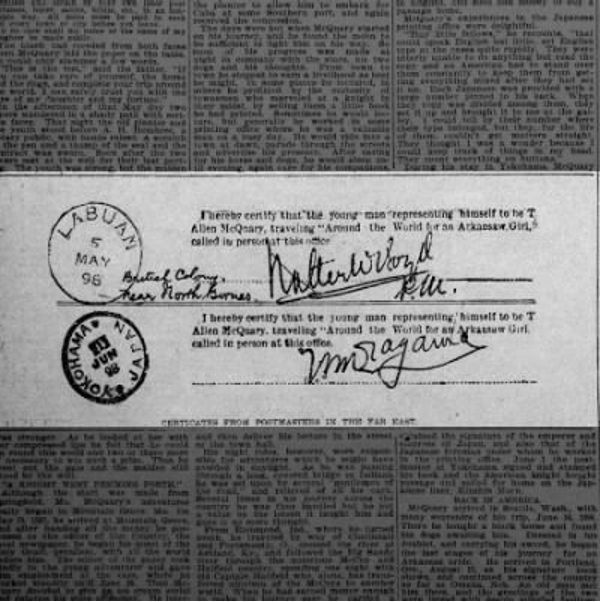
The Kansas City Star, Sunday, Nov. 6, 1898, p. 20.
What Mack remembered most, however, were not the places he saw but the stories he heard round the captain’s table in the cabin of Theophilus Trotter. He remembered the laughter and camaraderie and the feeling of dining with a real sea captain. The sheer audacity of his fanciful quest had paid off! Mack thought of Odysseus who prefaced his stories by saying he was famous for lying but who was so good at it that King Alcinous forgot he was a liar and gave Odysseus more gold than he brought back from Troy.
Moral to the story?
Fraud works better than force to get what you want.
Mack often reassured himself, I am Odysseus reborn!
Mack was stitching a book and breathing the sweet-scented paper when he recalled a dancer he had seen at a taverna in Bari. The girl moved sinuously in green sequined silk that clung to her small breasts and torso and hips, and she wore a green mask and an outrageous headpiece that splayed out like the tail of a peacock. The men hooted and clapped, but as she continued dancing, the heat of the night and the lamp pots and the men crowded around the small stage made her make-up run and smudge, and Mack discerned a faint shadow of beard, and he realized to his horror that she was not a woman but a man, a man dressed like a woman and moving like a woman and provoking desire like a woman. Mack turned to a fellow sitting at his table and said, “Lei e un uomo!” “She is a man!” and the man laughed and said, “Si! Un uomo! Ma che spettacolo!” “Yes, a man! But what a spectacle!” Then Mack realized that the men in the taverna were not deceived; they had come to see a man who was pretending to be a woman. In a shock of self-awareness, Mack saw himself as the dancer, and he realized that the only people he had ever deceived with his purple costume, his not-to-be-believed stories, and his ridiculous tale about a girl in Arkansas were people who wanted to be deceived. Deep down they knew he was a yokel, a liar, and a nonentity. They knew it the whole time, and now, he knew. He saw that the women in the Dorcas circles and the men in Masonic halls and the people in churches simultaneously believed and didn’t believe him, that his lectures as the Purple Knight reflected their own state of ambivalence so perfectly that they admired him for it. Mack looked deep inside and saw that ambivalence resides at the core of all human experience, and our minds shuttle back and forth between what we are and the ideals we pretend to value but don’t. Mack understood that preachers pound the pulpit not because they believe but because they doubt.
Mack tied off the thread at the bottom of the spine, snipped the thread, and let a small drop of candle wax fall on the frayed end. He set the book aside and rubbed his temples.
Mack feared that he might be falling into a kind of madness, so he counted out twelve new pages and tapped them until the stack was perfectly rectangular. Then he pierced a tiny hole in the far left margin of the quire and began to stitch. Then twelve more and another twelve until a new collation of butterflies and pale-blue streams and cherry blossoms had been assembled into One like Dante’s vision in the Highest Heaven.
Mack set the book aside and remembered Baxter’s story more clearly than he remembered Bernini’s twisting columns or the market in Ostia or a hundred other lived experiences.
How can it be, he wondered, that a story, a fiction, becomes more real than a lived experience?
Then he was sitting in the parlor of his childhood home on Christmas morning. His father was reading the birth of Jesus from the Gospel of Luke, and the lowing cattle and singing angels and Mary with her eyes demur in virgin innocence and irrelevant Joseph became more real to Mack than the Christmas tree and the fireplace and even his family: his prosaic brother and vapid sister, his anxious mother and unassailable father. The stable swelled to encompass his imagination and shut all else out.
Then an even greater reality intruded into his childish mind and body: The smells of roasting turkey and baking sweet potatoes and yeasty rolls browning in the oven.
The smell of baking bread is more real than the bread itself.
Mack tied off the string and let a drop of candle wax fall on the end.
The stable diminished and the babe fell asleep, and his family became real again around the dining room table. Mack squared twelve more pages and pierced a tiny hole in the left corner and followed Baxter down into the tombs of heroes.
Let’s see, there were Hercules and Enoch, but I can’t remember the other heroes. One of them was from Rome. I remember Moses–
I remember the skull of baby Jesus.
In his memory, Mack followed Baxter down into the spring of Panias and panicked when the watery darkness suffocated him and felt once more the overwhelming relief of emerging from the water into the black chamber and gasping air. Once again, the soles of his feet hurt when he stepped onto the gravelly beach, but Baxter’s grip in the darkness was firm and reassuring, so Mack undertook the downward path to the hot, red-glowing room where he saw pictures of miracles running in a band around the walls of the cave like a series of Sunday School lessons. Then he followed Baxter’s pointing finger to the small skull half-buried in the floor of the cave, and he heard the story of Mary weeping for her baby. Mack remembered the Steward smiling like Satan in a missionary pamphlet. He recalled Baxter’s claim that the story was all true and–
The long and the short of it is that it’s not a good story. In fact, it’s a shitty story. And I don’t have to believe it. I don’t! I’m free not to believe the shitty story. I’m free!
But Mack had seen the little skull in the cave floor, and in spite of himself, he remained in the cave after Baxter left; he was alone with the Steward, and the Steward was pointing at the skull and laughing.
Mack began massaging his temples.
Too much thinking! Too much–
He recalled waking up in the hospital of Constantinople and the old woman praying as she held her husband’s hand. He remembered the old lady’s delight when she snapped the key from his neck and her singing as she left the hospital.
He remembered the drowning spaniel.
Too much!
When at last Mack boarded the Kinghu Maru for Portland, he longed for a home and a peace he would never know again.