Historical Notes: Maggie Swan
The Emporia Gazette and the Aftermath of the Elopement
The Emporia Gazette and the Maggie Swan Affair
Of all the newspapers that covered McQuary’s various escapades, the Emporia Gazette followed the Maggie Swan affair with a particular attentiveness that no other paper could match—it was, after all, a local story, and Emporia was a small enough town that everyone from the Normal School headmistress to Mr. Dobbs would have had something to say about it. The clippings below document both the elopement itself and the ripples it sent through the community in the days and weeks that followed. Together, they constitute one of the most detailed local records of any episode in the entire Quest narrative, and they have the additional virtue of being almost entirely free of M.S. Glenn’s fingerprints.
Clippings from the Emporia Gazette
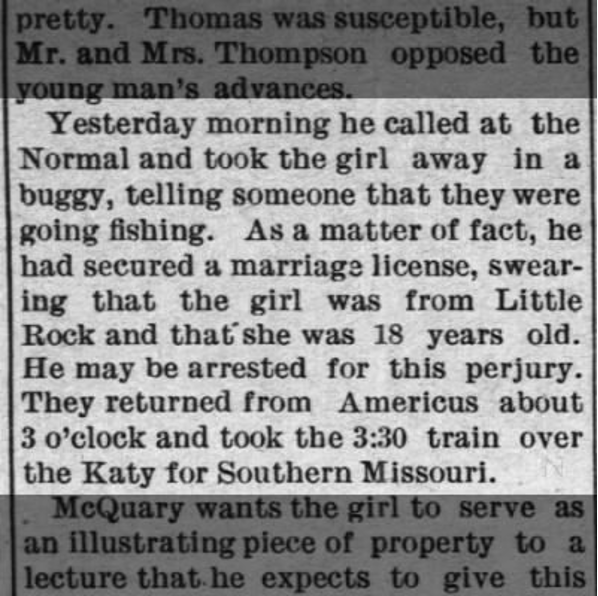
Emporia Gazette — The Kansas State Normal School figures prominently in the coverage. It was from these grounds that Maggie slipped away at midday, and the headmistress’s report to the police set the pursuit in motion.
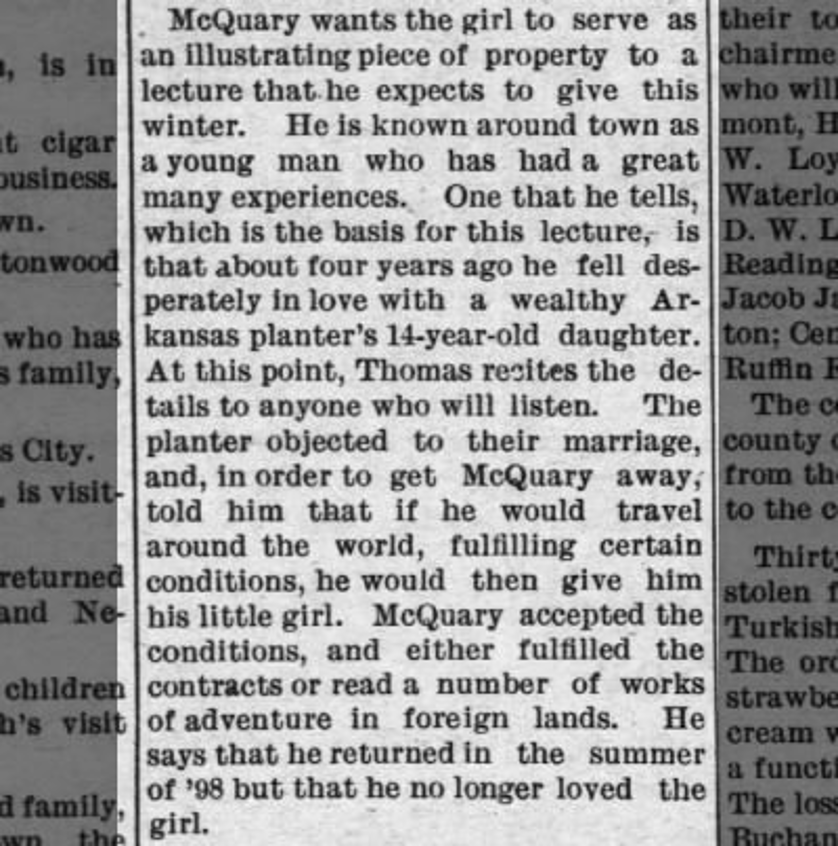
Emporia Gazette — McQuary’s reputation as a lecturer preceded him to Emporia. This notice suggests that his celebrity, such as it was, helped establish him as a respectable boarder in the Thompson household—and gave Maggie every reason to know exactly who he was before he knocked on her door.
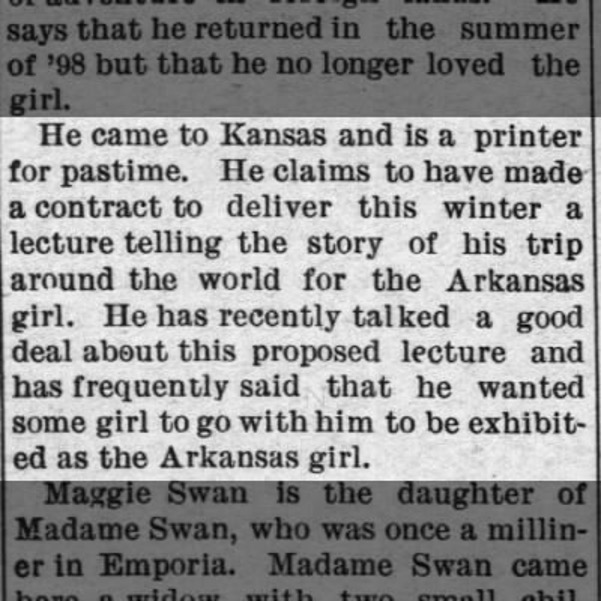
Emporia Gazette — The Arkansas girl was never far from any coverage of McQuary, and Emporia was no exception. Maggie herself raised the Arkansas girl during his proposal, having read about her in the papers—a reminder that the lie McQuary and Glenn had constructed had a way of preceding him into every room he entered.
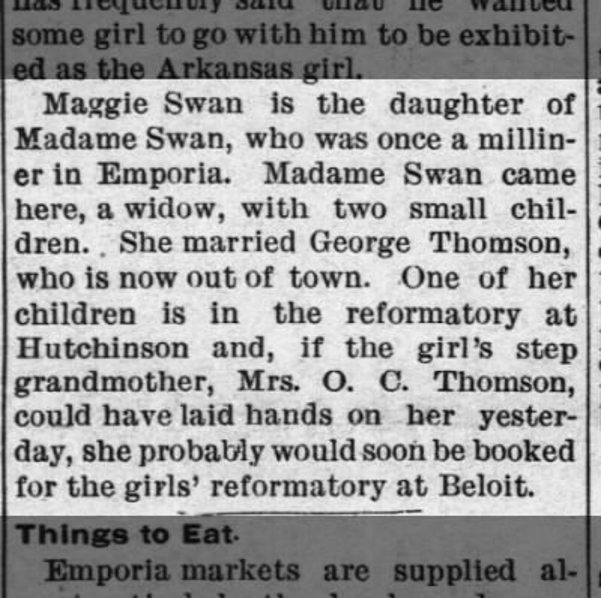
Emporia Gazette — The reformatory reference is the starkest document in this collection. That official consequences were at least contemplated—whether for McQuary, for Maggie, or for both—tells us something important about how the community understood what had happened: not as a romantic adventure, but as a crisis requiring institutional remedy.
Maggie Swan’s Silence
What the Emporia Gazette cannot tell us—what no newspaper can tell us—is what Maggie Swan thought about any of it. Her perspective on these events is nowhere recorded in the historical record. We know what McQuary wanted, what the Thompsons feared, what the headmistress reported, and what the police did. We know the carriage rattled north and that she looked straight ahead with serene eyes. We know she had packed her schoolbag the night before. Beyond that, the archive goes quiet.
That silence may be the most interesting document of all. A fourteen-year-old girl who packed a bag, recited Poe from memory in front of her class, convinced a headmistress she had “become a woman,” and climbed into a runaway carriage without flinching was not a passive participant in these events. Whatever she understood of what she was doing, she understood it clearly enough to do it. History chose not to ask her why.